Edited by Troy Dreier, Senior Editor, Compressed Air Best Practices®
For 20 years, Compressed Air Best Practices® Magazine has published articles focused on helping manufacturers reduce power demand, lower water consumption, and improve the performance of compressed air, cooling, blower and industrial vacuum systems. In this article, we highlight a sampling of those stories across the following industries:
Plastics and Packaging
Food and Beverage
Automotive and Transportation
Cement, Building Materials, and Mining
Metals, Pulp, and Paper
Pharmaceuticals, Healthcare, and Research
Wastewater Treatment
By Ryan Freymuller, Sales Director, Manufacturers Distributor, Inc.
Efficient compressed air distribution depends on proper piping design to balance flow, pressure and velocity. This article explains how modular aluminum piping systems improve performance by reducing friction, minimizing pressure drop and maintaining laminar flow. With smooth interiors, full-bore fittings and leak-free connections, these systems help lower energy consumption and extend equipment life. A real-world case study shows how an optimized design reduced material and installation costs while maintaining performance. The result is a more adaptable, efficient and reliable compressed air network for modern industrial facilities.
By Troy Dreier, Senior Editor, Compressed Air Best Practices® Magazine
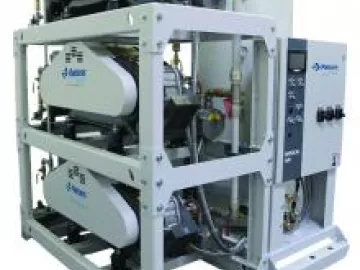
A modular nitrogen generation system integrated with compressed air infrastructure enabled on-site nitrogen production, reducing reliance on delivered CO₂ and improving process efficiency. Adjustable nitrogen purity levels (e.g., 99.99%) optimized flow rate and demand matching while maintaining product quality in brewing applications. The implementation demonstrates how scalable nitrogen generation technology can lower operating costs and support growth in small to mid-sized industrial operations.
A snack manufacturer, strengthened operational efficiency and product freshness by implementing onsite nitrogen generation at its Houston facility. By replacing delivered nitrogen with PSA-based systems from Liberty Systems, the company gained 24/7 supply reliability, reduced operating costs and improved sustainability performance. The investment supports scalable Modified Atmosphere Packaging (MAP), enhances business continuity and positions Dishaka for long-term growth in the competitive food manufacturing industry.
Compressed air boosters are engineered to amplify medium-pressure air (90–150 psig) to high-pressure ranges up to 435 psig (30 barg) using oil-free rotary screw technology, IE5 permanent magnet motors and advanced VSD+ drivetrains for improved turndown and energy efficiency. By combining Class 0 oil-free air quality, synchronous PM motor performance (up to 97% efficiency) and intelligent controls, next-generation booster systems deliver higher flow stability, reduced specific energy consumption and seamless integration into existing compressed air networks.
By Troy Dreier, Senior Editor, Compressed Air Best Practices® Magazine
Through detailed plant audits, load profiling and system standardization, a regional distributor helped a multi-plant food processor optimize its compressed air infrastructure using 200 hp lubricated VSD rotary screw compressors, 10,000 gallons of storage and properly specified food-grade lubricants. By focusing on correct sizing, temperature monitoring, contamination prevention and lifecycle maintenance practices in dusty environments, the installations delivered stable operating pressures, improved energy performance and scalable capacity for continued expansion.
By John Schmitt, Marketing Product Manager; Weston Benton, Product Channel Manager – Vacuum & Low Pressure, and Rob Grizzle, Midwest Sales Manager, Kaishan USA
This article examines strategies for achieving high-purity compressed air and vacuum systems in food processing and packaging facilities, emphasizing ISO 8573.1 quality classes, moisture control, particulate filtration, and food-grade lubricants. It also details best practices for system layout, centralized vacuum implementation, pressure dew point management, and preventive maintenance to reduce contamination risk, maintain equipment reliability, and ensure food safety compliance.
By Troy Dreier, Senior Editor, Compressed Air Best Practices® Magazine
A Southern Indiana office furniture plant was wasting hundreds of dollars per day because its oversized VSD air compressor could not turn down low enough to match reduced demand after a shift to metal fabrication. To avoid drive faults, the plant vented compressed air to create false load. The audit revealed 300 cfm of wasted air—about $400 per day—and led to a redesigned system using a fixed-speed compressor for base load and a VSD unit for trim. The new configuration eliminated artificial demand and cut compressed air energy use in half, setting the stage for further savings through advanced sequencing, storage, and demand control.
By Troy Dreier, Senior Editor, Compressed Air & Cooling Best Practices Magazine
They got to a point where every time they added a new piece of equipment, it did not eliminate their rental, nor did it eliminate the water problems, the leaks and everything else they were experiencing. The system had issues that adding more equipment simply could not fix.
By Ron Marshall, Chief Auditor, Marshall Compressed Air Consulting
The ISO 8573-1 was developed to provide standardized classes for compressed air purity in terms of particles, water and oil to drive the planning and design of compressed air systems in order to deliver the quality desired or required. This article explores why testing compressed air quality is as essential as choosing the right filtration, discusses real-world experiences, illustrates the risks of assuming things are right and explains the value of compressed air measurement.