
Reducing Compressed Air Waste in Manufacturing: A Forklift Plant’s $177,000 Energy Savings Success
At Hyster-Yale Materials Handling’s Greenville, NC, plant, sustainability is a shared responsibility embraced across all levels of the organization. In 2024 and 2025, the facility’s Air Compressor Demand Reduction project turned employee engagement into measurable environmental impact, helping earn the company recognition as an Environmental Steward by the North Carolina Department of Environmental Quality.
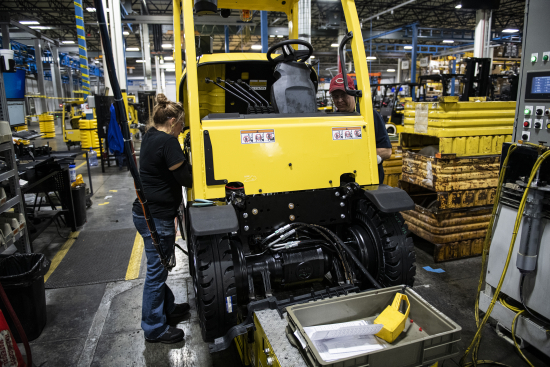
The 800 employees at Hyster-Yale’s Greenville, NC, plant manufacture 1,600 electric forklifts each month.
A Forklift Manufacturer with a Green Mission
Hyster-Yale and its facilities take sustainability seriously. Over the last decade, the company has committed to reducing VOCs, carbon emissions and hazardous waste by 30%, lowering water consumption by 20%, and achieving zero waste to landfill and striving for a worker injury rate of zero. With roughly 800 employees and a monthly output of 1,600 electric forklifts, the Greenville plant has long been a leader in clean manufacturing. It’s been part of the NC Environmental Stewardship Initiative (ESI) for over 20 years. But recent efforts to reduce compressed air waste have elevated its sustainability profile even further.
In 2024, the company partnered with two interns from East Carolina University’s Center for Sustainable Energy and Environmental Engineering (CSE3 Program). Both students spent their summer working alongside the Environmental Health and Safety team, identifying opportunities to help minimize the company’s environmental footprint. Projects such as LED light conversions, programmable thermostats, insulation improvements and chiller water system enhancements were evaluated and implemented at the Greenville plant, based on the interns’ research and recommendations, supported by the CSE3 program staff.
The interns were hired for a 12-week project. The plant shuts down for a week over the Fourth of July to allow team members time with family. This provides a window to complete preventative maintenance and other facility projects. With the intern’s assistance, we saw an opportunity to focus on a maintenance item that often gets deprioritized in favor of more urgent fixes: air leaks.
Air leaks are one of those issues that can (quite literally) become part of the background noise in a manufacturing environment. They’re so familiar they go unnoticed. Once repaired, the plant became noticeably quieter, revealing just how much compressed air had been escaping.
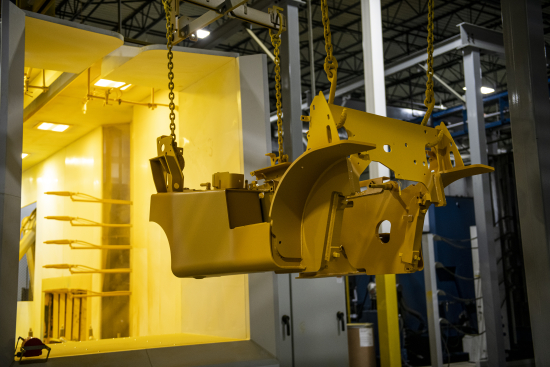
A freshly painted forklift frame.
Compressed Air Leak Detection: From Contest to Culture
The plant relies on three primary air compressors to support production: two Atlas Copco GA75, 100 hp, fixed-speed, oil-injected, air-cooled, rotary screw air compressors and one Atlas Copco GA132, 175 hp, VSD, lubricated, air-cooled, rotary screw air compressor. The larger air compressor serves as the primary unit, with the two others used as needed. These air compressors rarely shut off, even when the plant isn’t operating, to maintain system pressure. Compressed air is used throughout the manufacturing process to power the machining centers, welding robots, shot blast units, paint sprayers, parts conveyors and manipulators. It’s also used throughout the assembly process with positioners and torque tools. Compressed air is a critical system for forklift production.
In preparation for the summer shutdown, the interns secured an ultrasonic leak detector from the CSE3 Program and received training on its use. We collaborated with our maintenance team to determine what information would be most helpful for locating and repairing leaks. The interns developed a spreadsheet for documentation and purchased leak tags to mark leak locations throughout the plant.
By the end of the weeklong 2024 summer shutdown, the interns had traced the majority of the compressed air system and identified 97 leaks, all of which were later repaired by the maintenance team. Their analysis estimated annual energy savings of $107,000 and a reduction of 619 tons of CO₂ emissions. One of the most impacted groups was our maintenance team. It was responsible for repairing the leaks, and appreciated the results, especially the noticeable reduction in air compressor runtime. The air compressor room, located adjacent to the maintenance tool room, became significantly quieter, which was a welcome change.
The compressed air leak detection initiative didn’t end with the intern project. Over time, air leaks began to re-emerge as background noise. To re-engage the workforce, we launched an Earth Month compressed air leak identification contest in April 2025, inviting associates to tag leaks and submit entries. The contest was announced during team meetings, with instructions on how to fill out tags, mark leaks and submit the bottom half of the tag for a chance to win a prize. Area managers distributed tags to their teams, and a contest entry box was placed in the cafeteria. The result: 39 additional compressed air leaks fixed and an estimated $42,000 in annual savings.
Many of the compressed air leaks identified by team members were detected simply by listening (no specialized equipment required), which suggests they were likely larger leaks. Over the past year, non-maintenance personnel helped identify and resolve 225 compressed air leaks, demonstrating the power of grassroots engagement.
To encourage participation, the tear-off portion of each compressed air leak identification tag served as a raffle entry. Four lucky employees received portable air compressors as prizes for their efforts.
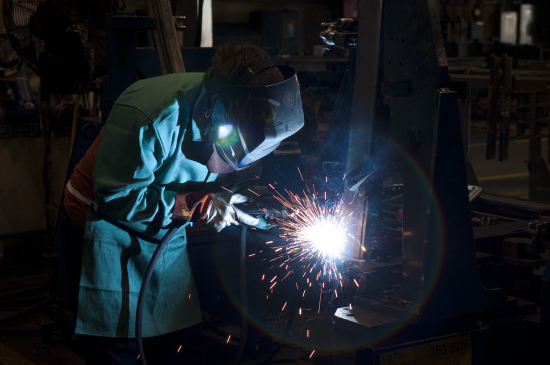
A Hyster-Yale employee welds components for an electric forklift.
Energy Savings of $177,000 Annually
The amount of compressed air lost through compressed air leaks that aren’t addressed is astounding. During normal plant operations, the Greenville Plant uses roughly 580 cfm of compressed air. During the summer shutdown (when all process machinery is turned off), the plant was still using about 360 cfm of compressed air. Over the course of a year, that worked out to 189,000,000 cubic feet of compressed air lost through compressed air leaks. That same compressed air took 1,400,000 kWh of energy to produce, generating 619 tons of carbon emissions in the process.
Maintenance personnel diligently tracked down each identified compressed air leak and completed repairs as scheduling and access allowed, ensuring minimal disruption to operations. The total supply costs of most repairs were negligible (these included regulators, O-rings and couplings), but the accumulated energy savings was calculated at $107,000 annually.
Addressing compressed air leaks resulted in another spinoff project that has tremendously benefited the company: the ability to lower the operating pressure of the compressed air system. Operating pressure had been set at 116 psig, as that was the level where the maintenance team quit seeing faults in production machinery during peak demand. Actively addressing compressed air leaks allowed the maintenance team to reduce system operating pressure to the needs of the highest consumer, which required 105 psig. Lowering the system operating pressure saved an additional 750,000 kWh of energy per year, providing $70,000 of additional energy savings and another 239 tons of CO₂ emissions avoided.
In total, the savings of the air compressor demand reduction project resulted in energy savings of 2,150,000 kWh, or about $177,000 per year. Importantly, these efforts mean the plant avoided 858 tons of CO₂ emissions – equivalent to the annual electricity use of 558 households or driving 4.29 million miles in a gasoline car.
Leak Detection Leads to Statewide Recognition
These impressive savings helped Hyster-Yale earn the Environmental Steward designation through the North Carolina Department of Environmental Quality’s Environmental Stewardship Initiative, becoming one of just 33 businesses statewide with this honor. The plant also holds the Carolina Star safety designation (OSHA Voluntary Protection Programs), making it one of only six facilities in North Carolina to simultaneously hold both titles. The Air Compressor Demand Reduction project was also nominated for the Pollution Prevention Project of the Year award through the NC ESI program.
“This recognition is a tremendous accomplishment for our entire team and underscores our unwavering commitment to responsible corporate citizenship and a positive community impact,” said Danny Owens, Plant Manager, Hyster-Yale Materials Handling. “In a state with more than 275,000 businesses eligible for this honor, to be just the 33rd to achieve this designation further demonstrates the strength of our environmental leadership.”

Hyster-Yale earned the Environmental Steward designation from the North Carolina Department of Environmental Quality’s Environmental Stewardship Initiative.
About the Author

Stephen Kelly is the Senior EHS Manager for Hyster-Yale Materials Handling, where he has worked for five years. He has a Master of Science degree from Eastern Kentucky University and is a licensed Certified Safety Professional by the Board of Certified Safety Professionals.
About Hyster-Yale Materials Handling
Hyster-Yale Materials Handling designs, engineers, manufactures, sells and services a comprehensive line of lift trucks, aftermarket parts and technology and energy solutions marketed globally under the Hyster®, Yale®, Maximal® and Nuvera® brand names. Hyster-Yale Materials Handling’s subsidiary, Bolzoni S.p.A., is a leading worldwide producer of attachments, forks and lift tables marketed under the Bolzoni®, Auramo® and Meyer® brand names. Hyster-Yale Materials Handling also has an unconsolidated joint venture in Japan with Sumitomo NACCO Forklift. Hyster-Yale Materials Handling, is a wholly owned subsidiary of Hyster-Yale. For more information, visit https://www.hyster-yale.com.
About the North Carolina Department of Environmental Quality
This is the lead stewardship agency for the protection of North Carolina's environmental resources. The organization administers regulatory programs designed to protect air quality, water quality and the public's health, and works to advance reliable, affordable and clean energy for North Carolinians. It offers technical assistance to businesses, farmers, local governments and the public and encourages responsible behavior with respect to the environment through education programs provided at DEQ facilities and through the state's school system. For more information, visit https://www.deq.nc.gov.
To read more Compressed Air Leak System Assessments articles, visit https://www.airbestpractices.com/system-assessments/leaks.
Visit our Webinar Archives to listen to expert presentations on Compressed Air Leak System Assessments at https://www.airbestpractices.com/webinars.



