
Roderick Smith, Publisher of Compressed Air Best Practices® Magazine, sits down with Everson De Campos to talk about the new CEO’s goals, trends in oil-free compressed air and the rigorous engineering needs of centrifugal air compressors.
Everson De Campos was appointed CEO of FS-Elliott in February 2025, bringing fresh vision to the company. He has more than 25 years of experience in the compressed air industry, including 15 years with FS-Elliott’s parent company, Fusheng Industrial Group. He played a key role in expanding engineering capabilities, manufacturing capacity and global business operations.

CEO Everson De Campos with a Polaris P700 centrifugal air compressor at FS-Elliott’s worldwide global headquarters in Export, PA.
In February 2026, Roderick Smith, Publisher of Compressed Air Best Practices® Magazine, sat down with De Campos at the company’s Export, PA, headquarters to hear how the company invests in its factory, meets demands from industrial customers with new services, develops new products and trains its sales channel. This continues our series of conversations with some of the most influential names in compressed air.
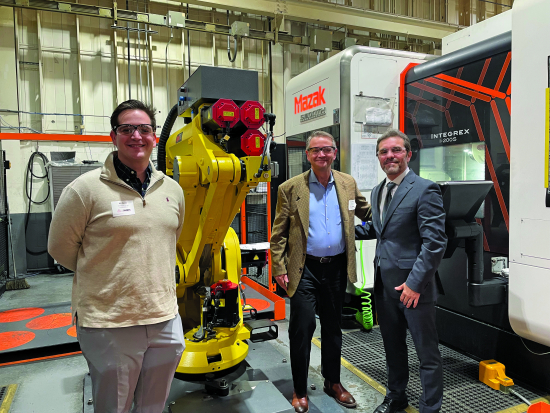
Bill Smith, Regional Sales Director, and Roderick Smith, Publisher, Compressed Air Best Practices® Magazine, with Everson De Campos, CEO, FS-Elliott (left to right) on FS-Elliott’s manufacturing floor. Between them is a Mazak INTEGREX dual-spindle milling and turning center, part of the company’s investment in advanced manufacturing.
Factory Investment at FS-Elliott
Smith: Can you comment on your parent company, Fusheng Industrial, its commitment to the compressed air industry and its investments in compressed air manufacturing?
De Campos: FS-Elliott is a proud member of the Fusheng Group, headquartered in Taiwan. Fusheng began in the compressed air industry, and air compressor manufacturing remains one of the company’s core business pillars today. The organization has grown significantly and now employs more than 22,000 people globally, yet this segment remains a major strategic focus. As a result, the company continues to invest heavily in manufacturing, technology and global production capacity.
In recent years, Fusheng has made significant investments in industrial air compressor production, including new factories in India and China to increase production capacity and better support local customers.
At FS-Elliott, we continue to invest in our facilities in the United States, China and India, including new manufacturing equipment, building upgrades, digital infrastructure and research and development. Our goal is to maintain our technology leadership while continuing to strengthen our competitiveness and deliver greater value to our customers.
Smith: When you were announced as CEO in February 2025, you identified innovation, sustainability and digital advancements as key areas for growth. How have you focused on new product development here in Export, PA?
De Campos: Innovation is a major focus for us, and we believe it has to be part of both our future and our present. Our new product development team is constantly working on new technologies, new air compressor frames and new control systems.
Recently, we launched the Polaris P650 centrifugal air compressor, followed by the P650 DF with a dual-inlet configuration. We also have advanced controls in development and a strong pipeline of new products coming over the next several years. Many of these developments are driven by customer demand and evolving market requirements.
To support this development work, we have made significant investments in our headquarters facility, including expanding our five-axis machining capabilities, which are critical for manufacturing aerodynamic components.
Smith: Can you talk about those 5-axis machines? That’s a major investment, right?
De Campos: It's a huge investment. The project involved not only purchasing the machines but also preparing the facility, installing the necessary power infrastructure and creating a dedicated machining area to support the equipment.
We offer multiple types of products, some more industrial, some more standard. Many are engineered to order, but for the standard ones, we’re looking at large-scale pipe benders to help us minimize our welding and hydro tests. To cut our impellers, we made a huge investment in new Mazak machines.
Smith: You've had to invest in capital equipment and specialists to manufacture in volume.
De Campos: Investing in people is a strategic decision. As our business grows, we create new work areas and bring in more specialists to support manufacturing and engineering. Our business is engineering-driven, and the expertise of our people is one of our biggest strengths.
Almost every machine we sell is engineered to order. We have standardized industrial machines, but even with those, we still look at the customer’s needs and ask, What's the range of temperatures in that area? What's the altitude? What's the required flow and pressure? We fine-tune and optimize the machines through our process, so even standardized air compressors are essentially engineered-to-order.
The Operations group has been investigating additive technology. Is that the future for us? The technology isn’t ready yet, but we don't want to stop thinking about it. We know some companies create airplane bearings using 3D printers, so we have our own 3D printers. It's looking at the future. We don't want to be surprised by the future. We want to stay in the vanguard as a dedicated centrifugal business.
Service Innovations to Meet Customer Demands
Smith: In June 2025, FS-Elliott announced a Rapid Response Service Center to minimize customer downtime and improve sustainability by reusing airends. What other ways is your company prioritizing service and support?
De Campos: ESG [environmental, social and governance] and sustainability are important to us and to many of our customers, especially in industries like chemical, petrochemical and air separation. One of the biggest contributions we can make in this area is improving efficiency and extending the life of existing equipment.
We’ve made significant investments in high-efficiency products, and sustainability has really become part of our company’s DNA. We also aim to make our headquarters carbon-free by 2030.
Another important part of ESG is lifecycle support. Customers don’t always want to replace equipment; they want to keep their machines running efficiently for as long as possible. We continue to invest in our global aftermarket services to refurbish, renew and overhaul machines when needed. In many cases, we can restore performance and efficiency without requiring a full equipment replacement.
Local service is one of our company’s key pillars, and that thinking led to the creation of our Rapid Response Storage program. At large refineries and industrial plants, facilities are large, and spare components can sometimes be lost, damaged or simply not available when needed. We started asking how we could help customers better manage critical components.
Now we can manufacture critical components in advance, like airends, test them, store them in a climate-controlled environment and have them ready to ship immediately when needed. We test the unit after production and again before shipment, and the warranty begins at shipment, not when it is stored. So it’s more than just a Rapid Response Storage Center; it’s really a reliability and asset management program for our customers.
Smith: FS-Elliott’s push to refurbish and review older air compressors is a big departure from our past as an industry.
De Campos: When you take a look at air compressor technologies, there are incentives to replace rotary screw air compressors after a certain number of years due to depreciation and replacement cycles. But centrifugal air compressors are different; they are designed for a much longer service life, and the machines are not obsolete after 10 years. In many cases, you can restore efficiency and performance through refurbishment and upgrades, essentially bringing the machine back to like-new performance.
Our air compressors are designed with serviceability in mind, and from a maintenance standpoint, they are somewhat plug-and-play. The airend can be removed from the machine and shipped back to the factory for overhaul while the rest of the installation, piping, electrical and auxiliary systems remain in place. Once the overhaul is complete, the airend is returned and reinstalled. We can also perform certain overhauls in the field, which helps reduce downtime. This approach makes upgrades and overhauls easier, faster and more cost-effective for our customers.
Smith: Very innovative.
De Campos: We’re talking about full machines right now. Customers want spare air compressors, and they want us to store them.
We established this business model in the U.S. and are looking to expand it to China, Singapore and other locations. All components are tested and certified, and many can be shipped overnight when needed. The overall goal is to reduce downtime risk, improve reliability and provide better lifecycle support for our customers.
Smith: Do you have strategic account managers who get to understand specific companies and their needs across multiple campuses?
De Campos: We do. On the industrial side of our business, we work through channel partner managers who support our channel distribution partners and help them understand customer needs and applications.
In addition, we serve certain niche markets directly. For industries such as the chemical and petrochemical sectors, we have dedicated specialists who focus on those markets. They understand the applications, specifications and customer requirements, and they work directly with customers in those industries.

Kyle Kelly, Airend/Service Assembler; Everson De Campos, CEO; Dan Kelly, Airend/Service Assembler, and Justin Johnson, Director of Product Management (left to right), at the Rapid Response Service Center.
The Push for New Product Development
Smith: Your company’s most recent release, the Polaris P650 DF, is for 30-50 psi applications. What's driving that strategy?
De Campos: The P650 DF was driven by customer demand. We started seeing more requests from industries such as pharmaceuticals and fermentation for higher flow at lower pressure, and our team decided to enhance the existing P650 platform to meet those requirements by developing a dual-inlet configuration to increase flow while maintaining the same footprint.
From an engineering standpoint, that was a significant challenge. You can’t simply duplicate an air intake and expect performance to double. Our engineering team had to address aerodynamic challenges and optimize the design to deliver higher flow at lower pressure while still maintaining efficiency and reliability.
We’re also seeing more companies focus on heat recovery and heat-of-compression applications. In some cases, our air compressors are efficient and don’t generate as much recoverable heat as some customers would like. As a result, we’ve made design adjustments to better support heat-of-compression requirements while still maintaining high efficiency. Overall, many of our recent developments were driven directly by customer applications and energy-efficiency initiatives, particularly in heat recovery and lower-pressure, high-flow applications.
Smith: Have you seen an increase in demand in systems with HOC and the P650 DF’s outlet temperatures?
De Campos: Yes, we’re seeing the benefits. It's not a regional play; this is a global play. We initially thought mainly European companies were focused on heat recovery, but now we see it all across the globe.
Customers have demanded heat recovery from every part of the air compressor possible. We have specific designs for large U.S.-based companies that recover heat from the motor.

Everson De Campos with an FS-Elliott centrifugal air compressor airend.
Smith: What are some other trends you're seeing with oil-free centrifugal air compressors?
De Campos: Demand for oil-free compressed air continues to grow as more companies understand the value and risk reduction it provides. In industries such as electronics manufacturing, oil-free, clean dry air has become the standard. We’re seeing a significant expansion of electronics manufacturing facilities worldwide, and these companies require large volumes of oil-free air to protect their processes and products. For many of these customers, oil-free air is really a form of insurance; it helps protect product quality, reduce contamination risk and avoid costly production issues.
Smith: Are you seeing a growing trend in air compressor technology experts re-evaluating oil-free centrifugals and using them for intermittent demand and oil-free applications?
De Campos: The simple answer is yes. We are seeing increased demand as more companies understand the benefits of oil-free centrifugal air compressors. In many cases, customers start with one machine and, once they see its reliability and efficiency, expand their systems.
Customers also realize they can use one, two or three centrifugal air compressors instead of 15 to 20 rotary screws. We’re also seeing more companies investing in people and expertise dedicated to centrifugal air compressor technology. The companies most successful in managing large compressed air systems are typically those making that transition and building that expertise.
Smith: Why are centrifugal air compressors a good match for heavy use applications like iron and steel, power generation and petrochemical, beyond flow and volume?
De Campos: Heavy industries such as iron and steel, power generation and petrochemicals typically operate continuously and require highly reliable equipment. Centrifugal air compressors are well-suited for these applications because they’re designed for continuous operation, high reliability, long service life and relatively easy maintenance, which is critical for facilities that cannot afford downtime. For example, our air compressors feature a horizontally split, field-serviceable airend design, which allows maintenance to be performed more quickly and efficiently without removing the entire air compressor from service.
Another advantage is the footprint. These facilities dedicate most of their space to the production process, so the air compressor system must deliver large volumes of air in a relatively compact area. Centrifugal air compressors can produce high volumes of air while maintaining a smaller footprint compared to many other technologies.
They also provide oil-free air, stable operation and high efficiency. Overall, centrifugal air compressors are a strong fit for heavy industrial applications because of their reliability, efficiency, compact footprint, ease of maintenance and long-term operating life.
Smith: Space used to not be a big deal in these places, right?
De Campos: In many cases, our air compressors are installed as part of a larger process module within the plant. While these facilities may appear to have a lot of land, most of that space is dedicated to production, not to utilities like compressed air. Because of that, the footprint becomes important. Our centrifugal air compressors are compact, oil-free and capable of producing large volumes of air. For industries like iron and steel, the footprint and air volume are important, and for petrochemical applications, it’s also our ability to meet strict industry specifications such as API, JIP and other industry standards.
Smith: Some of your customers have critical operations where cybersecurity is a concern. They may prefer wired control and monitoring solutions that don't use the cloud. How can your customers take advantage of IIoT monitoring solutions without creating risk?
De Campos: Cybersecurity is a major concern for many of our customers, and we take that seriously. Industries like chemical and petrochemical typically have strict policies regarding data security and system access.
Many customers prefer to maintain control of their own data and monitoring systems, and we support that approach. We can provide monitoring technology that allows customers to collect and manage their own data locally without relying on cloud-based systems.
In some cases, customers allow remote monitoring but not remote control. In those situations, we can monitor equipment performance and send alerts or service recommendations through cellular data as needed, while the customer maintains full control of the equipment.
Ultimately, the solution depends on each customer’s cybersecurity policies, but our goal is to provide monitoring and IIoT capabilities while still allowing customers to maintain control of their data and operations.
Investments in Compressed Air Sales Channel Training
Smith: New distribution partners are given the opportunity to participate in the FS-Elliott University Sales Training Program. What strategies for oil-free compressed air growth and development do you focus on with new distribution partners?
De Campos: This program evolved from the days when we would bring distributors to a hotel for classroom training. Over time, we realized our facilities and people are among our best-selling assets. When partners visit our factories and meet our engineers, product managers and service teams, they gain a better understanding of what we do and what makes our solutions different.
That’s why we moved much of our training to our manufacturing facilities in Export, PA, and Shanghai, China, and developed a structured curriculum through our FS-Elliott University program combining classroom instruction with hands-on training. The sessions are led by our internal experts, and the training extends well beyond product knowledge.
We not only teach channel partners about centrifugal air compressors; we also teach them how to approach different industries and applications. For example, working on a pharmaceutical project is different from working in electronics manufacturing or at a petrochemical plant project. We focus on helping them understand customer applications and how our engineered-to-order capabilities solve specific problems.
The more our channel partners understand our capabilities and applications, the smoother projects run and the easier it is to differentiate our solutions. Developing that centrifugal mindset is important, especially for people who come from the rotary air compressor world, and I came from the rotary side myself, so I understand that transition.
The U.S. Navy Talent Pipeline ProgramFS-Elliott participates in the U.S. Navy Talent Pipeline Program (TPP), a national workforce development initiative helping advanced manufacturers strengthen their ability to attract, train and retain skilled employees. The program is part of a broader effort to reinforce the U.S. industrial and defense manufacturing base by building sustainable talent pipelines in critical industries. Through the program’s structured framework, FS-Elliott is enhancing recruitment, onboarding and career-development practices for high-skill manufacturing roles essential to compressed air equipment production, including precision machining, assembly, testing and service engineering. Participation also connects the company with regional educators and workforce partners, supporting pathways into advanced manufacturing careers. By investing in workforce development alongside technology and innovation, the company helps ensure the long-term capability, reliability and competitiveness of U.S. compressed air manufacturing. The company’s involvement reflects a broader commitment to operational excellence, employee growth and strengthening the skilled-trade ecosystem underpinning industrial productivity. |
Smith: So your university is growing? A lot of people are coming into this building?
De Campos: Yes, and our goal is to continue expanding the program. As a company, we’re proud of our people and our capabilities, and bringing partners to our facilities helps build strong relationships. When people visit, they get to know our engineers, product managers, service technicians and leadership team, and that creates a much stronger working relationship.
Those relationships also help projects move more efficiently because people know who to contact and how to work together. It reduces delays and helps us support customers more effectively.
Smith: There's so much power when they understand the detailed, engineered features available. It just takes time to become aware of it all.
De Campos: They understand certain specifications are critical, and sometimes missing one small detail in a specification can create major challenges later in a project.
We have a Document Control department that creates the documentation package for every order. Every valve must be certified, every sensor must be documented, and, in many cases, the manuals can run to over a thousand pages. All of that documentation and certification gives our customers peace of mind, especially in industries with strict engineering and compliance requirements.
Our engineering capabilities support customers worldwide. We pride ourselves on meeting the most demanding customer specifications and requirements. You name it. We’re not on Mars yet, but maybe soon. We work with the toughest engineering companies and meet their demands. Centrifugal air compressors require a different level of engineering, and we have the best people in the industry to support those requirements.
Images courtesy of FS-Elliott.
For more information, visit https://www.fs-elliott.com.
To read similar Air Compressor Technology articles, visit https://www.airbestpractices.com/technology/air-compressors.
Visit our Webinar Archives to listen to expert presentations on Air Compressor Technology at https://www.airbestpractices.com/webinars.



