Compressed Air Best Practices® Magazine interviewed Ethan O’Brien, Group Sustainability Director, Klöckner Pentaplast
Compressed Air Best Practices® Magazine interviewed Ethan O’Brien, Group Sustainability Director, Klöckner Pentaplast.
Good afternoon, can you describe Klöckner Pentaplast (kp) and your operations in the Americas?
Good afternoon. Klöckner Pentaplast designs and manufactures plastic films and trays for many applications including food, medication, medical devices and durable products. Founded in 1965, we have 30 manufacturing plants (17 in Europe) in 18 countries and employ over 5,600 people. kp is a global leader in recycled content products and high-barrier protective packaging.
We operate six plants in North America: Montreal, Quebec; Greenville, Ohio; two in Gordonsville, Virginia; Rural Retreat, Virginia and Beaver, West Virginia. We also have two plants in South America, in Argentina and Brazil, and 22 others around the world. We use state-of-the-art equipment at our manufacturing plants to make, primarily, rigid plastic film products for conversion and thermoformed trays. Our core production process involves calendering, extruding and thermoforming polymers, adding chemical additives and then processing according to customer specifications and legal requirements. Our products are typically used by our customers on production lines where, for example, pharmaceuticals or food products are packaged. These items are then shipped to hospitals, pharmacies or retailers, after which they reach consumers.
We see a focus on post-consumer recycled (PCR) plastic in your products. Can you briefly describe sustainability at kp?
In manufacturing, sustainability often ranks fourth after safety, quality and efficiency. At kp, the goal is about moving sustainability higher up on the priority list, and integrating it into everything we do. Elevating sustainability requires recognizing it as a team sport, demanding cross-functional collaboration from procurement, finance, engineering, operations and HR. Crucially, environmental sustainability must be tangibly connected to financial sustainability, delivering for the bottom line and the planet. The Energy Task Force exemplifies this, focusing on reducing energy consumption, improving efficiency and deploying renewable energy across plants worldwide. This dedicated, cross-functional team demonstrates how sustainability can drive success in manufacturing by reducing carbon emissions. Progress is impossible without company-wide alignment and an understanding that sustainability and financial performance go hand-in-hand.
Our global sustainability strategy, Investing in Better, includes goals for increasing the use of post-consumer recycled materials, defined as materials that have been used by consumers for their intended purpose, collected through recycling programs and then processed into new products. This is where the circular economy and using more recycled material comes into play. We are innovating and simplifying our products to ensure they’re designed for circularity and recyclability while remaining fit for purpose. Globally in 2023, kp used 120,000 tons of post-consumer recycled content, which is 25% of our total production of packaging products – a phenomenal amount of recycled material. Additionally, over 700 tons of ocean bound plastics was used in our products, the equivalent to 20 million bottles. The standout milestone of 2023 was the fulfilment of our commitment to send no waste to landfills across our entire global footprint, where legislation allows.
Furthermore, our strategy is focused on working smarter in areas such reducing waste, improving energy efficiency and investing in renewable energy to reduce Scope 1, 2 and 3 carbon emissions.
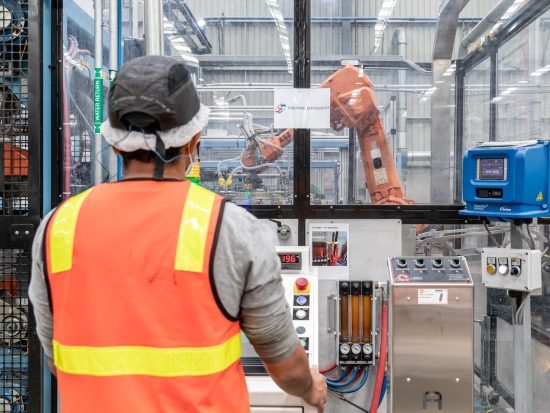
Klöckner Pentaplast used 120,000 tons of post-consumer recycled content in 2023.
Reducing energy consumption and carbon emissions in operations is where you come into play. Can you describe the Energy Task Force and your role?
I’m the kp Group Sustainability Director, based in London, U.K., with the responsibility to drive sustainability management globally in operations. At kp, we understand the greenest energy is the energy we don’t consume, and our dedicated team, the Energy Task Force, is focused on energy efficiency first and foremost. Members are cross-functional employees from procurement, business excellence, operations, engineering and maintenance.
Initially, we take a strategic, high-level view, but then we shift to a more data-driven approach. We manage a sustainability dashboard that tracks our progress on 10 goals across the three main pillars. We update this monthly and share it with relevant stakeholders. This information feeds into our monthly executive management meetings. It's about letting the facts speak for themselves while also keeping the bigger picture in mind.
I think my most important role is being passionate about energy efficiency and sustainability. This passion comes easily for me: I’m doing this job because I want to make a difference to the climate change challenge – to be part of the solution, not part of the problem.
What are the main production processes at kp and what are the largest energy users?
Our company operates in light manufacturing, transforming raw materials into packaging by using significant amounts of heat and subsequently cooling the products into their final form. Globally, this process consumes as much energy as a city with 200,000 houses, illustrating the significant energy use in our manufacturing operations. Managing this energy efficiently is one of the biggest impacts we can make in tackling climate change. In most of our factories, we have installed detailed energy monitoring systems at multiple points along production lines, including air compressors, chillers and lights. These systems feed into a digital dashboard that displays energy consumption throughout the factory. For data visualisation, we use dashboards that aggregate data collected via SAP from production lines and allows us to visualise the data at a high level.
We are experts in plastic extrusion, calendering and thermoforming production processes. Our energy profile varies by plant but at a high level – 65% of energy use comes from production equipment (from large motors on extruders) and 35% comes from plant utilities. Within plant utilities, a normal profile would look like cooling water (15%), compressed air (10%) and lighting/IT/vacuum/other (10%) of the plant’s total energy consumption.
Most of our plants operate round-the-clock. They are going 24 hours per day, seven days per week, with three shift operations. This means we don’t get many shutdown periods, and we just need to work around that. Energy champions must pick battles and work around the edges without jeopardizing quality, reliability or output rates. We like to say our energy management efforts focus on doing the basics brilliantly to achieve half of our savings each year – with more savings coming from CAPEX projects that further improve the energy efficiency at sites.
Additionally, we recognize a certain percentage of energy used in manufacturing plastics comes from the baseload, defined as the energy consumption that does not end up in making the product. An example is a machine heating up to 356â°F (180â°C) for a certain time period before production begins. In 2023, we focused our efforts on the extended shutdown for the December seasonal holiday, with all sites following a comprehensive shutdown process ahead of these nonproduction days. Our kp Energy Champions offered guidance across our factories, and all employees performed the appropriate shutdown procedures in a logical order to minimize energy used over the holidays. The results were outstanding: 1,000,000 kWh of energy (worth $331k or €300k) was saved in one week alone. For context, a baseload of less than 10% is considered a good result in a manufacturing environment, yet multiple sites reached under 5%, including our Holiday Shutdown Challenge 2023 winner, which reached under 1%. All teams can be proud of their efforts.
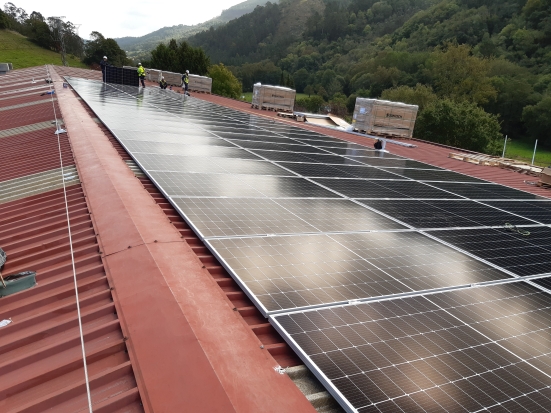
One of Klöckner Pentaplast’s energy efficiency projects was installing solar panels at its facility in Asturias, Spain.
I can feel your enthusiasm! What kind of results are you seeing from energy management at kp?
Overall, the consumption of energy in kp is down 20% since 2019. This energy reduction is the equivalent of eliminating the energy consumption of one of our larger manufacturing plants for an entire year. It’s like we created a factory that produced product all year but used no electricity – that’s what this is all about!
There are over 100 energy efficiency projects delivered from our plants all over the world. To name a few examples, we did LED retrofits to over 3,000 light bulbs in three U.S. plants, compressed air heat recovery projects in France, major upgrades to heat recovery systems in Germany and cooling optimization and high efficiency drive and motor projects in the U.K., Spain and Italy. We have a strong track record in implementing lean principles and, given our teams’ familiarity with the concept, when we used these same principles to design our sustainability-focused projects, they were ready to get going straight away. We continue to go from strength to strength in tackling carbon emissions. We strive to do the basics brilliantly.
Production process efficiency and energy efficiency go hand-in-hand, so we train our employees on the connections between waste treatment and energy consumption. Best practice is shared across all sites as part of helping energy management collaboration at kp.
What do you mean by “doing the basics brilliantly”?
The funny thing about low-hanging fruit energy efficiency projects is that the fruit grows back after a year. Doing the basics brilliantly is about not allowing that fruit to appear again or, if it does, addressing it right away. We are learning to excel at doing annual compressed air leak surveys, cleaning our chiller condensers, measuring our condenser temperatures, monitoring our cooling setpoints and improving the power factor at sites, to name a few examples. It also means creating checklists for operators to shut off machines correctly when idle.
This year, we implemented a new, more advanced shutdown mode on production lines at sites in Germany. Prior to the new mode, calender lines were cooled down to 248°F (120°C) during shutdowns. All machinery was operated at this temperature level when production was stopped. The process of switching lines to standby mode was therefore relatively inefficient, as lines idled at higher temperatures than required. In our streamlined shutdown operation, only circulation pumps and safety-relevant components remain in operation. This approach ensures optimal functionality without sacrificing reliability or lead times. We remain focused on maintaining peak performance while minimizing negative effects. Through this initiative, illustrative of kp’s commitment to lean thinking, we saved a remarkable 4,600,000 kWh of electricity, natural gas and steam – equivalent to $1.9m (€1.7m) worth of energy annually. For context, 1,500 homes could be run for a year from the energy saved through this initiative in 2023.
Conducting energy treasure hunts and kaizen events, following a lean methodology to go after ways to improve the process and reduce energy consumption, is part of how we do things at kp. These succeeded in bringing together different stakeholders on a treasure hunt and identifying opportunities to improve. There are the dragons of inaction with energy and carbon, and these workshops are great at getting teams involved with moving things forward.
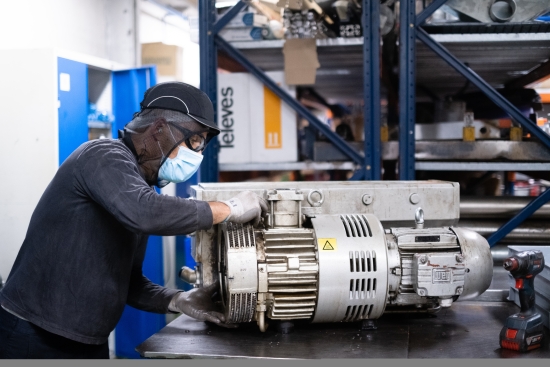
A Klöckner Pentaplast employee gives a vacuum system a high-efficiency motor upgrade.
Please describe the Energy Best Practice Toolkit that’s been created to support facilities around the world.
Our team came up with an Energy Best Practice Toolkit and it’s become an invaluable asset to our energy task force. It’s a list of 200 energy best practices across every energy consumption area. The main categories include lighting, compressed air, vacuums, chillers, motors and drives, operations, management systems, peak demand management and heat recovery. Each category has subcategories of at least five areas where we identify what good looks like and ask sites to give themselves a score of one to five. For example, under heat recovery, air compressors is a subcategory, and plants score themselves on whether or not they are doing it. The Energy Champions at each plant adds up their score and this creates a radar for us all to use, whether at the corporate level to compare plants or for the plants themselves to use as roadmaps for improvement. At the corporate level, we use this score to compare plants against a global average. Executives like these benchmarking tools. Honestly, it’s interesting, when you have such a diverse range of stakeholders. A lot can get done when you simplify things down to a score.
The Toolkit provides the Energy Task Force with fantastic information. We are constantly updating and improving it for each plant. It’s a working document where we debate things. For example, we have set points (and scores) for cooling water for each plant. We can see deviations and look at what’s happening – we don’t let a site run at 500F (100C) when we think it can work well at 590F (150C) based upon our experience at other plants.
Plants are scored on whether we have VSD drives on every applicable motor and whether or not a site does free cooling for cooling water. Sites are ranked on a score of 1 – 5, reflecting average performance to best in class. We really have used it to drive change. When we developed the toolkit, we were thinking about the question of how do you convince site managers, engineering managers and maintenance managers that energy management isn’t just a CAPEX exercise once per year? Now, it has become part of our continuous improvement culture and our focus on lean. The idea of the toolkit is even if we have limited CAPEX, we can still improve by doing the energy efficiency basics brilliantly.
Can you tell us the toolkit subcategories under compressed air?
In compressed air, we have some of the following categories:
- Annual monitoring of total kWh energy consumption by key consuming equipment
- Quarterly leak detection surveys, checking every six meters of piping
- Current air pressure setpoints for main system, as well as secondary and tertiary systems, to benchmark best in class
- Heat recovery opportunities including the distance from compressors to a suitable heat sink
- Frequency of efforts to reduce pressure loss
- Air flow (cfm) analysis mapped against production running hours
- Separate system for low pressure air to complement high pressure air system
- Variable speed drive air compressors
- Engineered nozzles for blowoff and air guns
- Air compressor, dryer and filter maintenance routines
Excellent, this is what we write about every month! What are the toolkit subcategories for cooling water?
This might not be everything, but off the top of my head here are some:
- Current cooling water set points, with global benchmarking checked annually
- Free cooling investigation and implementation where geography allows
- Full insulation of all chilled water piping
- Placement in well-ventilated areas and not exposed to sun
- Variable speed drives on all chilled water pumps
- Increasing chiller temps where possible
- Maintenance practices to ensure condensing temperatures are good
- Repairing damaged insulation
- Checking flow and return temperatures to understand the coefficient of performance as it changes throughout the year
- Pressure drops
What does the future hold for energy management at kp?
We published our latest sustainability report in July (https://www.kpfilms.com/en/sustainability/reports-and-disclosure/) We have a sustainability team driving this and reporting against our Investing in Better strategy goals. Energy efficiency comes under our objective to Work Smarter. We are building a high quality sustainability management program and want to be a leader in the plastics sector. We see energy management, renewable energy and material circularity as doing the right thing and being part of the solution. What better way to spend your time than this!
Thank you for sharing your best practices with our readers.
|
About the Author Ethan O'Brien serves as the Global Director of Operations Sustainability at Klöckner Pentaplast. He holds a Chartered Energy Engineer (CEng) qualification and has over 10 years of global experience leading renewable energy, sustainability and energy efficiency projects. An alumnus of the University of Edinburgh, Ethan is passionate about advancing sustainability and promoting more sustainable operational practices within companies. He is currently completing an Executive MBA at the University of Warwick Business School. |
 |
About Klöckner Pentaplast
kp is a global leader in rigid and flexible packaging and specialty film solutions, serving the pharmaceutical, medical device and protein markets, among others. With a broad and innovative portfolio of packaging and product films and services, kp plays an integral role in the customer value chain by safeguarding product integrity and brand reputation. For more information, visit https://www.kpfilms.com.
To read articles about Plastics Manufacturing, visit https://airbestpractices.com/industries/plastics.
For expert presentations, visit our Webinar Archive Section Air Compressor Technology at https://www.airbestpractices.com/magazine/webinars.