Onsite PSA Nitrogen Generation Enhances Modified Atmosphere Packaging, Reduces Costs and Improves Supply Chain Control
In the competitive world of snack food manufacturing, operational efficiency isn't just about cutting costs – it's about ensuring product quality, maintaining freshness and staying ahead in an industry where shelf life can make or break a brand. For Dishaka, a family-owned snack manufacturer with roots dating back to 1952, the decision to invest in onsite nitrogen generation has transformed its Houston facility into a model of modern food production efficiency.
“We've always believed in innovation, from our founding in Kuwait City to our state-of-the-art Houston operation,” said Rashim Oberoi, President, Dishaka. “But, when we analyzed our nitrogen costs and supply chain dependencies, we knew there was a better way. On-site nitrogen generation wasn't just about savings – it was about control, reliability and positioning Dishaka for the next chapter of growth.”
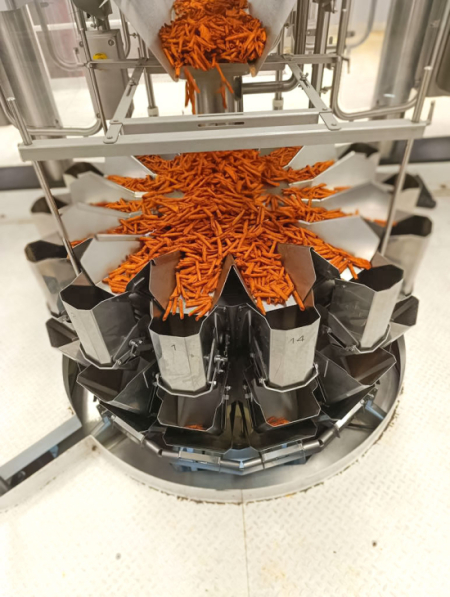
At the Dishaka snack factory, a rotary weigher portions snacks for packaging.
A Legacy of Innovation Meets Modern Technology
Dishaka’s North America manufacturing started in 2007 when its U.S. headquarters opened in Houston, Texas, with a singular vision: Offer the most innovative food products created using extrusion technology.
In 2016, the food processor moved to a 200,000-square-foot state-of-the-art facility where it produces an impressive array of extruded salty snacks, as well as popcorn and pretzel products. It specializes in private label, controlled label and house brands for retailers nationwide, offering 360-degree product development custom-tailored to customer needs. Its portfolio includes everything from traditional potato chips and corn snacks to innovative multi-grain options featuring chickpeas, lentils and veggie-based formulations.
“Growth propelled our move in 2016 to this facility and the addition of popcorn production,” Oberoi said. “With production running multiple lines and over 1,000 bags of chips produced per minute during peak operations, we needed infrastructure that could keep pace. Adopting Modified Atmosphere Packaging with nitrogen became essential – not optional.”
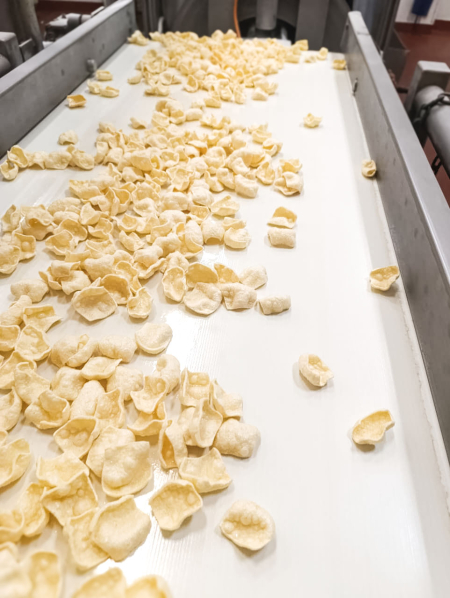
Conveying systems move fresh snacks through Dishaka's food processing and bagging operations.
The Nitrogen Imperative in Modern Food Packaging
For snack food manufacturers, nitrogen plays a critical role in Modified Atmosphere Packaging (MAP), a preservation technique that’s become the industry standard for maintaining product freshness and extending shelf life. By replacing oxygen inside sealed packages with nitrogen – an inert, non-reactive gas – manufacturers can significantly slow the oxidation process that causes oils to turn rancid, colors to fade and textures to deteriorate.
The science is straightforward but powerful. Oxygen promotes spoilage through oxidation of fats and supports microbial growth. Nitrogen displaces this oxygen, creating an environment where chips stay crisp, nuts retain their flavor and products maintain their visual appeal throughout their journey from factory to consumer. Additionally, nitrogen acts as a cushioning agent, protecting delicate products during shipping and handling while preventing package collapse.
“When customers open a bag of our chips, they expect a satisfying crunch and fresh taste,” Oberoi said. “Nitrogen flushing ensures we deliver on that expectation every single time, whether the product sits on a shelf for two weeks or two months.”
The challenge for scaling food manufacturers is sourcing nitrogen efficiently and cost-effectively.
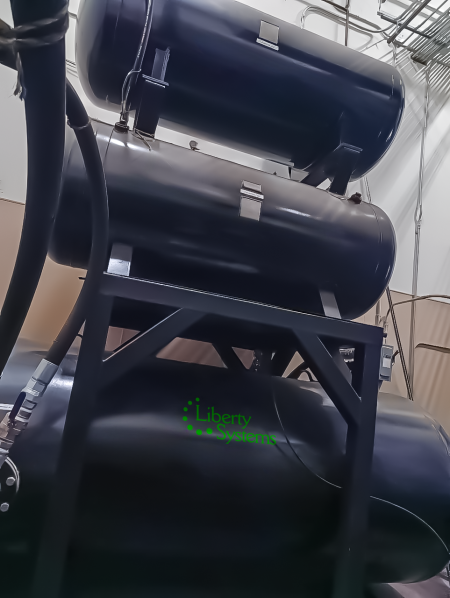
Liberty Systems supplied compressed air and nitrogen buffer tanks for Dishaka's modified atmosphere packaging.
Engineering Solutions Beyond Technology
The partnership with Liberty Systems proved instrumental in Dishaka's transformation. Founded in 2004, the company built its reputation by solving complex industrial gas challenges, beginning with a customer request to inert electrical control cabinets with nitrogen. That initial project – designed to extend the lifespan of electrical components from 12-18 months to 36 months or more by maintaining positive nitrogen pressure while excluding corrosive gases – established the company's philosophy of going beyond technology to deliver genuine solutions.
The company’s commitment to quality is backed by ISO 9001:2015 certification, ensuring precision-engineered solutions supported by rigorous quality management processes, risk-management practices and meticulous documentation. This dedication to excellence results in superior product consistency and drives ongoing enhancements in efficiency and reliability – critical factors for food manufacturers operating under strict food safety regulations.
“Dishaka needed a partner who understood technical requirements and food safety implications,” said Joshua Blair, Sales Engineer. “Our systems had to deliver consistent purity, reliable flow rates and seamless integration with its existing compressed air systems. There's no room for error when you're packaging food products at the scale it operates.”
First System: Nitrogen Generation System Installation
The food processor’s first Liberty Systems installation came in March 2022, with a nitrogen generation system. This initial system was designed to meet the facility's baseline nitrogen requirements for its primary packaging lines, using pressure swing adsorption (PSA) technology.
PSA systems represent the industry standard for on-site nitrogen generation in food manufacturing applications. The technology employs specially treated carbon molecular sieve materials within two alternating adsorber vessels. Compressed air charges both vessels, with one actively adsorbing oxygen, carbon dioxide and moisture while allowing nitrogen to pass through to the storage system. Simultaneously, the second vessel regenerates by reducing pressure and purging captured gases. This continuous cycling ensures uninterrupted nitrogen production at the specified purity level.
“The first system gave us immediate relief from delivery dependencies,” said Oberoi. “Within weeks, we realized we were operating more efficiently. No more coordinating delivery schedules or worrying about running low during peak production. The nitrogen was simply there, 24/7, exactly when we needed it.”
The system quickly validated the projected ROI. The facility gained the flexibility to scale production without concern for nitrogen supply constraints.
The installation went smoothly due to careful pre-planning. “We conducted a thorough assessment of the customer’s compressed air system, production schedules and peak demand periods,” Blair said. “This allowed us to size the nitrogen generation system appropriately and integrate it with minimal disruption to the client’s operations. Within 72 hours of installation, the system was online and producing specification-grade nitrogen.”
Second System Delivers Needed Expansion
Success breeds growth, and for Dishaka, the efficiency gains from its first nitrogen system paved the way for expansion. By early 2025, the facility had increased production capacity, added new packaging lines and identified additional applications for nitrogen throughout the plant. The decision to install a second system reflected both confidence in the technology partner and recognition that operational self-sufficiency extends beyond a single production area.
The second installation (P3OX-V1500), completed in May 2025, brought several strategic advantages. First, the system included a backup air compressor and additional plant air capacity, creating redundancy and ensuring uninterrupted operations even during maintenance or unexpected equipment issues. For food manufacturers operating on tight production schedules with retailers expecting on-time deliveries, this redundancy isn't a luxury – it's essential business continuity planning.
“The V1500 represented our commitment to operational excellence,” said Oberoi. “We weren't just adding nitrogen capacity; we were building a more resilient, more capable facility. The backup air compressor gave us peace of mind, and the additional plant air meant we could support future growth without incurring additional investments.”
The expanded system generated high-quality treated compressed air alongside nitrogen generation, supplying the entire facility with clean, dry air for pneumatic controls, actuators and other compressed air applications. This dual functionality created additional efficiencies and cost savings beyond nitrogen generation alone.
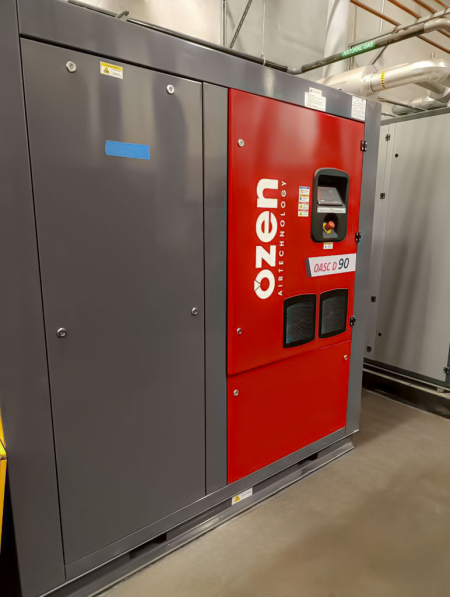
A nitrogen generator is fed by this variable frequency drive air compressor.
Quantifying the Benefits: More than Just Cost Savings
While the financial benefits of on-site nitrogen generation were compelling – with typical payback periods of 12 to 24 months – the client’s experience demonstrated how value extends beyond immediate cost reduction. The client saw financial, operational, environmental and strategic benefits from the installation.
Financial benefits include the elimination of recurring nitrogen delivery costs, the removal of tank rental and surcharge fees, the reduction of approximately 200 annual labor hours previously dedicated to nitrogen supply management, predictable operating costs based on electricity consumption rather than volatile commodity pricing and rapid ROI enabling capital redeployment to other growth initiatives.
Operational improvements included 24/7/365 nitrogen availability eliminating production constraints, the elimination of emergency delivery fees and premium charges, enhanced production scheduling flexibility without supply coordination, a reduced facility footprint thanks to the elimination of bulk storage tanks and improved workplace safety by eliminating high-pressure bulk storage hazards.
Environmental gains included a significant reduction in COâ emissions from eliminated delivery vehicles, alignment with corporate sustainability objectives, a reduced overall carbon footprint for manufacturing operations and leading the way in environmental stewardship in the food industry.
Finally, strategic advantages from the switch included operational independence from external suppliers, scalability to support future growth without infrastructure limitations, enhanced competitive positioning through lower operating costs and improved resilience against supply chain disruptions.
“The cost savings were significant and met our projections, but the operational freedom was transformative,” Oberoi said. “It's simply part of our facility infrastructure, like electricity or water. That mental shift allows our team to focus on what we do best – producing snack foods for our customers.”
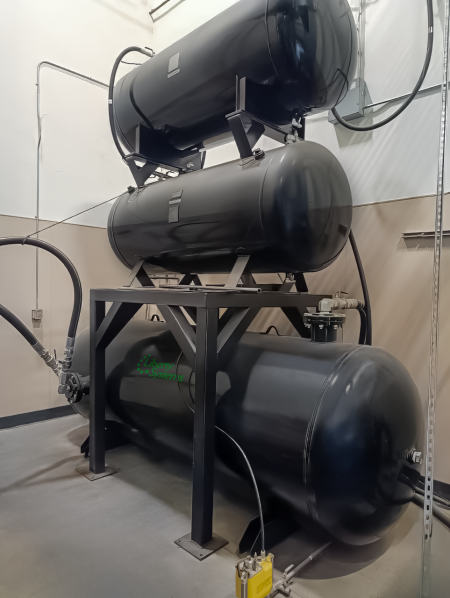
The tank system supporting the food processor’s modified atmosphere packaging for product freshness.
The Nitrogen Generation Self-Sufficiency Model
The customer’s experience offers valuable insights for food manufacturers evaluating their nitrogen supply strategies, particularly in an era of supply chain uncertainty and rising operational costs.
Start with a Comprehensive Analysis. Understanding the total cost of ownership for delivered nitrogen extends beyond the per-unit price. Administrative costs, labor for cylinder or tank management, delivery fees, rental charges and opportunity costs from supply delays all factor into the equation. A thorough analysis typically reveals that on-site nitrogen generation becomes cost-effective at much lower consumption volumes than many manufacturers assume.
Partner with Experienced Integrators. The technical aspects of nitrogen generation – purity requirements, flow rates, pressure specifications, integration with existing compressed air systems – demand expertise. Working with ISO-certified partners ensures proper system sizing, installation quality and ongoing support.
Consider Total Infrastructure Impact. Modern nitrogen generation systems can serve dual purposes, providing both specification-grade nitrogen and treated plant air. This integrated approach maximizes ROI and addresses multiple facility needs simultaneously.
Plan for Redundancy. For critical applications like food packaging, backup systems and redundant capacity prevent costly production interruptions. The incremental investment in redundancy delivers outsized returns through enhanced uptime and production reliability.
View it as Strategic Infrastructure. On-site nitrogen generation isn't merely a cost-reduction tactic; it's strategic infrastructure enabling growth, improving operational flexibility and enhancing competitive positioning. Companies viewing it through this lens make better long-term decisions.
A Food Processor’s Continuing Innovation Journey
As Dishaka continues expanding its product portfolio and production capacity, its nitrogen generation systems provide a foundation for sustainable growth. The food processor’s commitment to innovation – evident in its diverse product offerings – is matched by its commitment to operational excellence.
“We're always looking at how to improve our operations, reduce our environmental impact and deliver better value to our retail partners and their customers,” Oberoi said. “The partnership with Liberty Systems exemplifies this approach. We invested in technology to improve our bottom line while making us a more sustainable, more reliable supplier.”
For Blair, this represents an ideal client partnership: “Working with companies where there's a genuine commitment to operational excellence and a willingness to invest in the right solutions allows us to demonstrate what's possible. This isn't about selling equipment; it's about enabling the customer’s success and building long-term relationships based on performance and trust.”
The food manufacturing industry continues evolving, with increasing emphasis on sustainability, operational efficiency and supply chain resilience. The customer’s journey from delivered nitrogen to onsite generation offers a roadmap for others in the sector. The combination of proven technology, experienced partners and clear-eyed business analysis creates a winning formula – one delivering returns well beyond the initial investment.
From a small trading post in Kuwait City to a sophisticated U.S. manufacturing operation producing millions of bags of snacks annually, this customer’s story is one of continuous evolution and adaptation. The decision to take control of its nitrogen supply through onsite nitrogen generation represents the latest chapter in that story and a model for the future of food manufacturing efficiency.
About the Author

Joshua Blair is a Sales Engineer with Liberty Systems, bringing comprehensive knowledge of nitrogen and compressed air systems gained through hands-on experience in both production and client-facing roles. He specializes in listening to customer needs and pain points to design practical solutions for operational challenges. Blair values the connections he's built with professionals worldwide across diverse industries relying on compressed air systems.
About Liberty Systems
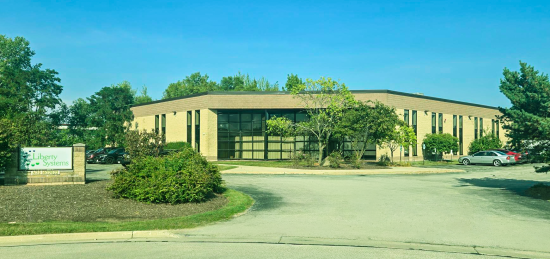
Liberty Systems is headquartered in Waukesha, Wisconsin.
Founded in 2004, Liberty Systems is a leading provider of onsite nitrogen generators, filtration and air dehydration solutions for industrial and food manufacturing applications. The company's founding principle, going beyond technology to deliver genuine solutions, drives its customer-focused approach. With ISO 9001:2015 certification, it demonstrates a commitment to quality management and meticulous documentation. The company's NITRO FORCE® nitrogen generation systems use proven PSA technology, delivering consistent purity levels, reliable performance and exceptional energy efficiency for applications including food packaging, Modified Atmosphere Packaging and other industrial nitrogen operations. For more information, visit https://lsn2.com.
To read more Nitrogen Generation articles, visit https://www.airbestpractices.com/technology/air-treatment.
Visit our Webinar Archives to listen to expert presentations on Nitrogen Generation at https://www.airbestpractices.com/webinars.