Compressed air is critical in food packaging, powering sealing machines, nitrogen generation systems and much more. Choosing the wrong air compressor can lead to contamination, compliance issues and wasted costs. To make the right choice, you need to ask the right questions. These six questions will help you design a compressed air system that meets food safety standards, ensures efficiency and keeps your operations running smoothly.
1. What Applications Will Use Compressed Air?
The first step in choosing an air compressor is understanding how compressed air will be used in your food packaging operations. Compressed air can serve a variety of roles, each with unique requirements for air quality and system design. Broadly, these applications fall into two categories:
- Direct Contact Applications: In direct contact applications, compressed air comes into direct contact with food products or packaging materials. Examples include air knives, product handling, blow-off and package inflation or cushioning. Because the air interacts with the product, maintaining the highest level of purity is essential to avoid contamination.
- Indirect Contact Applications: In indirect contact applications, compressed air powers machinery or supports processes without coming into direct contact with food. Examples include powering equipment (filling, sealing or labeling machines), running nitrogen generation systems for modified atmosphere packaging and blow-off or cleaning for outer containers and cartons. Air purity requirements for these applications can vary. Most nitrogen systems require a high degree of air purity. While other applications may be less sensitive, clean, dry compressed air is still important to prevent damage to equipment and maintain product safety.
2. What Are the Relevant Air Purity Standards for the Application?
Compressed air used in food packaging must meet stringent air purity standards to prevent product contamination and ensure compliance with Food and Drug Administration (FDA) regulations. Food manufacturers are required under Good Manufacturing Practices 21 CFR Part 110 to ensure compressed air does not contaminate food products. Compliance with compressed air standards is also an essential component of Safe Quality Food certification.
ISO 8573-1 is an international standard that specifies purity classes for compressed air based on three key contaminants: particulates [A], water [B], and oil [C], given in an [A]:[B]:[C] format. The standard defines ten classes for each contaminant, ranging from the strictest (Class 0, nearly contaminant-free) to Class 9. While the FDA does not mandate specific air purity classes for food packaging, there are common industry guidelines. For example:
- Direct contact applications: Purity class of 2:2:1 or better.
- Indirect contact applications: Purity class of 2:4:2 or better.
3. Do You Need an Oil-Free Air Compressor?
Most food packaging applications rely on rotary screw air compressors, which are ideal for high-volume, continuous applications. These air compressors come in both oil-flooded and oil-free versions. Choosing between oil-free and oil-flooded air compressors is a balancing act between cost and compliance.
- Oil-free air compressors are designed to deliver air free from oil contamination, making them a strong choice for applications requiring strict air purity. They are well-suited for direct contact applications where any trace of oil contamination could result in food safety issues or regulatory violations. These systems are more expensive than lubricated air compressors and have higher maintenance costs.
- Oil-flooded air compressors use oil to lubricate moving parts in the airend. Oil-flooded air compressors are usually less expensive than oil-free versions. These air compressors are a great choice for indirect contact and less sensitive applications. Oil-flooded air compressors can still meet food-grade air standards when paired with the right filtration and air treatment options.
While oil-flooded air compressors paired with advanced air treatment can offer cost savings upfront, filtration costs can add up over time. The best solution depends on the specific needs of your operation, including the type of applications, purity standards and production volume.
4. What Kind of Air Treatment Is Required?
Proper air treatment involving filtration and compressed air dryers ensures compressed air is clean, dry and free of contaminants. The compressed air treatment strategy used depends on the compressed air purity standard required and the type of air compressor.
- Air dryers: Excess moisture in compressed air can lead to equipment corrosion, microbial growth and contamination risks, especially in food packaging. Compressed air dryers remove this moisture and lower the dew point (a measure of moisture content) of the air. Refrigerated compressed air dryers do this by cooling the air to let moisture fall out naturally. They can achieve dew points down to 38°F (3°C). This is typically suitable for general manufacturing and indirect contact applications. However, in direct contact applications that require Class 1 or 2 purity levels for moisture, a desiccant compressed air dryer is usually required. These use adsorptive material to remove water from the compressed air, achieving dew points as low as -40°F to -100°F (-40 to -73°C).
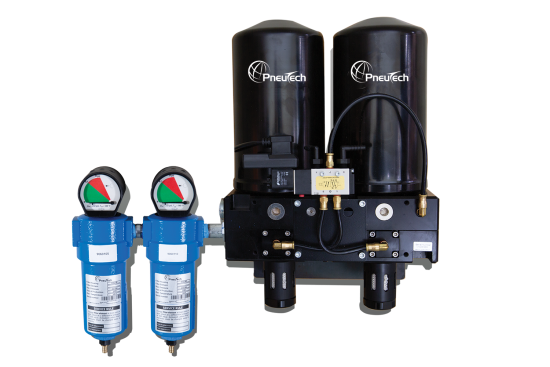
Most food applications require a desiccant compressed air dryer to remove all traces of moisture. These compressed air dryers can achieve dew points as low as -40°F (-40°C) or even -100°F (-73°C).
- Filtration: Inline filtration is essential to remove contaminants from compressed air, including particulates, oil aerosols and vapors. Filter options include particulate filters (for solid particles), coalescing filters (for oils, aerosols and fine particulates) and activated carbon filters (for oil vapors and odors) which may be used in combination. Filters should be strategically installed to target contaminants at various stages of the compressed air system, with multiple layers of filtration for maximum effectiveness. For oil-flooded air compressors, an additional layer of treatment is necessary to remove residual oil content. High-efficiency coalescing filters and activated carbon stages are crucial for achieving ISO 8573-1 Class 1 or Class 0 oil purity.
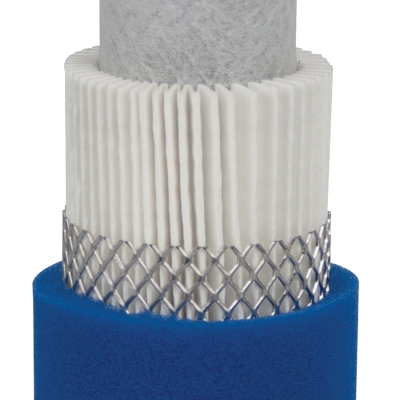
A coalescing inline filter removes both oil residue and fine particulates. With the right filtration, it is possible to meet food quality standards for compressed air with a lubricated air compressor.
5. How Will You Monitor and Maintain Air Quality?
Even with a well-designed compressed air system, maintaining consistent compressed air quality requires regular monitoring and proactive maintenance. Without these measures, contaminants can accumulate, jeopardizing food safety and compressed air system performance. Maintenance and monitoring includes:
- Regular compressed air testing to ensure air meets purity class requirements. Testing should align with ISO 8573-1 standards and include periodic audits to confirm compliance with food safety protocols.
- Replacing filters at regular intervals recommended by the manufacturer.
- Proactive maintenance of the air compressor and compressed air dryers.
- For oil-flooded air compressors, maintenance and inspection of the oil/water separator (including filter changes, cleaning and water testing) to prevent contamination or failure.
6. What Is the Total Cost of Ownership?
Choosing the right compressed air system for food packaging isn’t only about upfront costs—it’s about understanding long-term expenses and benefits. A compressed air system that seems cost-effective initially may turn out to be more expensive over time due to energy inefficiency, maintenance or non-compliance penalties. Evaluating the total cost of ownership helps you make a smarter investment in your compressed air system. Factors to consider include:
- Capital expenses: While oil-flooded air compressors paired with advanced air treatment can offer cost savings upfront, oil-free air compressors might be more economical in the long run for applications requiring strict air purity. Consider both the air compressor itself and the cost of air treatment systems such as compressed air dryers and filtration.
- Maintenance and consumables: Ongoing costs include filter replacements, oil changes (for oil-flooded systems) and servicing of compressed air dryers, separators and other air treatment components. Oil-free air compressors eliminate the need for oil-related maintenance but still require regular servicing of filters, compressed air dryers and other components. Weigh the recurring costs of consumables and servicing for each system type.
- Energy efficiency: Air compressors are energy-intensive, often accounting for a significant portion of operational costs. Look for compressed air systems with features like variable-speed drives to optimize energy use based on demand.
- Compliance costs: Meeting air purity standards ensures regulatory compliance and avoids costly penalties or recalls. Factor in air quality testing and monitoring to maintain consistent performance.
- Downtime and productivity: Unplanned downtime disrupts operations and results in revenue losses. Investing in equipment with monitoring capabilities helps minimize risks.
- Longevity: Investing in a high-quality compressed air system with durable components can extend the lifecycle of your equipment, reducing the frequency and cost of replacements.
Choosing the Right Air Compressor for Food Packaging
In the food packaging sector, choosing an air compressor is a critical decision impacting your operations, product safety and bottom line. By asking these six questions, you can ensure your compressed air system meets the unique demands of your applications and operates efficiently. Working with a qualified compressed air system designer is essential to ensure your compressed air system is tailored to your specific application and compliance requirements. An experienced professional can help analyze your needs, select the right equipment and design a compressed air system that is both efficient and compliant with food safety standards.
About the Author
Brad Taylor is a Compressed Air Systems Engineer and co-owner of Fluid-Aire Dynamics, a specialist in the design, installation, maintenance and repair of industrial compressed air systems.
About Fluid-Aire Dynamics
Fluid-Aire Dynamics is a leading provider of industrial compressed air system sales and service in Chicago, Milwaukee, Minneapolis, Detroit, Philadelphia and San Antonio. Specializing in rotary screw air compressors, it offers compressed air system design and engineering, equipment sales, preventative maintenance, emergency repair and air compressor rentals. Based in Schaumburg, Illinois, Fluid-Aire Dynamics services all major makes and models of industrial air compressors and associated air accessories. For more information, visit https://fluidairedynamics.com.
For similar articles on Food-Grade Air, please visit https://www.airbestpractices.com/standards/food-grade-air.
Visit our Webinar Archives to listen to expert presentations on Food Industry at https://www.airbestpractices.com/webinars.