
The Compressed Air and Gas Institute (CAGI) released its all-new Compressed Air Purity Guide, a comprehensive resource designed to help industries achieve clean, dry compressed air. This guide addresses the critical importance of air purity in sectors that rely on compressed air as a utility or process gas, excluding specialty applications such as breathing air and sterile air. When manmade or naturally occurring substances become airborne, these chemicals, compounds and matter contaminate the air and affect the reliability and efficiency of any compressed air system. Contaminants can cause catastrophic damage to equipment and costly losses if they contact a sensitive product, such as food or pharmaceuticals. For this reason, compressed air, as used in industrial processes, must be treated to achieve a desired level of purity.
Developed by a subcommittee of CAGI’s Air Drying and Filtration (ADF) Section, the guide draws on expert knowledge and information from important sources such as the Compressed Air and Gas Handbook; ISO 8573-1, Compressed Air: Part 1: Contaminants and Purity Classes and VDMA 15390-1-2014-12, Compressed Air Purity – Part 1: Typical Application Specific Purity Classes According to ISO 8753-1:2010 and Guidance for Achieving and Monitoring of a Respective Compressed Air Purity for Industrial Applications with modifications.
The subcommittee was formed to develop the guide as part of the library of educational guides, which includes the Air Compressor Selection Guide, Compressed Air and Gas Drying and the Rotary Air Compressor Selection Guide. These guides provide information to help users understand the different air compressor and compressed air dryer technologies, and provide technical guidance for selecting the proper equipment for the application. In addition to subcommittee members, CAGI’s Technical Editor and Chair of the Education Committee provided input and direction for the guide. Once the committee completed the draft, the document was reviewed and approved by the ADF Section. Following the review by the ADF Section, comments and proposed edits were addressed by the subcommittee. A final review was completed by the CAGI board of directors to ensure the guide met the institute’s objectives. Upon the approval of the guide, it was published and made available on the CAGI website for free download.
The guide includes a glossary of terms as well as illustrating concepts with tables and images. As with all CAGI educational resources, the subcommittee ensured a robust process that delivers a reliable, unbiased and science-based document.
Industries Benefitting Most from the Compressed Air Purity Guide
The guide was developed for end users of compressed air, designers of compressed air systems, engineering students, plant engineers, maintenance personnel and those who service the industry, such as consultative salespersons and service personnel.
While any manufacturer may benefit from the air purity guide, the industries which may benefit most is where risk of contamination has greater impact. For example, in cases where the compressed air may come in contact with products for human consumption or vessels that hold products for human consumption, the impact of contamination is greater for the manufacturer. The guide addresses the differences in the risk levels by identifying three well-accepted categories of compressed air purity: 1) Plant air with moderate purity levels for general use, such as tools and actuators, 2) Instrument air with higher purity for sensitive control systems and 3) Process air with highest purity when air becomes an ingredient in the process or product. Process air is an example where the air may have direct contact with the product.
Examples of the types of industries that would likely align with the three categories would be: general manufacturing and assembly for plant air, utilities or power companies for instrument air and food and beverage or pharmaceutical manufacturing for process air. The guide delves into detail on the types of purity levels and cautions to always consult OEM recommendations.
In order to deliver a quantifiable purity level, the guide explains the ISO 8573-1 standard, which provides the types of contaminants and creates classes of purity based on specific quantities of the contaminants.
The guide references the three types of contaminants found in ISO 8573-1: particles, water and oil.
Particles. Particles in compressed air can be viable (microorganisms) or non-viable (dust, dirt, pollen). Natural sources include deserts, agricultural operations and construction activities, while manmade sources include industrial emissions and fossil fuel combustion. These particles can damage pneumatic equipment, clog filters and contaminate products.
Water. Water is present in atmospheric air as vapor, liquid or aerosol. Under average conditions, water vapor constitutes between 0.25% in drier climates and up to 2% in humid environments. With compression of the air, the concentration of water increases significantly, making drying essential.
Oil. Oil contamination originates from two sources: 1) atmospheric hydrocarbons (exhaust fumes, industrial emissions, petrochemical processes) and 2) air compressor lubrication (oil-lubricated air compressors) can introduce significant oil carryover, measured in gallons per year, depending on air compressor size and type. Even oil-free air compressors can ingest hydrocarbons if placed near sources like loading docks, where truck exhaust introduces compounds such as benzene and toluene.
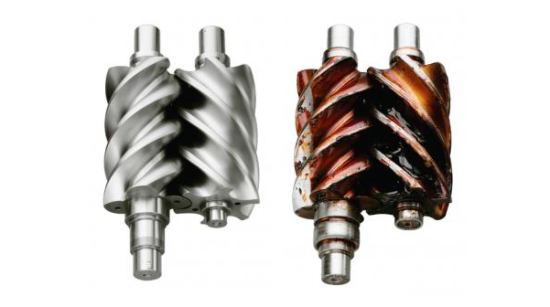
The Compressed Air Purity Guide notes, depending on the type of air compressor and compression temperatures, some air compressor lubricants can create varnish. (Photo courtesy of Hitachi Global Air Power US).
Key Technologies for Compressed Air Treatment
The ADF Section understood that identifying the types of contaminants and quantifying the air purity requirements would not be enough information. Readers would want guidance on the methods for attaining the required purity levels. Therefore, once the user has determined the level of compressed air purity that is required for the application, the task becomes one of selecting and installing the air treatment equipment that will reliably deliver the required air purity. The guide emphasizes proper system design and equipment selection. Key technologies include:
- Compressed air dryers: Refrigerated compressed air dryers for general use; desiccant compressed air dryers for ultra-dry air.
- Filters: Particulate filters, coalescing filters for oil aerosols, activated carbon for vapors.
- Moisture separators and drains: Prevent liquid water accumulation.
The purity guide provides a table of treatment component technologies and their efficacy to remove contaminants based on type of contaminant.
The guide has much more to offer in designing or correcting a compressed air system for the required purity levels. From assessing the air quality at intake to identifying the right air purity for the user application, to selecting and installing the proper equipment to achieve the desired purity, the guide is comprehensive in its approach.
Don’t let untreated compressed air introduce contaminants that compromise equipment reliability, product quality and operational efficiency. Access the free Compressed Air Purity Guide from the CAGI website under Working with Compressed Air, Selection Guides.
.jpg)
About the Author
Chad Larrabee is a well-recognized expert in the compressed air industry with a career spanning more than 30 years with Ingersoll Rand and now as a consultant through his company, Profundity LLC.
About the Compressed Air and Gas Institute and the ADF Section
The Compressed Air and Gas Institute (CAGI) is the united voice of the compressed air industry, serving as the unbiased authority on technical, educational, promotional and other matters that impact compressed air and gas equipment suppliers and their customers. CAGI educational resources include e-learning coursework, selection guides, videos and the Compressed Air & Gas Handbook.
The ADF Section consists of the following member companies: Altec Air, Atlas Copco Compressors, BEKO Technologies, Donaldson Company, Hankison, Ingersoll Rand, Kaeser Compressors, Lectrodryer, Mikropor America, nano-purification solutions, Parker-Hannifin Corporation, Pentair, Pneumatech, Quincy Compressor, Van Air Systems, Walker Filtration and ZEKS Compressed Air Solutions. For more information, visit http://www.cagi.org.
To read similar articles on Compressed Air Standards, please visit https://www.airbestpractices.com/standards.
Visit our Webinar Archives to listen to expert presentations on Compressed Air Treatment at https://www.airbestpractices.com/webinars.