
Pennsylvania brewery shares its innovative approach to water conservation and decarbonization
Sustainability is a topic on everyone’s mind – not just individuals, but companies, too. Businesses are looking for ways to lower their carbon footprint and contribute to the cause.
Tröegs Independent Brewing, a craft brewery based in Central Pennsylvania, is making strides with sustainability best practices.
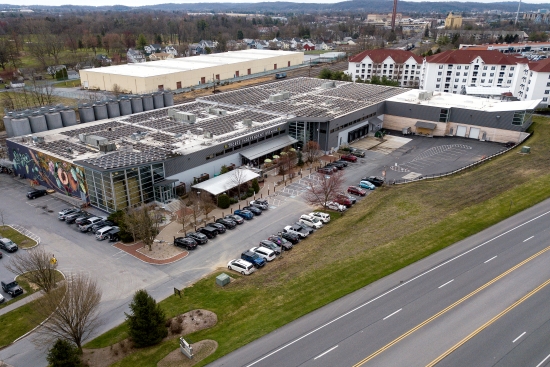
Aerial view of Tröegs Independent Brewing facility in Hershey, Pennsylvania.
“We all have families, we all have children and we want to leave this world a better place than when we came into it,” said Jason Knox, Maintenance Manager at Tröegs. “At Tröegs, we pay attention to our carbon footprint and drive sustainability efforts so we can be a good neighbor to our community.”
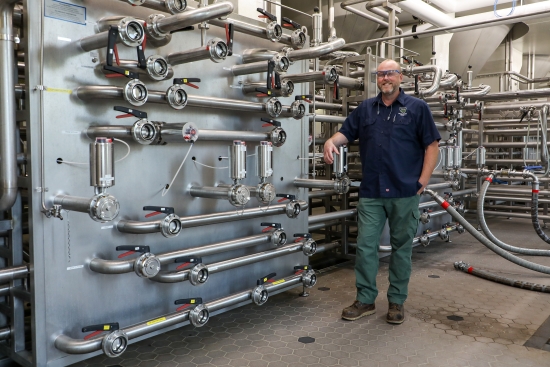
Jason Knox, Maintenance Manager at Tröegs.
Production at Tröegs
As the 27th largest craft brewer in the U.S., Tröegs produces 112,000 barrels of beer per year at its facility in Hershey, Pennsylvania. The brewery is 115,000 square feet, with about 25,000 square feet allocated for retail space, kitchen and a 250-seat restaurant. The remaining 90,000 square feet is devoted to production.
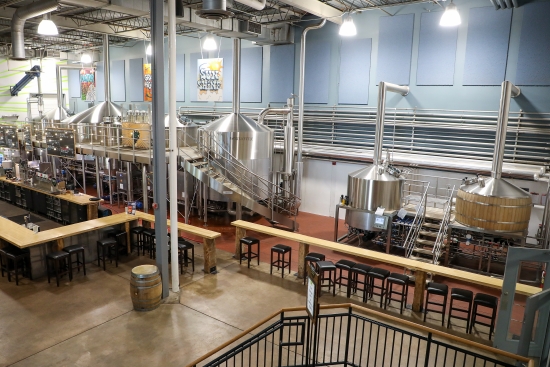
The main 100-barrel brewhouse, left, and 15-barrel brewhouse, right.
Tröegs has three brewhouses – 100 barrel, 15 barrel and 3 barrel. The 100-barrel brewhouse serves as the company’s primary manufacturing plant where a vast majority of its beers are brewed. Known as Tröegs’s scratch brewhouse, the 15-barrel brewhouse is used to solidify new recipes and do collaboration brews with other breweries. These beers are created in smaller quantities and are sold exclusively inhouse. Lastly, the 3-barrel brewhouse is a test kitchen used for research and development.
The brewery also includes two bottling lines. The larger line is capable of filling 215 bottles per minute, while the other is capable of filling 45 bottles per minute and is used for specialty bottles sealed with a cork. In 2022, Tröegs installed a fully automated canning line that fills 390 12-ounce cans per minute. The brewery’s semi-automated keg line can fill 40 half barrels per hour.
Compressed Air in the Production Process
Compressed air plays a large role in Tröegs’s brewing process. One of its main uses is to control valves opening and closing all throughout production and packaging.
“In our brew houses, compressed air controls all of the openings and closings of the butterfly valves for all the paths the beer has to travel,” said Knox. “This is the same in the cellar and our filtration process. For the packaging process, compressed air opens and closes valves. We don’t have electric valves and use compressed air for as much as we can. It never directly touches the beer though, and there’s nowhere we would have potential for crossover.”
Tröegs’s main source for compressed air is a 50-horsepower (hp), lubricated, air-cooled, rotary screw air compressor with a variable frequency drive. The brewery also has an older 25-hp rotary screw air compressor that’s used for backup. The compressed air system includes an SSRC-250 Sullair cycling, refrigerated air dryer and a 400 gallon receiver tank.
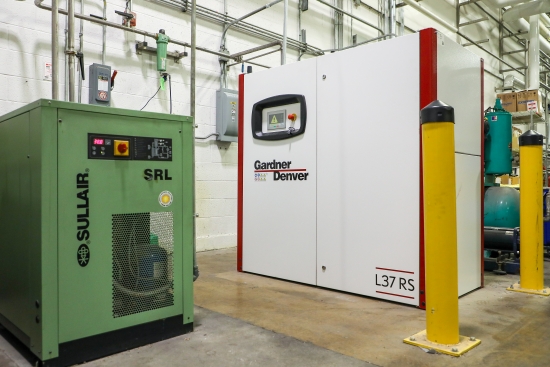
Tröegs’s Gardner Denver L37 RS and backup Sullivan-Palatek air compressor.
“Compressed air is a 24/7/365 operation at Tröegs,” Knox said. “99% of our valves are air operated. If a valve needs to open, the air compressor has to be ready to supply air or we risk ruining the beer.”
Tröegs’s main air compressor includes a variable frequency drive that delivers 235 cfm at 115 psi (8 bar) at full load. This is how the brewery runs when at full capacity using its air-driven diaphragm pumps that dispose of yeast and filtration media to outdoor storage tanks, which is the largest compressed air application at Tröegs. During operation periods with only two packaging lines running, Tröegs can run at 45% turndown.
Knox and his team understand the importance of regular maintenance, equipment monitoring and scheduled cleanings of screens and filters. The majority of Tröegs’s machinery has low air cutoffs, so if there’s an issue with part of the system, the team can figure out where the problem is going to be. Each piece of equipment that uses compressed air has an air pressure monitor that will show an alert if the air pressure dips below that particular machine’s setpoint. These issues would be present in the event of a compressor fault or failure, or a possible leak causing air to be starved from that location.
Since 2010, Tröegs has been under contract with Cleveland Brothers, its local supply house for partner vendor products. Every 2,000 hours, Cleveland Brothers services the equipment, conducts an oil analysis, changes filters and ensures everything is working properly.
Keeping Things Cool with Pro Refrigeration Chillers
Along with compressed air, Tröegs relies on three chillers for production. Each chiller is manufactured by Pro Refrigeration, and is responsible for keeping the beer and yeast at a stable temperature, as well as providing cooling for the brewery’s filtration and flash pasteurizer. The refrigeration compressors used in the chiller units are manufactured by Bitzer and all units use R-404A.
Chiller 1 is a packaged unit that uses two 50-hp reciprocating compressors to remove the heat from propylene glycol. It has a 1,200 gallon reservoir of glycol that is kept at -5°F (-21°C) freeze concentration.
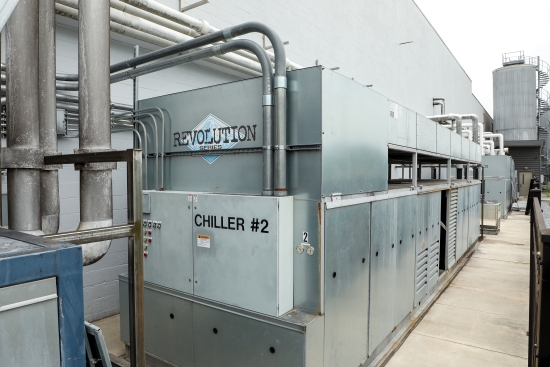
Tröegs’s three chillers from Pro Refrigeration keep the beer and yeast at a stable temperature for production.
Chiller 2 and chiller 3 each have two 110-hp rotary screw compressors that accomplish the same thing as chiller 1. These units share a separate 2,000 gallon glycol reservoir.
Making a Difference with Water Conservation
For Tröegs, the first step to being green starts with education. Brewery leadership believes it’s crucial to educate employees on what’s important to the company – such as being a good member of the community and prioritizing sustainability. Water usage is always top of mind.
“Breweries are notorious for being massive water consumers, so we pay attention to every drop of water we bring in,” Knox said. “On the flip side, we also monitor every drop of waste we put out of here – anything that goes through our waste stream be it effluent, human effluent, lab waste, dishwashers or kitchen grease. We pay attention to what we’re loading the local municipality with, such as total suspended solids (TSS) or biochemical oxygen demand (BOD) and other high-strength waste.”
One of Tröegs’s big initiatives was to side stream its high-strength effluent, which is wastewater that has higher concentrations of contaminants than standard domestic wastewater. The brewery side streams it out of the underground stream that goes to the local municipality, Derry Township Municipal Authority (DTMA), and has it tankard off site. This high-strength effluent then goes to DTMA to be run through an anaerobic digester, turning it back into electricity.
Typically, effluent first needs to go through a screening process. Tröegs bypasses these steps and directs its high-strength waste right into the DTMA’s digester. Microbes eat the waste and generate methane, which DTMA uses to run its generators.
Bypassing the DTMA’s screening not only saves Tröegs $600,000 per year, but means the municipality can skip the first steps of the treatment process, saving energy and manpower. The brewery provides effluent that’s high in soluble sugars, so it can go straight into the municipality’s digester.
“When I first started in this industry 17 years ago, it took an average of seven to eight gallons of water to manufacture one gallon of beer,” Knox said. “Today, Tröegs has gotten water usage down to 4.6 gallons of water per one gallon of beer.”
In order to reduce its water usage, Tröegs has implemented numerous tactics. The brewery has reverse osmosis systems, which are water filtration devices that use pressure to force water through a semi-permeable membrane to remove contaminants. This process creates two products – permeate, water that has nearly all contaminants removed, and concentrate, the leftover liquid with the contaminants unable to pass through the membrane.
To save water, Tröegs has converted most spray down hoses, most safety showers, foam trap rinses, keg cip tanks and the keg external washer from the main water line to concentrate water. The brewery has reduced and optimized the volume of whirlpool, lauter tun, mash tun, boil kettle and FV pre cip rinses. It also reduced and optimized pipe rinses pre hotloop as well as pre and postflush rinses for all packaging lines and filtration. Lastly, Tröegs reduced the time centrifuge sits in standby wet.
In addition to its water conservation efforts, the brewery has created its own solar farm, with more than 1,600 solar panels on its roof. At the time of installation, the solar farm accounted for 17% of the brewery’s electrical needs. In 2023, the farm produced 727 megawatt hours of electricity.
Decarbonizing and Cutting Costs with Carbon Capture
Tröegs’s next sustainability measure is already in progress: a carbon capture project.
Beer manufacturing creates three byproducts: heat, CO2 and alcohol. The CO2 vents back into the atmosphere, but soon Tröegs will be able to put it into a collection system and reuse it.
A large amount of CO2 is needed to maintain the brewery’s production. Currently, Tröegs buys liquid CO2 by the pound and has three holding tanks on site. With the carbon capture project currently in development, the brewery will be able to reclaim the CO2 from its fermentation process, clean it, recompress it from a gas back to a liquid and then reuse that CO2. Once complete, this project is expected to produce 65% of the brewery’s CO2 needs.
As part of this CO2 reclamation system, Tröegs will be making use of a nitrogen generator. It will use a Generon Nitrogen Generator that is 10 scfm with a purity of 95%.
The carbon capture process involves the collected CO2 going through a pre-compression skid and then to a dryer, followed by an activated carbon bed to remove any impurities. After approximately eight hours of run time, the carbon will be saturated and needs to be cleaned. Nitrogen will be heated and run through the dryer and activated carbon bed until it is free of contaminants.
About Tröegs Independent Brewing
Founded in Pennsylvania in 1997 by brothers John and Chris Trogner, Tröegs Independent Brewing is driven by a sense of adventure and curiosity. It brews a variety of year-round, seasonal and limited beers as well as small-batch and specialty beers. For more information, visit https://troegs.com.
To read articles on the Food and Beverage Industry, visit https://www.airbestpractices.com/industries/food.
For expert presentations on the Food and Beverage Industry, visit our Webinar Archive Section at https://www.airbestpractices.com/webinars.