What is more soul-warming than the aroma of a freshly opened bag of perfectly roasted coffee beans? Imagine waking up on a crisp, fall Sunday morning and you head to the kitchen to brew that much-anticipated cup of coffee. Upon opening the new bag of beans you are utterly disappointed to discover that the bag is full of spoiled coffee beans staring back at you. Your delicious coffee experience has been ruined by a bag of rancid coffee beans. Had the coffee producer packaged the freshly roasted beans in a hermetically sealed container that had been properly flushed and filled with the appropriate purity of nitrogen gas, the start to your Sunday would have been entirely different.
There are countless uses for nitrogen gas in industry and many other applications. Selecting the appropriate nitrogen purity for the application is critical as it dictates the final quality of the product or process.
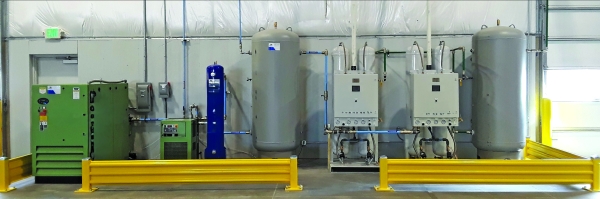
This complete nitrogen gas system includes an air compressor and a nitrogen generator.
|
Purity Level |
Applications |
|
Ultra-High Purity (UHP) – 99.999%+ |
Semiconductor manufacturing, electronics, research |
|
High Purity – 99.9% to 99.999% |
Laser cutting, heat treating, pharmaceutical manufacturing |
|
Food Grade – 99% to 99.9% |
Food packaging, winemaking, food processing |
|
Medical Grade – 99%+ |
Cryopreservation, cryotherapy, medical imaging |
|
Industrial Grade – 95% to 99% |
Tire inflation, chemical blanketing |
|
Fire Sprinkler Systems – 98%+ |
Corrosion prevention for fire sprinkler systems |
Table 1. Nitrogen purity guide for various applications.
The level of nitrogen purity also affects the total lifecycle cost of the nitrogen system, including equipment costs, energy consumption and system maintenance. As the purity level of the nitrogen increases, so does the size of the nitrogen generating equipment and the air compressor that is required to feed the system. This is why selecting the appropriate purity level is so very important.
The typical purity range for nitrogen gas used in industrial applications is 95% to 99.999%. Within the nitrogen industry, the convention is to state nitrogen purity levels relative to oxygen content, since oxygen is the volatile component which can spoil products and processes by causing unwanted oxidation. Cryogenic liquid nitrogen is extremely pure at roughly 99.998% nitrogen. So, 99.998% nitrogen is stated as 20 ppm oxygen content. Liquid nitrogen is created by the process of cryogenic distillation. The temperature of the air is reduced to the point where it condenses into a liquid mixture of gases. The liquid air is heated and since different gases have different boiling temperatures, each gas boils off as an ultra-pure gas at its unique boiling temperature. Nitrogen, with a lower boiling point than oxygen and argon, boils off first and is separated and collected in a pure liquid state at roughly 99.998% purity.
Pressure swing adsorption (PSA) nitrogen generators produce gaseous nitrogen through the process of adsorption, where clean, dry compressed air is flowed through a special media called a carbon molecular sieve. The carbon molecular sieve selectively attracts the molecules of other gases like oxygen and argon and removes them from the airstream. What exits the sieve is a steady stream of high-purity nitrogen gas. A PSA nitrogen generator is more sustainable and environmentally friendly compared to the production of liquid nitrogen as the energy consumption is significantly lower. PSA nitrogen generating systems offer a wide range of nitrogen flow, purity, dryness and pressure, and they can be designed for many different applications. Key to selecting the optimal PSA nitrogen generating solution is identifying the purity of nitrogen needed.
There are two main reasons to select the appropriate purity level for a nitrogen generation system. The first reason is financial and the second is directly related to the quality outcome of the product or process being influenced by the nitrogen gas.
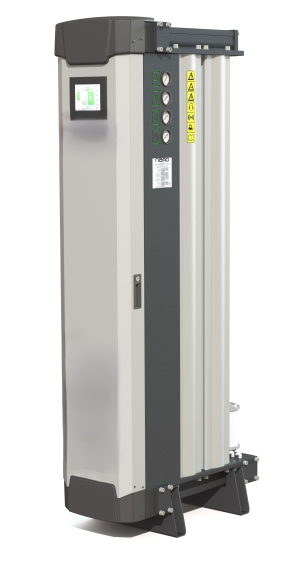
A nitrogen generator.
Financial Considerations for Nitrogen Gas Purity Selection
PSA nitrogen generators can produce nitrogen gas across the entire industrial purity range (95-99.999%). However, both equipment costs and energy consumption rise proportionally with the desired increase in purity. As nitrogen purity levels exceed 95%, the relationship becomes non-linear, requiring a larger nitrogen generator. This is because achieving higher purity demands a greater volume of internal media to effectively capture and remove more oxygen molecules from the feed air stream.
Since the media is not 100% efficient and traps some nitrogen molecules, the increased size of the generator is not directly proportional to the purity increase in the nitrogen being produced. As a result, the size of the PSA nitrogen generator system grows disproportionately in relation to the increase in nitrogen purity.
The following is a real-world example showing how increasing the purity of nitrogen affects the size of the nitrogen generator: A customer requires a 1,000 standard cubic feet per hour (scfh) flow of nitrogen gas. When selecting the purity of nitrogen, the customer may default to the ultra-high purity level produced by cryogenic nitrogen, 99.998% or 20 ppm oxygen content. This results in a nitrogen generator that is twice the size and cost of a nitrogen generator that produces a lower purity level of nitrogen, 99.9% or 1,000 ppm oxygen content. Some applications do require ultra-high nitrogen purity, but many times applications will accept a lower purity level.
1,000 scfh of nitrogen at 99.999% purity requires a feed air compressor delivering slightly over 100 standard cubic feet per minute (scfm) of compressed air. This capacity requires a 25 horsepower (hp) air compressor. For 1,000 scfh of nitrogen at the lower purity of 99.9%, the inlet compressed air requirement would be just over 50 scfm, which equates to a 15 hp air compressor, a 40% reduction in both air compressor size and associated energy expense.
The desired nitrogen purity and its dryness also affect the required pressure dew point of the compressed air that feeds the nitrogen generator. The drier and cleaner the compressed air that feeds the nitrogen generator, the longer the service life of the media within the generator. Oil vapors can be removed by activated carbon filtration of the inlet air. Compressed air dried by a refrigerated compressed air dryer is typically sufficient, but if the ambient temperature is below 35°F (2°C) or the nitrogen must be extremely dry, a desiccant dryer may be used to achieve -40°F (-40°C) pressure dew point for the inlet air. Desiccant compressed air dryers consume 15-20% of their capacity for purge air, meaning this additional compressed air requirement must be factored into the overall compressed air demand, thus increasing both the size and cost of the air compressor.
You can see why selecting the appropriate, lowest acceptable nitrogen purity level is important when making return on investment decisions for a nitrogen generation system.
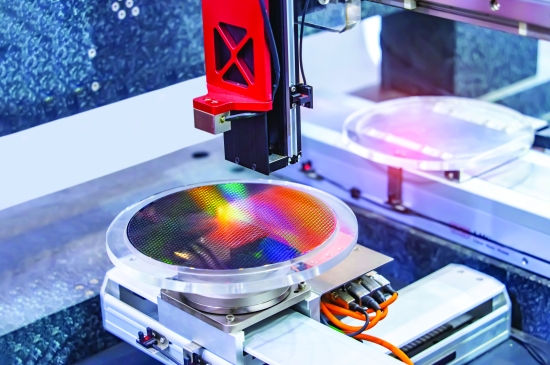
Nitrogen gas used in semiconductor manufacturing.
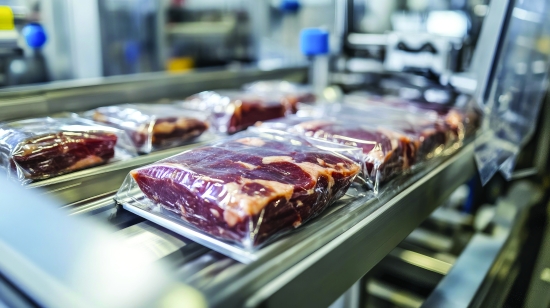
Food packaging using nitrogen gas.
Quality Considerations for Nitrogen Gas Purity Selection
Oxidation occurs when oxygen molecules bond to a substance and create a new substance. This new substance has a different molecular structure than the original substance. This change can have negative impacts upon a product or process.
Oxidation rates are specific to each substance and are determined by its reactivity to oxygen at a molecular level. The user of nitrogen must determine the maximum concentration of oxygen that will negatively impact their product or process. This is often related to the length of time that the product will be in storage and needs to resist oxidation to remain fresh. In the fresh cup of coffee example, if the coffee producer had packaged the beans at the appropriate nitrogen purity level – preventing oxidation over an extended period – the consumer would have a fresh and satisfying coffee experience. Some products or processes depend upon oxidation and simply cannot occur unless a specific concentration of oxygen exists. Combustion is such a process which requires fuel, oxygen and a heat source.
Unless the oxygen concentration is above the reaction threshold required for the specific fuel, no combustion will take place. Knowing the critical, allowable oxygen concentration for any process is required to determine the purity of nitrogen that the process needs. In summary, where product or process quality is concerned, there is no room for error when selecting a nitrogen purity level that avoids costly product spoilage or process contamination.
The Benefits of On-Site Nitrogen Gas Generation
Producing nitrogen locally is an excellent way to reduce nitrogen costs and ensure a continuous supply of nitrogen gas at the appropriate purity. The ideal nitrogen generation solution varies by application, based on the specific levels of nitrogen purity, flow, pressure and dryness that are required. Environmental factors such as air quality, humidity and temperature also affect the performance of the system. These variables significantly influence the selection of the complementary system components, such as air compressors, dryers and tank sizes. As a result, the best approach to generating nitrogen is always tailored to the customer and their unique application.
In most cases, it is recommended that the supplier of the nitrogen generation equipment works very closely with the end-user of the nitrogen gas. Exploring the requirements of the nitrogen gas purity, quantity, pressure and dryness with the user’s technical engineers ensures the nitrogen generation system is sized efficiently, and the product and/or process quality is stable.
Applying sound principles for system sizing and maintaining open communication with the user about nitrogen gas purity requirements are key to the successful implementation of nitrogen generation equipment.
About the Compressed Air and Gas Institute (CAGI)
The Compressed Air and Gas Institute (CAGI) is the united voice of the compressed air industry, serving as the unbiased authority on technical, educational, promotional and other matters that affect compressed air and gas equipment suppliers and their customers. CAGI educational resources include e-learning coursework, selection guides, videos and the Compressed Air & Gas Handbook. For more information, visit https://www.cagi.org.
To read more Nitrogen Generation Technology articles, visit https://www.airbestpractices.com/technology/air-treatment.
Visit our Webinar Archives to listen to expert presentations on Nitrogen Generation Technology at https://www.airbestpractices.com/webinars.