Inside the Smart Compressed Air Upgrade: Energy Transparency, ISO 50001 Reporting and 1.4 GWh Savings
In today’s manufacturing landscape, efficiency is no longer a silent virtue. It must be demonstrable, defensible and aligned with environmental responsibility. As environmental, social and governance (ESG) frameworks tighten and ISO 50001 standards become the norm, energy-intensive industries across the globe are under increasing scrutiny. Stakeholders, from regulators to investors, now demand proof that every kilowatt-hour is justified, every ton of CO2 is actively reduced and every operational process is traceable through data.
.png)
Egger’s factory in Rambervillers, France.
For Egger, a global leader in wood-based materials, this challenge converges on one of its most critical yet historically overlooked utilities. Compressed air may be the most critical utility you don’t see – essential to production, yet often under-monitored. As the de facto fourth utility in manufacturing, it drives everything from actuation to packaging. But unlike electricity or water, its consumption is rarely tracked with precision. Without dedicated instrumentation – including flow meters, pressure sensors and dew point probes – compressed air systems remain vulnerable to inefficiencies, hidden losses and missed savings opportunities.
Visibility isn’t a luxury anymore; it’s a baseline requirement for performance, compliance and control.
At Egger’s Rambervillers site in France, compressed air is not a peripheral service; it’s a production enabler. It drives high-precision cutting tools, supports finishing lines, powers pneumatic recycling systems and maintains packaging integrity across multiple zones. The compressed air system operates continuously, with 11 air compressors distributed across three zones and over seven dedicated rooms, each tailored to the plant’s evolving layout and air pressure demands.
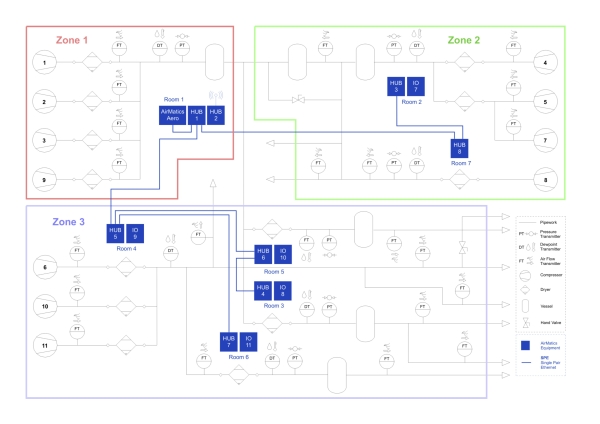
Egger’s Rambervillers plant includes 11 air compressors distributed across three zones and seven dedicated rooms. Click to enlarge.
Yet despite its centrality, compressed air had long remained in a black box – reliable but invisible. Legacy control systems provide automation, but not insight. Energy use was estimated, not measured. Performance was inferred, not verified. As Egger’s sustainability goals matured, this lack of visibility became a strategic liability. The company needed more than operational uptime. It needed an auditable infrastructure that could deliver real-time data, cross-departmental transparency and ESG-ready reporting.
That realization marked a turning point. Compressed air was no longer just a utility; it became a measurable asset, a source of competitive advantage and a cornerstone of Egger’s environmental accountability.
Eleven air compressors form the backbone of this compressed air system, all ranging in age, brand and control logic, but unified in purpose: delivering stable, high-quality compressed air to every corner of the Rambervillers facility. These machines aren’t just mechanical assets; they’re embedded in the rhythm of daily operations, powering cutting lines, finishing stations, recycling processes and packaging zones around the clock.
Each air compressor plays a distinct role in maintaining pressure stability across the plant’s multi-zone architecture. Whether responding to peak demand, stabilizing pressure across the network or distributing load cycles efficiently, each air compressor’s performance directly impacts energy consumption, product quality and overall system reliability. In a facility where compressed air is as vital as electricity or water, these 11 units represent more than infrastructure; they’re strategic instruments of efficiency, reliability and environmental accountability.
In 2024, Egger’s engineering team recognized that its current Metacentre XC control system, installed by CMC NV in 2010, no longer met modern expectations for transparency or ESG reporting. “We needed more than control,” said a member of Egger’s maintenance team. “We needed intelligence; a system that could tell us in real time how each air compressor performed and what that meant for our energy and ESG goals.”
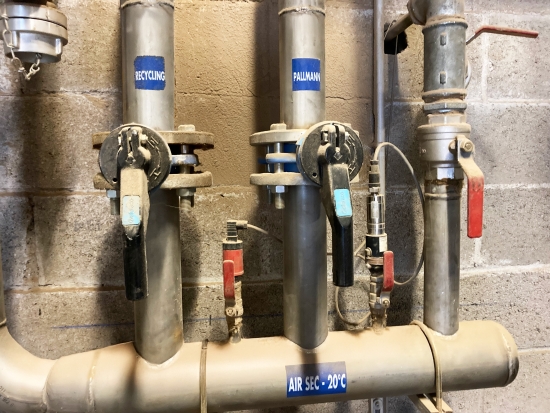
Instrumentation measures real-time moisture, dewpoint and pressure on a header pipe.
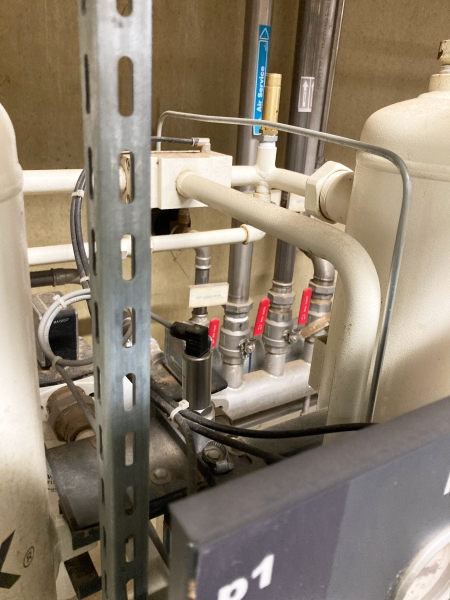
These dewpoint sensors are downstream of the compressed air dryers and filters.
Project Snapshot
|
Attribute |
Details |
|
System Integrator |
CMC NV |
|
Control Platform |
Airmatics AERO + Aircloud |
|
Legacy System |
Metacentre XC (installed 2010) |
|
Commissioning |
March–April 2025 |
|
Air Compressors |
11 |
|
Compressed Air Dryers |
13 |
|
Flow Meters |
22 |
|
Sensors |
6 dewpoint + 6 pressure transmitters |
|
Annual Energy Savings |
1,438,567 kWh |
|
Annual Cost Savings |
$166,500 USD |
|
COâ Reduction |
889 metric tons |
Information Reporting Needs for an Expanding Compressed Air System
The original Metacentre XC system delivered reliable automation, centralized sequencing, reduced idling and balanced load sharing across multiple air compressors. For years, it ensured a stable air supply at minimal energy cost. However, technology and expectations have advanced dramatically.
The system relied on localized data and manual reporting. Information existed but was difficult to share or analyze across departments. Maintenance teams exported readings manually, while energy teams reconciled data offline for monthly summaries. As Egger expanded and environmental accountability became a corporate imperative, limitations in visibility became a bottleneck.
“As our group pushed harder on sustainability and energy transparency, we realized our compressed air system needed to become more than an invisible utility; it had to become auditable infrastructure,” explained Pascal Labourdique, Energy Manager at Egger Aubervilliers.
By 2024, Egger’s production growth in France created a multi-zone compressed air system spanning three distinct areas—CONTI, FINITION, and MONO—each with its own air compressors, compressed air dryers and storage tanks. The compressed air system’s complexity had outgrown its legacy control platform. The hardware remained reliable, but the network lacked visibility, automation and integration.
CMC NV, Egger’s long-time service partner, conducted a site assessment in December 2024. The team cataloged air compressors, compressed air dryers, flow meters, and sensors across the facility, mapping the network topology in detail. Eleven air compressors, 13 compressed air dryers, 22 flow meters, five dew point sensors and multiple pressure transmitters were integrated into a working digital model.
Egger’s goals were clear: higher transparency, faster reporting, and deeper automation – without sacrificing reliability.
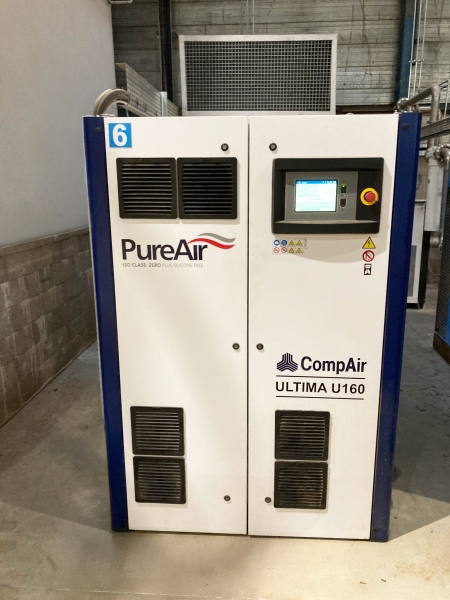
This oil-free rotary screw air compressor is instrumented for power and flow monitoring.
Selecting a More Robust Monitoring Platform
Airmatics, the next-generation platform from CMC NV, was chosen to bridge the gap between traditional industrial control and modern digital intelligence, delivering not just automation but actionable insight. In an environment where compressed air systems span multiple zones, brands and generations of equipment, Egger needed more than a controller. It needed a unified architecture capable of harvesting, analyzing and reporting performance data in real time.
Unlike legacy systems that rely on proprietary logic or siloed data, this platform is designed to be brand-agnostic and modular. It integrates four key components that together form a hybrid local/cloud ecosystem:
- AERO: An intelligent controller that sequences air compressors based on live demand, pressure stability and energy efficiency. It adapts to changing load profiles and supports predictive maintenance through runtime analytics.
- Fortress HUBs: These distributed communication nodes manage data flow within each air compressor room, ensuring resilience and low-latency connectivity. Each HUB operates semi-independently, maintaining local continuity even if the central link is interrupted.
- SmartTags: Field-level instrumentation that captures electrical and pneumatic data – amps, volts, flow, pressure, dew point and temperature – per air compressor and per phase. This enables granular tracking of asset performance, regardless of age or OEM.
- Aircloud: A secure cloud interface that delivers dashboards, alarms, ESG-ready reports and remote diagnostics. It allows maintenance, energy and sustainability teams to access the same verified dataset, streamlining collaboration and compliance.
Together, these components transform compressed air from a reactive utility into a proactive energy asset. This platform doesn’t just control air compressors; it contextualizes their performance, correlates energy use with production demand and generates traceable reports for ISO 50001 and ESG frameworks. For Egger, this meant real-time visibility, faster reporting and a scalable foundation for future optimization.
“We had a mix of air compressor brands, ages and controllers, but we needed a unified way to compare performance. The ability to measure flow and power per asset was a game-changer,” said Labourdique
The choice was also built on a 15-year partnership. “When it came time to upgrade, it was a no-brainer,” said an Egger maintenance engineer. “CMC NV knows our site and expectations. Moving from our old platform to this one with the same partner meant continuity, confidence and minimal disruption.”
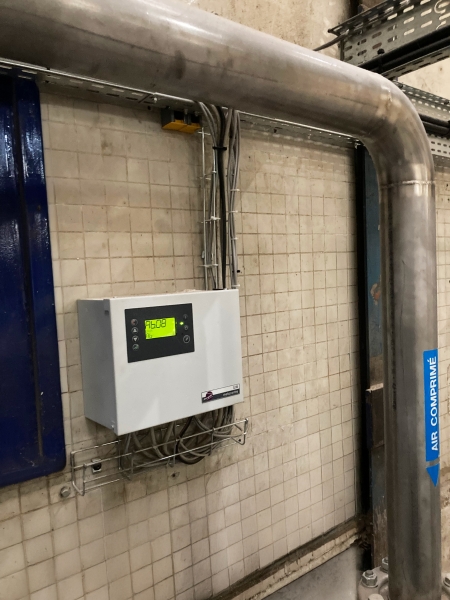
This wall-mounted Edge I/O hub device collects sensor data from nearby equipment and transmits it across Airmatics and Aircloud.
The Customer Journey from Assessment to Commissioning
The plant’s modernization project progressed in five phases:
Infrastructure Preparation: Fortress HUBs were installed across 3 zones and four air compressor rooms (Conti, Finition, Recyclage, Mono), connected through a secure single pair Ethernet (SPE) backbone for reliable, low-latency data. “By reusing Egger’s existing two-wire serial-bus network and upgrading it with SPE T1L adaptors, we achieved Ethernet-grade connectivity without rewiring,” said Tibo Verbeken, Engineer, CMC NV.
Air Compressor Integration: Eleven CompAir air compressors (including D132 and Ultima 160 models) were instrumented with SmartTAGs and MODBUS gateways to enable phase-level electrical data and pneumatic readings. “Deploying SmartTAGs where logic was unavailable meant we never had to force the lowest common denominator. We could pull real data from every air compressor,” Verbeken said.
Data Validation and Configuration: Flow meters were calibrated, communication links tested and naming conventions standardized. Dew point and pressure sensors were verified against live readings to ensure accuracy.
AERO & Aircloud Setup: Local interfaces provide live data per room, while the Aircloud dashboard unified all zones for centralized reporting, alarms and performance visualization.
Training and Handover: On April 3, 2025, CMC NV delivered hands-on training for Egger’s staff on dashboards, maintenance tools and alarm management. “Egger’s team was fully engaged,” said Verbeken. “Together, we ensured the data wasn’t just available, it was meaningful.”
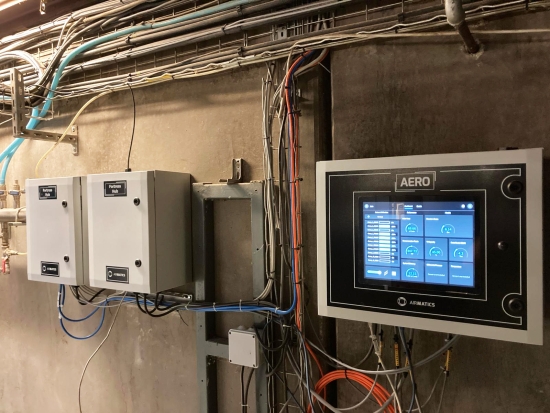
This controller is the heart of the monitoring network. Its 12-inch color display offers full system visibility in real time.
Technical Transformation: Understanding the Zones
Like many established plants, Egger’s compressed air system has evolved over the decades. Each zone was originally added to address local pressure issues, a practical solution that later introduced inefficiencies. The platform doesn’t erase this physical structure; it manages it.
With pressure sensors across every header, the compressed air system continuously balances supply and demand. “We didn’t add zones to waste energy – we inherited them. What the platform gives us is the ability to balance those zones intelligently, not just reactively,” Labourdique said.
The platform collects data from every relevant parameter: amps, volts, flow, pressure, temperature and dew point. By doing this, it provides a full operational fingerprint. The result is verified, time-stamped data ready for ISO 50001 and ESG reporting.
Each Fortress HUB maintains data continuity locally, ensuring resilience if cloud connectivity is lost. This hybrid local-cloud model provides both industrial reliability and enterprise-level visibility.
An Annual Energy Reduction Of 1,438,567 kWh and \$166,500
Before Airmatics, Egger’s compressed air data landscape was fragmented and reactive. Maintenance teams relied on manual logs and visual inspections to estimate runtime, often basing service intervals on calendar schedules rather than actual load cycles. Sustainability reporting was a separate challenge altogether, requiring manual reconciliation of spreadsheets, controller readouts and third-party audits to approximate CO2 impact.
This siloed approach not only consumed time, but also introduced risk. Without unified, real-time data, teams couldn’t confidently correlate air compressor performance with energy use, nor could they detect efficiency drift before it impacted cost or compliance. Decisions were delayed, maintenance was reactive and ESG reporting lacked the traceability increasingly demanded by auditors and stakeholders.
Today, with the new platform fully deployed, Egger operates from a single, verified dataset. Maintenance teams now schedule interventions based on actual runtime and load hours, using automated alerts and service timers embedded in the controller. Energy managers monitor live power draw, flow rates and pressure stability across all air compressors and zones, enabling proactive adjustments and continuous optimization. Sustainability coordinators can export verified kWh and CO2 data directly, with traceable time stamps and zone-level breakdowns ready for ISO 50001 and ESG submissions.
“Everyone now works from one version of the truth,” said an Egger energy coordinator. “We don’t debate data; we act on it.”
This shift from fragmented oversight to unified intelligence has transformed compressed air from a background utility into a strategic asset, one that supports operational uptime, environmental accountability and cross-team collaboration.
The results were immediate, measurable and strategically significant. Within months of commissioning the new system, Egger Rambervillers recorded verified performance improvements that exceeded initial projections. Post-installation audits confirmed an annual energy reduction of 1,438,567 kWh, translating to \$166,500 USD and a CO2 reduction of 889 metric tons – figures that now underpin Egger’s internal sustainability reporting and external ESG disclosures.
“We were confident savings would follow,” Labourdique said. “But to see a 1.4 GWh reduction and nearly 900 tons of CO2 cut – that gave us real proof.”
These gains weren’t the result of a single intervention; they stemmed from a layered optimization strategy enabled by the platform’s intelligent control architecture. The system’s adaptive sequencing algorithm continuously evaluates air compressor performance, aligning machine loading with real-time demand across multiple zones. This prevents over-cycling, reduces idle energy and distributes runtime more evenly, extending asset life and improving service planning.
Pressure-band optimization played a critical role. With sensors installed across headers and receivers, the platform maintains pressure stability within ±0.2 bar, a level of control that not only improves energy efficiency but also protects downstream processes from variability. Flow meters and SmartTags provide granular visibility into both supply and demand-side dynamics, allowing Egger’s team to identify inefficiencies, adjust operating parameters and validate improvements with hard data.
Machine use has also improved. Predictive alerts and automated service timers now guide maintenance interventions based on actual load hours, not calendar estimates. This shift from reactive to proactive servicing has reduced unplanned downtime and helped balance wear across the compressed air fleet.
Together, these enhancements have transformed Egger’s compressed air system from a reactive utility into a proactive energy asset, one that delivers operational reliability, environmental accountability and financial return.
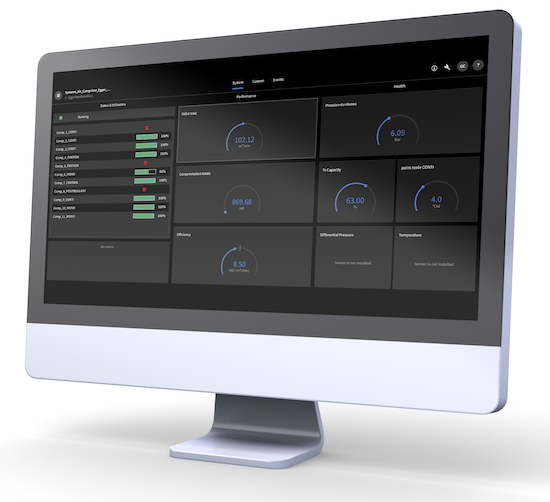
A dashboard view provides real-time system performance, efficiency and health metrics through a unified monitoring interface.
Compressed Air System Data Integrity and Smart Reporting
Airmatics automates KPI generation and reporting. It can filter results by air compressor, zone,or time period, automatically generating ESG-ready datasets. For ISO 50001 and sustainability audits, this means verifiable, auditable performance data without manual reconciliation.
Before, energy reporting was a monthly chore. Now, it’s instantaneous, consistent and traceable. Each kWh, cubic meter of air and hour of runtime is captured, time-stamped and contextualized.
A key strength of Egger’s installation is its distributed architecture. Each Fortress HUB operates semi-independently to ensure data continuity if a network segment fails. All devices operate on protected 100-240 VAC circuits with surge suppression, guaranteeing stability.
During commissioning, minor issues such as defective fuses were identified and corrected. After they were resolved, communications stabilized fully across all nodes and controllers. The final configuration achieved both data precision and network reliability, verified through real-time comparisons with plant sensors.
The platform transformed not only Egger’s technology but also its organizational workflow. Previously, maintenance and energy departments maintained separate datasets. Today, maintenance, operations and management all work from shared dashboards:
- View air compressor performance trends.
- Track power draw, flow and pressure stability.
- Plan maintenance using actual runtime and load cycles.
- Generate ESG-compliant reports instantly.
“Compressed air used to be invisible,” said a site manager. “Now it’s transparent and strategically managed.”
Commissioning logs from CMC NV show meticulous calibration and validation, verifying flow ranges, adjusting Modbus registers, fine-tuning I/O mapping and aligning digital readings with sensor reality.
“Once configured correctly, pressure balancing worked seamlessly,” said Nils Spileers, Project and Support Manager, CMC NV, part of the commissioning team. “It’s an adaptive system that learns the plant’s behavior.”
Intelligent Compressed Air System ManagementRising energy costs, tighter environmental targets and demands for real-time transparency are reshaping compressed air management. Airmatics bridges traditional control and modern data-driven energy management: real-time insights, automated reporting and advanced control logic that help manufacturers improve efficiency, reduce waste,and meet ESG/ISO 50001 requirements from one platform. At the core, AERO manages sequencing, load distribution and pressure stability. Fortress HUBs and SmartTags collect precise electrical and pneumatic data across air compressors, compressed air dryers and peripherals. The system monitors flow, pressure, dew point, temperature, amps and volts per air compressor and per phase. Through Aircloud, users visualize performance in real-time. Dynamic dashboards present energy consumption, load/unload cycles, pressure stability and flow efficiency as actionable insights. Teams can drill from system views to individual machines to identify inefficiencies before they become problems, schedule maintenance by actual run hours and balance load to extend equipment life. The platform logs time-stamped, traceable energy and environmental data supporting ISO 50001 and corporate ESG reporting. Managers can auto-generate reports for:
Each Fortress HUB maintains data continuity locally. The system supports LAN and cloud, providing redundancy and flexibility for multi-site operations. Industrial-grade power and communications standards ensure stable operation. Firmware updates and remote diagnostics enhance uptime. Whether a site runs two air compressors or 20, the platform expands without major rewiring. New assets connect via plug-and-play, allowing the platform to evolve with production and sustainability targets. Operators maintain pressure stability and respond to alarms faster. Maintenance plans interventions based on usage. Energy managers get verified data for audits. Executives and ESG leaders see plant-level summaries across facilities. Compressed air becomes measurable, manageable, reportable and strategically important. |
Industrial Sustainability through Technology
Egger’s deployment exemplifies how digitalization drives environmental performance. By reducing waste, balancing load and improving reporting accuracy, the company directly supports its corporate ESG and carbon reduction goals.
The platform allows Egger to track the CO2 intensity of every cubic meter of air, providing the transparency required for external verification and internal optimization. Sustainability is now built into the system, not added on afterward.
Egger’s partnership with CMC NV spans nearly two decades. The 2010 installation was state-of-the-art at its time; the 2025 upgrade builds upon that foundation, bringing intelligence to proven infrastructure.
“The site is now benefiting from pressure-balance and zone-control features,” said Stéphane Martins, Business Development Manager, CMC NV. “It’s a clear example of innovation building on a solid base.”
The platform is modular and scalable. As Egger continues to evolve, new air compressors, sensors or analytics can be integrated without major rewiring. The platform’s architecture supports remote diagnostics, firmware updates and predictive maintenance tools powered by AI. This ensures Egger’s compressed air management remains aligned with future sustainability targets and corporate digitalization initiatives.
Data-Driven Efficiency for the ESG Age
Egger’s journey from Metacentre to Airmatics reflects a broader transformation in industrial energy management, from control to clarity, and from automation to accountability.
Through digital monitoring, real-time data and verified reporting, the company has turned compressed air from a hidden cost into a measurable performance asset. The results speak for themselves:
- 1.43 GWh annual energy savings
- \$166,500 cost reduction
- 889 metric tons of CO2 avoided annually
- Real-time transparency across all zones
Egger Rambervillers demonstrates that sustainability, transparency and operational excellence are not competing priorities. They are inseparable pillars of modern manufacturing.
In an era where the smartest factories are also the most accountable, the platform has given Egger not just control over its air but confidence in its data.
About the Author

Graham Coats is Director of Strategic Product and Business Development and SCADAR Product Line Management. He specialises in transforming fragmented air compressor systems into efficient, accountable, and data-driven networks. With global experience across the U.K., Europe, the U.S., and APAC, Graham unifies mixed-brand technologies across SCADAR, Metacentre Core and Airmatics while maintaining independence from OEM bias. Known for turning engineering innovation into measurable P&L results, he champions the principle that energy is the hidden P&L, making every kilowatt-hour visible, controllable and accountable.
To read more Air Compressor Controls articles, visit https://www.airbestpractices.com/system-assessments/compressor-controls.
For expert presentations on Air Compressor Controls visit our webinar archive section at https://www.airbestpractices.com/webinars.