Compressed air systems are one of the most chronically undervalued components of manufacturing operations. These systems are expected to run quietly in the background, constantly relied upon but rarely focused on, when, in fact, they are among the most important pieces of equipment in any industrial setting. Without proper preventive maintenance and repair practices, issues with compressed air systems – problems as small as clogged filters, cracked piping or inadequate cooling systems – can quickly progress from a minor inconvenience to a major complication, requiring unplanned system downtime and pauses in production, not to mention costly repairs.
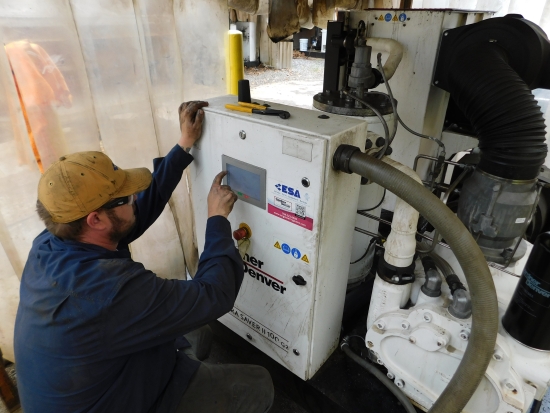
A technician reviews the controller configuration of an oil-flooded, rotary screw air compressor, verifying system parameters and operational settings as part of a comprehensive service inspection.
Compressed air system issues often develop gradually and quietly, making them difficult to detect during normal operations until a deeper inspection is conducted. For instance, an intake filter that appears clean may still contain embedded particulates restricting airflow and gradually impacting system performance. A saturated oil separator may allow a small amount of oil carryover, which may seem insignificant initially but continues to affect system performance. Malfunctioning pressure transducers are a common problem with air compressors – typically signaled by overheating, unexpected machine shutdown and failure to start up – and can cause an otherwise functional air compressor to go offline, forcing other units to work harder to manage the production load. Even something as small as a cracked oil cooler can leak slowly and steadily before thermal stress eventually exacerbates the damage.
Some commonly overlooked but important components include minimum pressure valves (MPVs) and condensate drains. These parts experience significant wear and tear and are not always prioritized in preventive maintenance plans. When MPVs fail, repairs can be costly and may require machine downtime. Issues with condensate drains can lead to water buildup within tanks, housings and piping.
Keeping an eye out for all of these potential issues is what makes preventive maintenance more than a task to be checked off a list; it is a strict discipline that requires looking beyond the obvious to identify and maintain the integrity of machinery and address developing risks before they impact production.
This reality becomes even more apparent in recent service work completed for J.C. Steele & Sons and a particular packaging manufacturer in North Carolina. In both instances, standard preventive maintenance practices helped discover problems before they escalated. Both companies had systems functioning properly under normal production requirements. They had not neglected their systems. Yet, both companies had minor development issues that hadn’t yet affected system performance but could have become larger problems over time. These case studies show how routine preventive maintenance helps prevent not only system breakdowns but also unintended consequences.
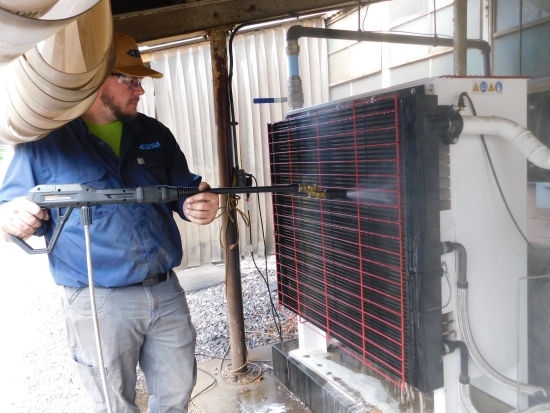
A technician pressure washes the heat exchanger on an oil-flooded, rotary screw air compressor.
What Preventive Maintenance Really Means in Compressed Air Systems
In most manufacturing applications, preventive maintenance takes the form of a predictable process. For example, on rotary screw air compressors, maintenance tasks typically run as follows: Change oil, replace oil filter/separator, replace air filter, log the machine’s hours and your air compressor is back up and running. These tasks are essential to maintaining air compressor efficiency and lifespan, but effective preventive maintenance also includes evaluating system performance and identifying early indicators of potential issues. The other vital part of preventive maintenance involves looking beyond routine maintenance of your system to identify potential issues before they become operational risks.
Compressed air systems are more than just simple pieces of machinery – they are entire ecosystems of their own, with each piece and part having an integral impact on one another. Techs have to take a step back and look at the big picture when evaluating a compressed air system. They must examine the system both when running and when shut down, searching for issues such as oil leaks, wear and any sounds that may indicate a problem. Looking at the system as a whole helps identify areas that may need to be addressed. While an intake restriction may seem to affect only the airflow rate within the air compressor, in truth, it influences much more: increasing vacuum load, elevating discharge temperature and placing stress on the oil circuit. The elevated discharge temperature affects oil viscosity, compromising lubrication within the airend of the air compressor. Eventually, bearing wear within the air compressor increases, as does oil carryover. Before long, what started as a simple air intake issue can shorten the lifespan of the most costly component of the entire compressed air system.
Upon entering the room where an air compressor is housed, ensure the machinery is the right size, the filtration is appropriate, the drains work properly and the oil/water separators are in good condition. By looking at the entire flow from initial compression to end-product use, areas for improvement can be identified.
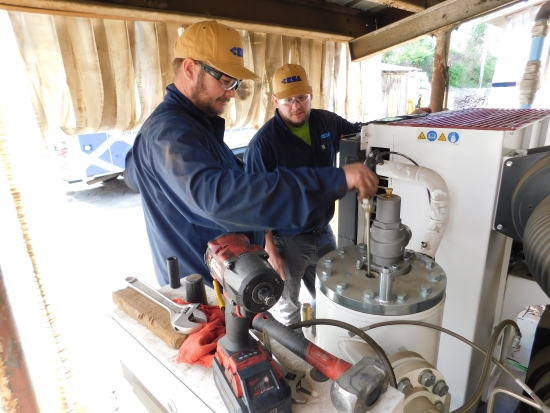
A technician performs an oil separator element changeout on an oil-flooded, rotary screw air compressor as part of a scheduled preventive maintenance service.
The Most Expensive System Failures Begin Quietly
Intake Filtration: While the filter may look clean, as though it does not yet require replacement, small embedded particulates likely remain, restricting media flow and allowing contaminants and other particles to pass through the filtration system, increasing wear and tear on your air compressor and raising system temperature. Filtration issues are commonly detected through increased air temperature, flow restrictions and overall performance issues.
Oil Separators: The presence of a faint mist at discharge may be easy to dismiss initially, but this mist is actually the first sign of oil carryover from an air compressor’s oil separator. Left unresolved, that small amount of mist soon becomes measurable loss, eventually leading to oil separators collapsing, sending contaminants downstream and resulting in emergency system shutdowns.
Cooling Systems: Hairline cracks or seal failures within oil cooling systems may appear minor at first glance, but can lead to major issues down the line. Leaks can rapidly cause heat to build up in your compressed air system, leading to the entire machine overheating.
Control Systems: Even a simple failure can result in machine lockouts or mismanaged loading and unloading cycles, often shifting stress to other machines in the system.
While scheduled maintenance is important, preventive maintenance is most effective when it also includes careful inspection of system performance and trend analysis. Preventive maintenance requires trained technicians to investigate, identify patterns, recognize anomalies and correctly interpret the information a compressed air system provides.
One important consideration is the possibility of counterintuitive outcomes. For example, adding oil to an air compressor running hot without determining whether or not oil is truly the cause of the problem opens the potential for oil carryover, which can saturate separators and degrade downstream product quality. These types of reactive fixes can exacerbate the problem rather than improve it.
Environmental issues can also be the root cause of air compressor problems. Issues such as high humidity and temperature fluctuations can cause components to wear out faster, degrade system lubrication and trigger high-temperature shutdowns. Low temperatures can cause condensate to freeze in pipes and system components.
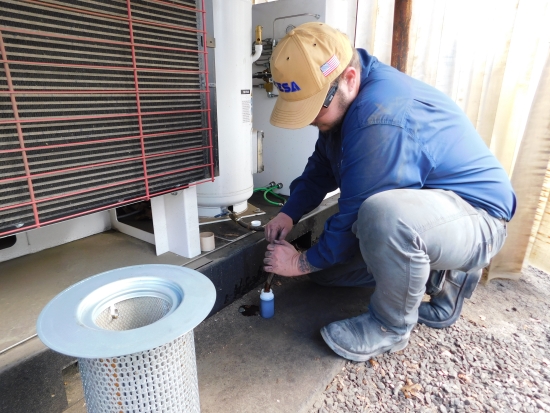
A technician takes an oil sample for lab analysis, a proactive diagnostic measure used to monitor lubricant condition, detect early-stage wear and extend air compressor service life.
How Often Should an Industrial Air Compressor Be Serviced?There is no cut-and-dried rule for how often an industrial air compressor needs to be serviced. Developing a routine maintenance plan is vital to the success of any manufacturing application, but the specific requirements of a given application depend on several variables, including:
General guidelines can help determine the right maintenance tasks and the frequency of service an application requires:
While these are good guidelines for your preventive maintenance schedule, remember each system and application has different requirements. Tailor your maintenance schedule to your needs. |
J.C. Steele & Sons: Prevention in a High-Demand System
Compressed air systems are rarely an optional luxury in manufacturing applications. The need for compressed air is integral to the manufacturer’s overall success, so if air compressors aren’t operating at peak efficiency, the facility as a whole is operating below ideal levels. For J.C. Steele & Sons, a readily available source of compressed air is required to maintain a reliable level of output for clients. The facility relies on several rotary screw air compressors, all operating in sequence, to meet high-demand production requirements. If one air compressor goes down, the outage impacts the entire production system, straining the remaining air compressors, increasing the potential for cascading failures within the application and accelerating wear on the still-working parts of the system.
The company was in no way neglecting its compressed air system; quite the opposite. Preventive maintenance was already part of the facility's procedures, and machines were serviced at appropriate intervals. There was no catastrophic breakdown. Instead, routine service helped expose issues as they developed, before they became notable enough to trigger alarms or cause system shutdowns.
This example illustrates the value of identifying issues while the compressed air system is still operating normally – not in response to emergencies.
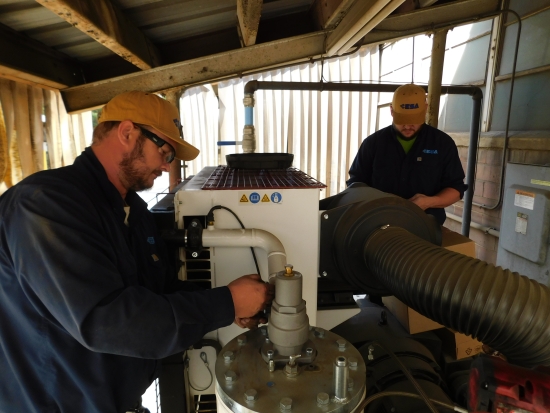
A technician performs a scheduled preventive maintenance service on an oil-flooded, rotary screw air compressor at J.C. Steele & Sons.
Discovering a Cracked Oil Cooler During Maintenance
During a routine maintenance inspection, a crack along the top of an oil cooler was identified. The crack hadn’t yet caused any problems, but could quickly develop into a serious issue. The key factor allowing technicians to detect these issues is experience. When techs know what to look for, they can trace problems to their source, sometimes even identifying potential issues before they occur.
In a rotary screw air compressor, oil coolers are subject to harsh operating conditions. They constantly experience thermal changes as the air compressor loads and unloads. Pair those changes with consistent vibration from the air compressor frame, and small cracks can easily expand into larger issues. In this instance, inspection of the oil cooler revealed a small crack just beginning to form, compromising the air compressor’s integrity.
When the issue was discovered, oil loss had not yet occurred. However, if the crack had gone undetected, the oil cooler could have failed, resulting in oil loss and potentially compromising system lubrication and heat dissipation. While some cooler damage can be addressed through localized repair or welding, in this case, the damage required the replacement of the cooler assembly.
Because the problem was identified before it could cause a larger issue, the repair could be scheduled at a time that wouldn’t negatively affect the facility’s production capabilities, rather than requiring a system shutdown and unscheduled downtime.

A technician records air compressor performance data into field service management software, ensuring accurate documentation and service history tracking for the customer’s equipment.
Pressure Transducer Failure and Potential Unknown Shutdown
On another service visit, technicians came upon a different type of issue, this one within an air compressor’s control system. One of the air compressors in use shut down, and the failure was traced to a pressure transducer.
Pressure transducers provide real-time information on pressure levels within the compressed air system. When a transducer fails, the system controller can no longer properly interpret the system's conditions. Many systems have an auto-lock feature to lock down the air compressor as a protective measure in situations like these. From the operator's perspective, the air compressor seemed to stop without warning, even though it was still mechanically sound.
In this instance, the transducer failure caused the air compressor to go completely offline. Replacing the part became more complex due to delays in the original supplier's product availability. To minimize downtime, technicians sourced a compatible part locally and restored the air compressor to service.
The repair itself was straightforward, but the implications of the issue were clear: Without the air compressor in question operating, the other air compressors needed to work overtime to compensate for the load increase. Operating under heightened demand can increase wear on the other air compressors, raising the risk of secondary issues. By identifying and addressing the root cause of the air compressor shutdown, the problem was quickly resolved, and the risk to the rest of the compressed air system was mitigated.
Identifying Vulnerabilities at a Package Manufacturing Company
Compressed air quality and stability are top concerns for air compressor systems at a major manufacturer of flexible and specialty packaging in North Carolina. Compressed air is more integral to the printing and packaging sectors than many realize. Even small instabilities in airflow or quality can significantly affect end-of-the-line products, leading to print inconsistencies, bonding issues or web-handling problems resulting in scrap. System shutdowns, even short ones, result in significant product loss, so this packaging manufacturer’s maintenance strategy focused on preserving compressed air quality and system stability rather than reacting to visible wear. Issues such as decreases in air pressure can negatively affect a host of system components, including printers, workstations, conveyors and lasers, while impurities in the air itself can block nozzles or leave streaks or a sheen on printed surfaces.
The initial assessment of the facility showed the air compressors received regular maintenance services, though some key findings spoke to potential risks:
- Differential pressure across coalescing filters was heightened.
- The dew point reliability of their desiccant compressed air dryers was declining.
- Cooling components in the air compressors showed signs of degradation.
- Control sequences between air compressors could be optimized.
While these issues did not pose an immediate risk to the system, they could if left unaddressed.
The maintenance approach focused on evaluating the compressed air system as a whole rather than only the air compressor’s internal components. Filters found to be nearing their efficiency limits were replaced, preserving compressed air purity and limiting strain on the compressed air system. To ensure dew point control, desiccant condition and purge function were evaluated, and regeneration cycles were assessed and altered to match real-world conditions. Heat exchangers were properly inspected and cleaned, and air compressor staging was investigated and adjusted to meet system requirements.
The assessment at this packaging company also took tank sizing and air handling into consideration, ensuring proper wet/dry tank configuration and that the compressed air dryers used were appropriately sized for system demand. Improving air handling and storage can reduce or even eliminate the need for larger air compressors.
The Bottom Line
The significance for this packaging company lies in the shift in perspective required for air compressor system maintenance. Instead of being viewed as tasks to be completed at set intervals, maintenance services were seen as crucial for the integrity of the production process. Early intervention and problem-solving before issues arose allowed technicians to keep this client’s application running smoothly.
Preventive maintenance is seldom newsworthy inside manufacturing facilities. By design, preventive maintenance should be a non-event. Production keeps running, shifts continue to change, trucks are reloaded and unloaded and work goes on. The experiences at J.C. Steele & Sons and this packaging manufacturer show the reliability of a compressed air system cannot always be achieved by following a schedule. Instead, it’s the result of focus, attention and discipline: paying attention to variables, detecting patterns and knowing when something seems amiss. Looking deeper into system performance turns routine maintenance into a strategic tool for improving reliability and production stability.
Engineering Sales Associates
The story of Engineering Sales Associates (ESA) began in 1961, when founders Arthur Pue Sr. and Addison Bell were employed by McDonnell Douglas. They were disappointed by the compressed air support they received as manufacturers. When equipment encountered issues, it was up to them to figure out how to get things in working order as quickly as possible or face being held responsible for downtime. The two decided change needed to start with them: They created their own company to support manufacturers by offering industrial maintenance services. Over 60 years later, ESA is a thriving, veteran-owned, family business providing essential services for industrial applications in the Carolinas. The company works closely with clients to provide the highest level of service possible. Technicians collaborate with customers to find solutions to best fit each scenario. Building trust with clients is one of the company’s main goals. Technicians never try to upsell customers or sell parts or equipment that aren’t the right fit for an application. The company provides air compressors, air filters, compressed air dryers and air compressor parts and accessories from leading suppliers and major brands. It offers routine and emergency maintenance services. For more than six decades, ESA has remained committed to the same mission it was founded on: Supporting manufacturers with dependable service, honest solutions and lasting partnerships. For more information, visit https://engineeringsales.com. |

About the Author

Arthur Pue is the second-generation owner of Engineering Sales Associates. He grew up in the business, spending summers sweeping warehouse floors. Today, he enjoys serving strategic customers in high-impact industries and essential infrastructure, helping them produce critical products for the American economy. Before running ESA, Pue served in the U.S. Army Special Operations. An avid runner, he is currently training for a rim-to-rim hike of the Grand Canyon.
To read more Compressed Air System Assessment articles, visit https://www.airbestpractices.com/system-assessments.
Visit our Webinar Archives to listen to expert presentations on Compressed Air System Assessments at https://www.airbestpractices.com/webinars.