A multinational cabinet manufacturing company with a production plant in Manitoba, Canada, recognized as one of the largest energy consumers in the province by the local utility, looked for ways to improve its compressed air system efficiency, reduce energy consumption and lower greenhouse gas emissions to align with its sustainability goals. Understanding the social, economic and environmental impact of its operations, the company committed to embracing a more sustainable approach to its production processes.
The plant’s compressed air system consisted of multiple air compressors from different manufacturers, with capacities ranging from 100 to 250-horsepower (hp), for a total system capacity of around 1,100-hp. The plant’s average compressed air demand was 2,300 cfm, with peaks reaching 3,500 cfm. System pressure fluctuated between 105 and 110 psi (7.2-7.6 bar).
The system included three refrigerated compressed air dryers, a variety of filtration units including mist eliminators, particulate filters and coalescing filters, plus various styles of condensate drains. These components removed moisture and contaminants from the system, maintaining the required air quality of 1:4:2 as per ISO 8573-1 for the plant’s diverse application processes.
The compressed air system included three compressed air dry tanks, offering a total compressed air storage capacity of 2,000 gallons, along with a pressure/flow controller to ensure reliable and stable operation throughout the compressed air system.
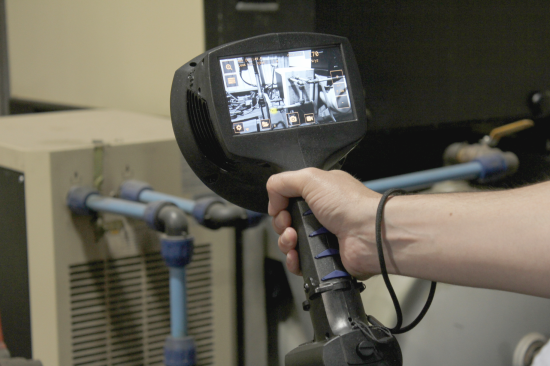
Air Unlimited used a UE Systems UVLP acoustic camera to conduct its inspection.
A Detailed Compressed Air System Assessment
In August 2023, the plant worked with Air Unlimited, the local manufacturer’s representative, when one of its largest air compressors failed. Upon arriving at the site, the service manager discovered the failure was caused by an electrical power supply fault rather than a mechanical or internal electrical failure in the air compressor itself. Working with the company’s maintenance team, the service manager restored the air compressor to full operation.
Following this successful service, the company’s maintenance supervisor reached out to Air Unlimited again. He wanted to explore opportunities for improving the compressed air system’s efficiency, reducing air compressor use where possible and lowering energy consumption.
Air Unlimited conducted a system assessment in November 2023, to identify the primary sources of energy consumption. The assessment showed targeting compressed air leaks would be an ideal starting point due to the number of leaks observed during the walkthrough. This aligned with the cabinet manufacturer’s sustainability goals by enhancing system performance, lowering costs and setting the stage for further energy-saving measures.
During the leak detection service, conducted over multiple days in September and October 2024, Air Unlimited collected data using a UE Systems UVLP industrial acoustic imaging camera. The process was supported by a maintenance team member who was familiar with the plant layout and would be responsible for repairing the identified leaks. The scanning process began in the air compressor room and continued throughout the facility, following all compressed air lines across the various departments.
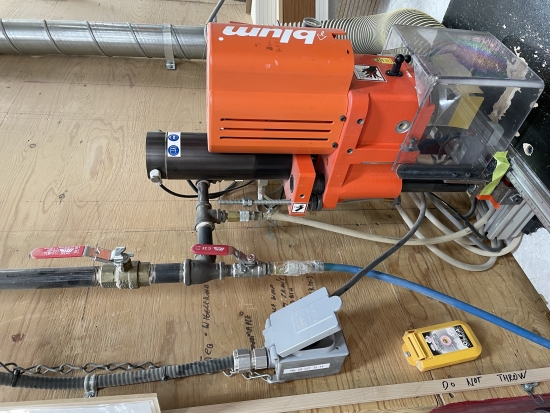
Before working with Air Unlimited, the cabinet maker wrapped this compressed air leak in clear tape.
358 Leaks Discovered
The greatest number of leaks were identified in the painting, finishing and polishing areas, as well as the assembly lines where most of the pneumatic tools were located. These areas included numerous compressed air hoses and connection points. Leaks were found at couplings, old and poorly maintained hoses with small holes, fittings, quick disconnects and the flexible tubing connecting pipe drops to point-of-use applications, a common problem area.
In production areas with automated machines (rather than pneumatic tools), most leaks were at pipe and hose joints, as well as FRLs (filters, regulators and lubricators).
In the air compressor room, leaks were observed in condensate traps, flanges and thread sealants. It is uncommon to find significant leaks in the air compressor room, as these typically involve substantial airflow and are noticed immediately.
Several factors contributed to the great number of compressed air leaks found in the plant: employees not reporting compressed air leaks to the maintenance department, compressed air leaks in loud areas where they were difficult to hear and compressed air leaks in isolated areas with minimal staff traffic or supervision. Additionally, the maintenance department did not prioritize compressed air leak repair so known compressed air leaks went unaddressed. Air Unlimited documented and tagged each compressed air leak, ensuring precise reporting and an organized repair process.
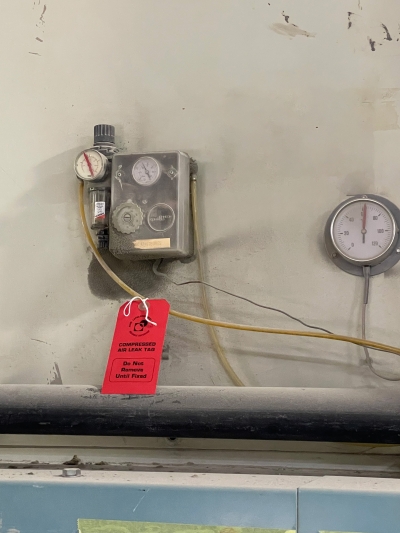
This compressed air leak on the cabinet maker’s production line was identified and tagged.
To assess the financial impact of the leaks and create a comprehensive evaluation of energy savings, Air Unlimited requested the plant’s electrical rates. It analyzed collected data to assess the impact of compressed air leaks on both energy consumption and emissions. The results were striking: It identified a total of 358 leaks for a loss of 750.8 cfm. This compressed air loss represented approximately \$40,520 in annual energy savings in U.S. dollars. To put this into perspective, the volume of air lost matched the output of a 150-hp air compressor. Manitoba benefits from one of the lowest electricity rates in North America, with an average cost of \$0.03 per kWh in U.S. dollars. This favorable rate influences energy savings calculations for industrial facilities.
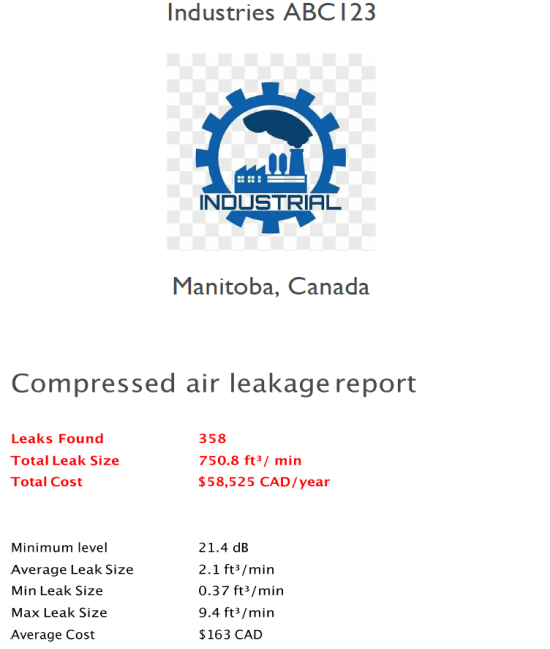
Air Unlimited provided the cabinet manufacturer with a report detailing its findings.
Persuaded by the quick and substantial return on investment associated with repairs, the cabinet manufacturer committed to addressing its compressed air leaks quickly. Repairing compressed air leaks has a low upfront cost with immediate benefits in compressed air flow, energy reduction and system efficiency.
Compressed Air Leaks Were Only the Beginning
During the compressed air leak detection, Air Unlimited identified additional compressed air system inefficiencies. These included:
- Pressure set points on some air compressors were identical. Therefore, more than one air compressor loaded and unloaded at the same time leading to a fight for control and short cycling.
- Air compressors were set for higher pressure than was needed to compensate for compressed air system losses. Reducing the output pressure on air compressors leads to a reduction in overall power consumption. For every two psi decrease in discharge pressure, energy consumption decreases by 1%.
- The plant’s compressed air system piping didn’t include a full loop, which would optimize air flow and improve pressure stability. The compressed air system piping included several sharp angles and elbows, slowing air flow and reducing pressure. The compressed air piping system also lacked drip legs for reducing moisture content.
- Inappropriate compressed air uses included open blowing, cabinet cooling, personnel cooling and vacuum venturis.
These issues lead to a rise in energy costs and a lowering of operational efficiency. They will be evaluated in an upcoming comprehensive compressed air audit in spring 2025. This audit will provide deeper insights into each area, guiding targeted improvements to enhance system performance and lowering long-term costs.
Best Practices for Compressed Air System Efficiency
Air Unlimited provided the client with the following compressed air best practices to ensure lasting efficiency and sustainability:
- Inspect workstations and encourage operators to report any compressed air leaks or fluctuations in system pressure. This helps detect new compressed air leaks early, preventing them from going unnoticed.
- Follow manufacturers’ maintenance schedules. Routine checks and maintenance will help ensure compressed air equipment operates at peak levels, minimizing unplanned downtime and improving system efficiency.
- Provide comprehensive training to the maintenance team on best practices for compressed air systems, ensuring they have the skills to operate, maintain and troubleshoot the compressed air system. Gaps in training included knowledge of air compressor controls and coordination strategies, evaluating compressed air use throughout the facility to identify and address inefficient or inappropriate uses and adhering to manufacturer maintenance guidelines for all compressed air system components. Establish a detailed maintenance plan that involves all team members to enhance compressed air system reliability and efficiency.
- Track and report key performance indicators. Many components and operating parameters within the compressed air system were unmonitored. Implementing continuous compressed air system monitoring with alarms and detailed reporting allows staff to track essential metrics such as equipment running hours, compressed air system pressure, power consumption, airflow, air and equipment temperature, relative humidity, dew point and system efficiency. Consistent tracking and reporting help plants verify energy savings and emissions reductions, helping assess improvements and marking progress toward sustainability goals.
Taking proactive measures will help the plant maintain operational efficiency, reduce energy consumption and continue progress in its sustainability objectives.

Juan Londono.
About the Author
Juan Londono is an Applications Engineer at Air Unlimited Inc., with over seven years of experience in engineering, project management, compressed air systems and nitrogen generation. His areas of expertise include designing compressed air systems and nitrogen generation solutions and conducting comprehensive compressed air audits. His proficiency in both engineering and project management allows him to oversee projects from conception to execution.
About Air Unlimited
Air Unlimited Inc. has been a leader in the compressed air systems and building power solutions industry for over 50 years, providing sales and services to clients in Manitoba, Saskatchewan and Northwestern Ontario. It offers 24/7 certified technicians, installation capabilities, compressed air audits and energy conservation studies, preventative maintenance programs and electric and diesel rental options. For more information, visit https://www.airunlimited.ca.
To read more Compressed Air Leak System Assessment articles, visit https://www.airbestpractices.com/system-assessments/leaks.
Visit our Webinar Archives to listen to expert presentations on Compressed Air Leak System Assessments at https://www.airbestpractices.com/webinars.