Take a structured approach to save money and boost efficiency
Compressed air is an essential energy source in most factories, but its misuse can lead to high costs, production downtime and energy inefficiency. Unfortunately, many companies overlook leaks and pressure drops, which are major contributors to these problems. Luckily, there are simple and cost-effective techniques to manage leaks and sustainably boost the efficiency of compressed air installations. Don't let inefficiencies and downtime drain profits. Act now to manage your compressed air system effectively and save costs.
This article discusses methods and techniques to increase the efficiency of a compressed air installation in both the short and long term. Start by identifying and repairing compressed air leaks, which can result in a decrease in energy use and a savings in operating costs. There are various methods for detecting and quantifying leaks. Simple methods provide a rough indication of the leakage level. But, if you want to take it more seriously, you will need leak detectors and flow meters, as well as the budget and manpower to carry out leak detections and repairs. Repairing leaks is rewarding both financially and for production efficiency. Companies immediately see a reduction in costs, and workers on the floor are motivated by the improved performance of the compressed air system, which reduces the likelihood of production disruptions.
Quick Tests for Compressed Air Leaks
One of the oldest and simplest methods of identifying leaks in a compressed air system is measuring the load time (T1) and offload time (T2) of the air compressor in minutes. After obtaining these two values, calculate the percent of leakage using the following formula:
Total leak rate (%) = [(T1x100)] / [(T1+T2)]
If the result is higher than 10%, the compressed air system is leaking.
Another quick and proven method to verify whether or not there are leaks in the compressed air system is the pressure drop test. This test should be carried out during downtime when no compressed air is being used. If the air compressor starts frequently, there are likely leaks in the system. To estimate the total level of leakage, first bring the compressed air system up to operating pressure. Then, turn off the air compressor. Stand next to the pressure gauge and use a stopwatch to measure how long it takes for the system to drop 15 or 30 psi (1 or 2 bar). The faster this goes, the greater the number of leaks.
Apart from the fact the plant must be shut down for both tests, another disadvantage is these measurements do not take into account the inefficiency of the air compressor itself. Even when an air compressor appears to be working normally, there may be wear and internal leaks (especially with older air compressors). Also, both methods do not provide information about the specific location of leaks in the compressed air system and these tests are not suitable for factories that operate 24/7 due to the necessary shutdown. The advantage, however, is both tests do not require any financial investments.
Ultrasonic Leak Detection
Once a significant level of compressed air leakage has been identified, locate and measure the size of all leaks as soon as possible. To accomplish this, ultrasonic leak detectors can be used. These detectors identify any air leaks, even those not audible to humans. While acquiring an ultrasonic detector requires some investment, the savings will quickly cover the costs. With ultrasonic leak detection systems, the precise location of a leak, as well as the degree of leakage, can be determined. This allows the financial loss of each leak to be calculated as well as the return on investment based on repair costs. Leaks with the highest ROI can be addressed first, resulting in significant savings achieved quickly.
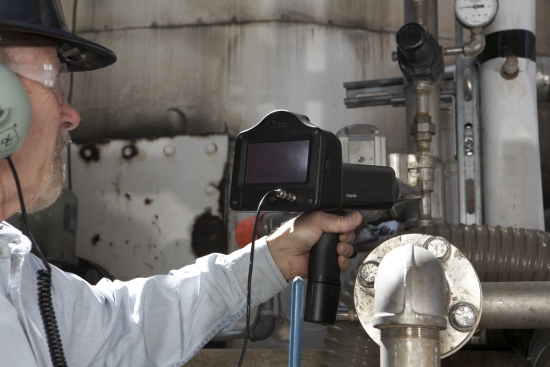
Using an ultrasonic leak detector to identify the source of a compressed air leak.
Leakage Management Based on Data with Flow Monitoring
A reliable way to manage air leakage in your compressed air system is by using flow meters. Install one or more flow meters in the compressed air network, such as in the main pipe after the buffer tank or in branched pipes per production department. This gives you insight into the compressed air consumption as well as the leakage level for the total factory and per department. Based on the data collected, you can then work on leak detection in a more targeted manner. It’s best to install flow meters before repairing leaks, as this gives you a clear picture of the savings made after repair. The newly measured value of total consumption then becomes the new baseline consumption level. If your compressed air consumption unexpectedly increases during production, it could indicate the presence of new leaks. Installing more flow meters in your factory can help you pinpoint the location of abnormal increases. Once you identify potential leak sites, use ultrasonic detectors to examine the area.
Continuously monitoring compressed air consumption and detecting and repairing significant leaks is essential to prevent high costs in the long term. New leaks appear over time, making early discovery and repair crucial to minimize losses. Once you've fixed all the leaks, you can gradually reduce the frequency of leak detections to avoid unnecessary rounds and costs. Using flow meters to measure not only flow but also pressure, temperature and total flow is recommended for better optimization. This combined approach can result in energy savings of up to 30%.
Bi-Directional Flow or Leaks?
If you suspect leaks, keep in mind there may instead be abnormal system behavior such as bi-directional flow. This means compressed air unexpectedly moves through the system in the opposite direction, giving the appearance of compressed air loss (such as leakage). If your system has bi-directional flow meters, you can immediately detect this behavior. Also, it's essential to check the system pressure critically. The higher the pressure, the more compressed air will escape through leaks. Keep in mind that a lower system pressure is not only valuable for this reason, but also because every 14.5 psi (1 bar) reduction results in 7% energy savings.
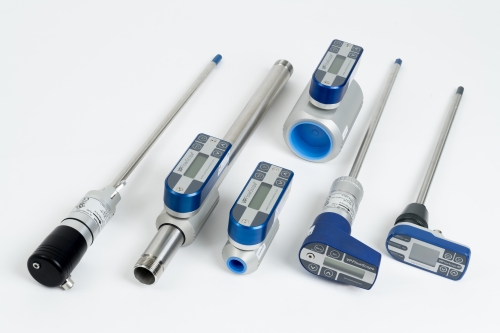
These 4-in-1 flow meters monitor flow, pressure, temperature and total flow.
Energy and Compressed Air Monitoring
Compressed air systems experience a decrease in efficiency due to various factors, including leaks. To monitor and improve the system's performance, use power, flow, pressure, temperature and dew point sensors. This approach provides both qualitative and quantitative information about the entire compressed air system, including the air compressors, compressed air dryers and filters. Real-time monitoring systems, like VPVision, are especially useful as they store system data and allow for trend discovery. This information is presented by a dashboard and in reports, providing a clear picture of the compressed air system's progress. Factories operating 24/7 can particularly benefit from monitoring as it allows for continuous analysis and immediate intervention in case of any deviations.
Energy use can be measured for major energy consumers such as air compressors, generating valuable energy management reports over longer periods. Even after repairing leaks, it's important to continue monitoring energy use to ensure optimal performance. By doing so, you can promptly intervene when necessary, and monitor the effectiveness of actions taken such as pressure reduction or leak repairs. In this way, you can establish a sustainable, economical and optimally performing compressed air system.
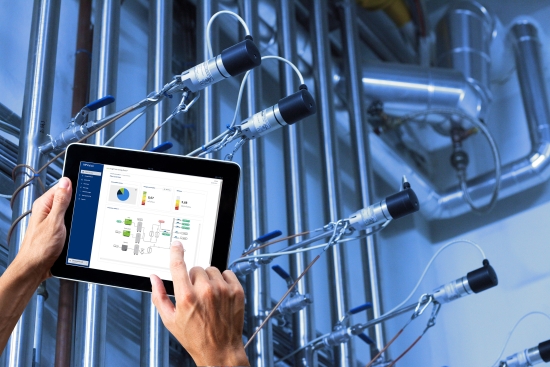
Real-time monitoring systems store system data and allow for easy trend discovery.
About the Author
Menno Verbeek has been the Sales Director at VPInstruments for over 12 years, bringing extensive expertise in industrial energy monitoring solutions. His commitment to helping companies optimize their energy use has been instrumental in driving innovation.
About VPInstruments
Founded in 1999, VPInstruments offers easy-to-use solutions for industrial measurement worldwide, helping businesses gain insights, save energy and optimize their processes. Its VPFlowScope flow meters are designed for a wide range of applications, from supply to demand. When paired with the VPVision energy monitoring system, they provide a clear view of where, when and how much energy can be saved. For more information, visit https://www.vpinstruments.com.
To read more Compressed Air Leak System Assessment articles, visit https://www.airbestpractices.com/system-assessments/leaks.
Visit our Webinar Archives to listen to expert presentations on Compressed Air Leak System Assessments at https://www.airbestpractices.com/webinars.