Ultrasound refers to sound pressure waves with frequencies above 20 kHz, which are beyond the range of human hearing. These waves can only be detected using specialized ultrasound technology, allowing inspectors to identify the earliest signs of asset failure.
One of the primary applications of ultrasound is detecting and repairing compressed air system leaks. These leaks not only waste money, but also reduce equipment efficiency, increase wear and pose safety risks for employees. However, with a simple point-and-scan approach, maintenance teams can quickly locate leaks. This helps lower energy costs, improve safety and keep industrial operations running at peak efficiency.
With energy prices high, detecting and repairing compressed air system leaks has become a top priority. Rising electricity costs make compressed air generation more expensive. Leak detection has become essential for controlling energy spending.
Ultrasound tools, such as UE Systems’ Ultraprobes and FLIR’s acoustic imaging cameras, make it easy to identify leaks quickly and accurately, delivering both immediate cost savings and long-term efficiency gains. In addition to energy savings, detecting and fixing compressed air system leaks helps ensure optimal equipment performance.
Nearly every industrial facility has compressed air system leaks. It’s not a question of whether or not they exist, but rather how many exist.
Leak Detection Methods for Compressed Air Systems
U.S. Department of Energy studies of industrial plants found that only 50% of all compressed air produced in plants is used wisely, with approximately 30% lost due to leaks. These inefficiencies result in significant economic and environmental costs. For example, a single 3mm leak in a 73 psi (5 barg) compressed air system can waste as much as $574 annually. Multiply this loss by dozens or even hundreds of leaks within an industrial facility, and the financial waste becomes substantial. Addressing compressed air system leaks not only leads to considerable energy and financial savings, but also enhances overall operation.
Multiple methods are used to detect compressed air system leaks, each with its own advantages and disadvantages:
Traditional Soap and Water Method. The traditional soap and water method for detecting compressed air system leaks is time-consuming and labor-intensive, requiring technicians to manually inspect each potential compressed air system leak up close. This approach is not only inefficient, but also poses risks in industrial environments: Introducing moisture can be hazardous to sensitive industrial equipment.
Ultrasound Inspection Instruments. A more advanced and efficient method for compressed air system leak detection involves the use of ultrasound technology. There are two primary types of ultrasound-based compressed air system leak detection tools: listen-only ultrasonic instruments, which allow users to hear the high-frequency sounds produced by escaping compressed air; and acoustic imaging cameras, which provide real-time visual imaging of compressed air system leaks, enhancing detection accuracy and efficiency.
Why Use Ultrasound for Compressed Air System Leak Detection?
Ultrasound technology offers numerous benefits for compressed air system leak detection. Its directional sound waves help pinpoint the exact location of compressed air leaks with precision, while the intensity of the detected signal increases as the instrument moves closer to the compressed air leak source, making localization more accurate.
Because ultrasound operates at a fixed frequency, it remains effective even in noisy industrial environments. Additionally, ultrasound technology is versatile and can be used to detect leaks across a variety of gases, including oxygen, nitrogen, helium and argon.
When scanning an area, ultrasonic instruments, such as select UE Systems Ultraprobes, detect high-frequency turbulence created by compressed air escaping through a leak. This is perceived as a distinctive rushing sound through a headset or visually represented on a display. If ambient noise is problematic, rubber focusing probes and frequency tuning features help shield and isolate the compressed air leak’s sound from background noise.
One of the most common and valuable applications for ultrasound technology is conducting comprehensive compressed air system leak surveys. By using an Ultraprobe coupled with software such as UE Systems’ DMS or the Leak Survey SideKick app, users can quickly and efficiently locate compressed air system leaks, tag their locations while digitally recording data, generate reports detailing estimated energy losses and cost savings and document repairs and track unrepaired compressed air system leaks for quality assurance.
BioKyowa Saved Over $86,000 Annually in Compressed Air Leaks Alone
BioKyowa represents the first major industrial plant investment by a Japanese company in the state of Missouri. It began construction in 1982. In 1984, when production began, it produced feed supplements for the swine and poultry markets. It was the first commercial plant to produce lysine in the United States.
Over the past 30 years, BioKyowa has evolved from a feed-grade facility that produces a single product to a multiple-plant industrial campus that produces high-quality amino acids, including glutamine, arginine, threonine and valine using advanced biotechnology with strict quality control standards. Its amino acids are used in nutritional food supplements, cosmetics and precursors for pharmaceuticals.
Semi-Annual Audits Turn Data into Dollars Saved
Technicians knew the company’s plants contained compressed air leaks, but they didn’t have the tools required to efficiently perform compressed air leak surveys. As a result, their maintenance program was largely reactive. This led to costly compressed air leaks and unexpected downtime. Eventually, the technicians discovered UE Systems’ Ultraprobe 15,000, an all-in-one instrument that uses ultrasound to analyze everything from bearings and electrical systems to steam traps and leaks.
After using the Ultraprobe 15,000 for a year, BioKyowa had discovered multiple energy-saving opportunities. Its transition from a reactive maintenance program to a proactive predictive maintenance program has been substantial. BioKyowa implemented a semi-annual compressed air system leak survey. It discovered an annual loss of $86,324 from compressed air system leaks throughout the plant. After a few months, the compressed air leak detector paid for itself through savings it helped generate.
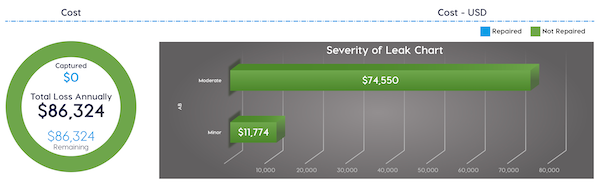
BioKyowa discovered $86,324 in annual compressed air leaks throughout its plants.
Moving forward, BioKyowa is committed to the continued use of advanced technologies in plant maintenance. This approach enables it to closely monitor its equipment. The implementation of a comprehensive reliability program positions it to better predict future problems and proactively address them before they lead to equipment failure.
Acoustic Imaging Cameras for Compressed Air Leak Detection
While traditional ultrasonic instruments rely on sound detection, recent advancements in ultrasound technology have led to acoustic imaging cameras for a more intuitive and efficient approach. These cameras, such as FLIR’s Si1-LD Camera and Si2-Camera Series, provide a real-time visual representation of compressed air leaks on a screen, allowing maintenance professionals to quickly scan large areas without extensive manual searching, identify multiple compressed air leaks simultaneously from a safe distance and increase the speed and accuracy of compressed air leak detection compared to traditional compressed air leak inspection methods.
With these advantages, facilities can significantly reduce their energy costs, enhance maintenance efficiency and minimize energy waste.
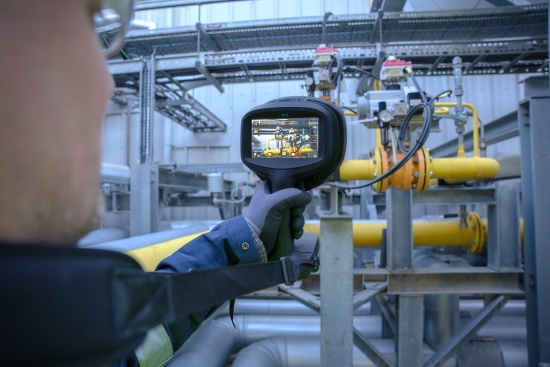
This acoustic imaging camera lets technicians detect and reduce compressed air leaks in industrial facilities, thereby cutting costs.
Rousselott Dubuque Increases Compressed Air Leak Detection by 400%
Established in France in 1891 by Edward Rousselot, Rousselot is now part of Darling Ingredients International and is committed to producing high-quality, safe gelatin and collagen products. Today, Rousselot offers a wide range of gelatins and collagens.
Rousselot’s operational teams, located in 17 state-of-the-art facilities, have also developed outstanding know-how in manufacturing products from collagen-rich sources. Rousselot’s Dubuque site produces food, pharmaceutical, medical and fuel ingredients.
Rousselot Dubuque was experiencing unplanned downtime, and its facilities weren’t running at optimal efficiency. They encountered frequent issues with compressed air leaks, but lacked an efficient strategy to address the problem.
Although introducing an ultrasound compressed air leak detection program in its facility could help remedy compressed air leaks, the maintenance team was aware that incorporating new technology, even if it’s intended to save a company money and improve efficiency, can be tricky to justify and adopt.
Fortunately for Rousselot, the maintenance team knew it could sell ultrasound technology to management because of its fast payback and early detection capabilities. Although it’s made with high-quality tools and offers thousands in annual savings, ultrasound is a relatively low-cost technology to introduce, and it allowed Rousselot Dubuque’s in-house reliability program to evolve quickly.
The Dubuque site introduced its ultrasound program in 2013, focusing primarily on using ultrasound for compressed air system leaks. After training technicians to use ultrasound equipment and develop consistent leak auditing routes, it started experiencing significant savings due to compressed air leak system repairs. Not only did repairs quickly pay off the cost of the ultrasound equipment, but they also provided concrete data to justify the use of ultrasound throughout their facilities.
Taking Ultrasound to the Next Level with an Acoustic Imaging Camera
From 2018 to 2022, Rousselot Dubuque used the Ultraprobe 15,000 and DMS software to detect, measure and repair 284 compressed air system leaks. This resulted in a cost avoidance estimate of $160,572 in total or $40,134 annually. This was accomplished by performing only seven compressed air system leak audit routes each quarter, ensuring the plant had a consistent and efficient compressed air leak detection process in place.
In December of 2022, the plant took its ultrasound compressed air system leak detection program to the next level by adding an acoustic imaging camera to its toolkit. This upgrade proved to be a game-changer because it eliminated interference from competing ultrasound sources, including cavitation in pumps, vacuum transfer systems and proportional valves that leak compressed air intentionally. Since purchasing the acoustic imaging camera, the average number of compressed air system leaks discovered per route has increased by over 400%.
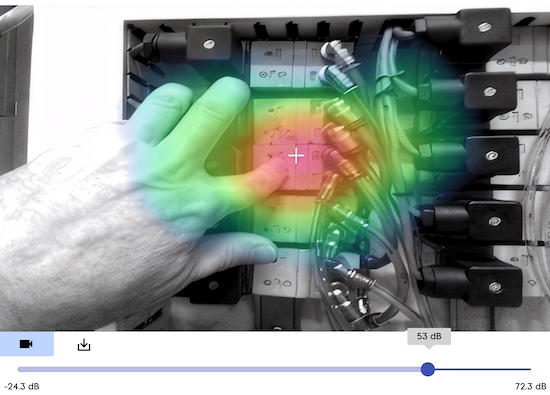
Acoustic imaging cameras provide a high level of detail about detected compressed air leaks.
It has now been 12 years since Rousselot Dubuque began its ultrasound compressed air system leak detection program, and it continues to expand the use of ultrasound technology across its global sites. It plans to use ultrasound in all its facilities. Its ultrasound compressed air system leak detection program has come a long way since 2013. The company is in continuous communication with UE Systems to learn about new products and services.
Conclusion
Locating and repairing compressed air system leaks is critical for improving energy efficiency, reducing operational costs and extending equipment life. As energy prices continue to rise, having a reliable and well-executed ultrasound program is more important than ever for maintaining optimal industrial facility performance.
While tools like the Ultraprobe 15,000 have proven to be highly effective for conducting thorough and reliable compressed air system leak detection surveys, the addition of acoustic imaging cameras takes ultrasound technology to the next level. With real-time visual detection and faster identification of even the most challenging compressed air system leaks, these cameras streamline inspections and increase detection rates, making them a powerful upgrade for any industrial facility committed to minimizing waste and maximizing performance.
About the Author

First joining the ultrasound industry in 2020, Robin Marcinkus earned his Level I Certification and has enjoyed learning about the power of ultrasound technology and its capabilities daily.
About UE Systems
UE Systems believes every person, regardless of their industry, company size, experience or budget, should have the tools and support to help their facilities operate efficiently, reliably and safely. It provides a portfolio of ultrasound solutions designed for versatility and ease of use. Since 1973, it’s helped thousands of customers worldwide prevent equipment failures, identify energy losses and return home safely to their families.
To read more Compressed Air Leak System Assessment articles, visit https://www.airbestpractices.com/system-assessments/leaks.
Visit our Webinar Archives to listen to expert presentations on Compressed Air Leak System Assessments at https://www.airbestpractices.com/webinars.