The 2025 AHR Expo, co-sponsored by ASHRAE and AHRI, was held Feb. 10-12 at the Orange County Convention Center in Orlando, FL, concurrent with the ASHRAE Winter Conference. More than 1,800 exhibitors and 350 speakers drew in over 50,000 attendees. HVACR professionals from across the globe gathered to discuss the latest regulation updates and explore innovations. This article focuses on chiller, heat rejection and related cooling technologies for industrial use.
Chillers
Atlas Copco Compressors highlighted several technologies for industrial use including the air-cooled TCX process cooling chiller. With 15 models available, it offers cooling capacities from 4 to 90 kW. The newly launched TDV Series industrial adiabatic cooler was also on display. The company offers custom builds for this product and has worked with projects up to 500 tons. TDV models are available in both adiabatic and dry fluid versions. “The reason we’ve moved to closed-loop coolers as opposed to open-loop towers is because the water savings provided by this equipment completely outpaces an open-loop tower,” explained Daniel Perez, Business Development Manager, Atlas Copco. “On average, a 100-gallon open-loop system will lose about 8 million gallons of water per year, just through the evaporation process.”
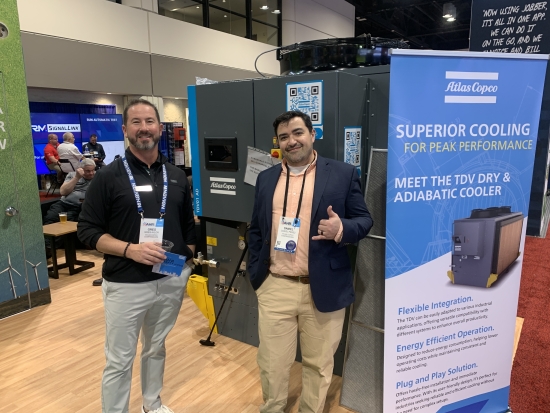
Greg Aylor and Daniel Perez of Atlas Copco Compressors (left to right) with a TDV adiabatic cooler.
The Johnson Controls booth featured the modular YMAE R-454, air-source, VSD, scroll heat pump chiller, which can make chilled water and hot water up to 140°F (60°C) in -13°F (-11°C) ambient temperatures. “An installation in the Northeast has 5,000 tons of CYK heat pump chillers producing 41°F (5°C) for its campus chilled water loop and 160°F (71°C) for the hot water loop. This installation saves the campus 59 million GPY of water, 20,000 metric tons of CO2 emissions and 380,000 million BTUs of natural gas,” said Todd Grabowski, President, Global Data Center Solutions, Johnson Controls. “The issue of carbon isn’t just an issue for the biggest companies to solve, but all companies.” Johnson Controls also showcased its largest 3,200 ton centrifugal chiller redesigned for new refrigerants like R-1234ze.
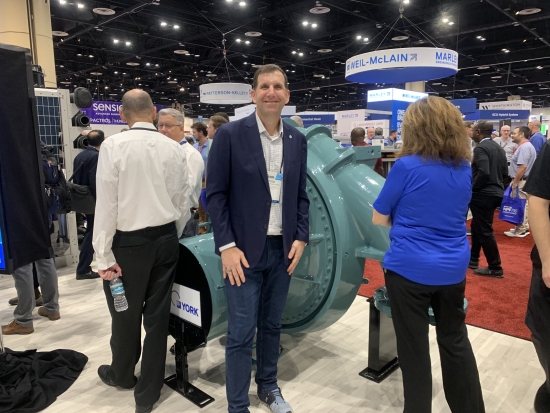
Todd Grabowski of Johnson Controls with a 3,200 ton centrifugal chiller.
Daikin Applied displayed a Magnitude® magnetic bearing chiller. This centrifugal chiller is capable of 90 to 1,560 tons and features a hermetic, direct-drive motor. The Magnitude models use R-1233zd(E), R-513A and R-515B refrigerants. The company also displayed a Trailblazer® AGZ-F air-cooled, scroll chiller that provides 30 to 230 tons and uses R-32. Addressing manufacturing plants looking for a starting point to increase energy efficiency, Adam Crimboli, Regional Equipment Sales Manager – Southeast, Daikin Applied, said, “You have to do a full lifecycle analysis to determine what’s best for your application. That involves the actual energy analysis of the equipment being used.”
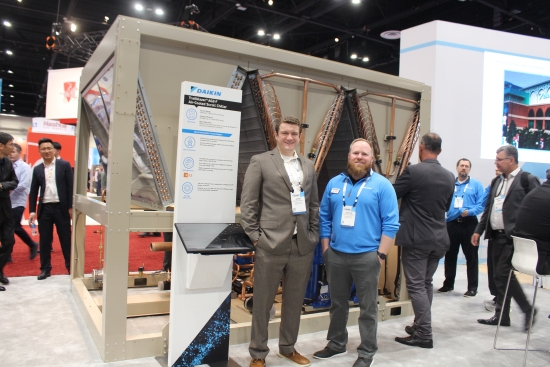
Adam Crimboli and Trevor Ramsey of Daikin Applied (left to right) with the Trailblazer® AGZ-F.
Montreal-based SMARDT displayed its new AeroPure™ air-cooled chiller – a magnetic bearing, oil-free, centrifugal chiller capable of 60 to 710 tons. It’s compatible with R-1234ze, R-515B, R-513A and R-134a refrigerants. “Manufacturers can use a multiple refrigerant compressor to save energy, and this can also help with redundancy. This can be especially beneficial for plants that need 24/7 cooling,” said Marcos Awad, Global Director of Sales/Applications Engineering, SMARDT. The company also showed its new modular chiller option featuring variable speed scroll technology. It’s available in 30 and 40 ton modules, and can reach up to 400 tons with 10 units connected in parallel.
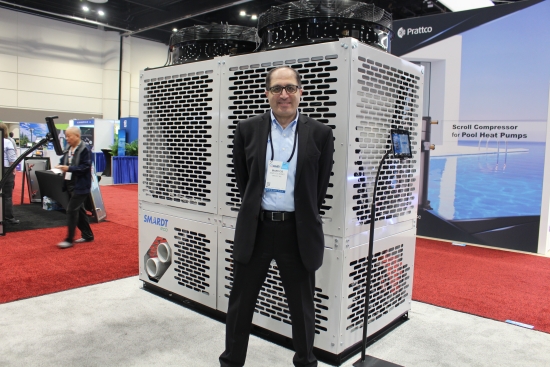
Marcos Awad of SMARDT with the company’s new VSD modular chiller.
Attendees were able to explore Climate Control Group’s offerings through large touch screens around the booth. Several new chiller products are on the horizon for 2025, including vapor injection – a refrigerant compressor technology that allows for high lift, creating the ability to produce hot water with low ambient air temperatures. It will use low-GWP R-454B. When asked about solutions for manufacturing plants looking to be more energy efficient, Michael Medlock, National Decarbonization Strategy Leader, ClimaCool, recommended heat recovery. “Don’t waste energy. If you’re cool in one area of the building and heating with something else on the other end of the building, you’re wasting energy.”
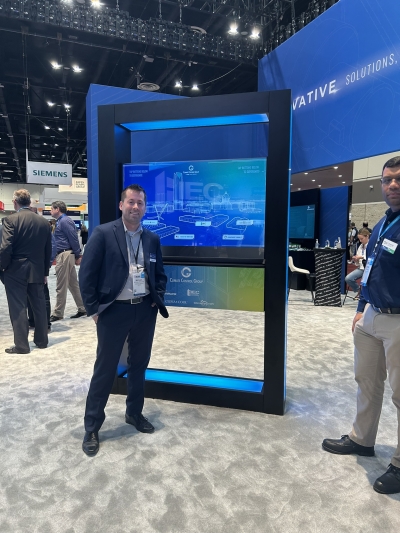
Michael Medlock of ClimaCool, a Climate Control Group brand.
Heat recovery was a hot topic at the Multistack booth. On display was an MFH water-cooled MagLev® flooded heat recovery chiller, able to reach water temperatures up to 145°F (63°C) and available in capacities starting at 80 ton. This chiller features oil-free, magnetic levitation bearings in a high-lift centrifugal compressor. “We’ve been leaders in heat recovery for a long time, but we’re continuing to take everything we know and try to do it in different sizes and applications. It’s our contribution to decarbonization and electrification,” said Pat Carus, Western Regional Manager, Multistack. “30% or more of what we do has some component of heat recovery.”
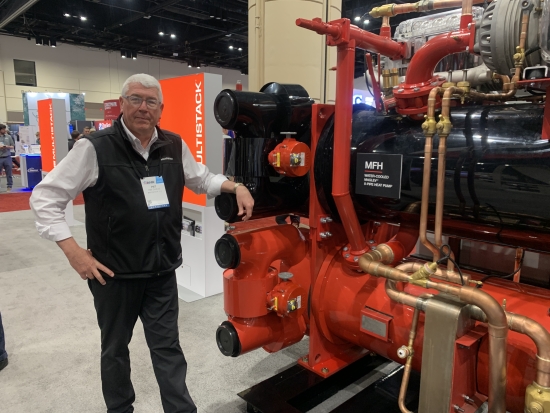
Pat Carus of Multistack with an MFH water-cooled MagLev® flooded heat recovery chiller.
Across from the Multistack booth was Budzar Industries, a Multistack subsidiary focused on industrial applications. On display was a cascade chiller system with a set point of -121°F (-85°C). It was cascading a two refrigerant circuit – R-404A brought the temperature down to -22°F (-30°C) and then a second circuit with R-508B brought the temperature down to -121°F (-85°C). “This product is used in pharmaceutical manufacturing and has the capacity to go down to -121°F (-85°C) and up to 392°F (200°C). It controls a jacketed vessel to make medicines,” explained Anthony LaRiccia, Rubber Sales Manager, Budzar.
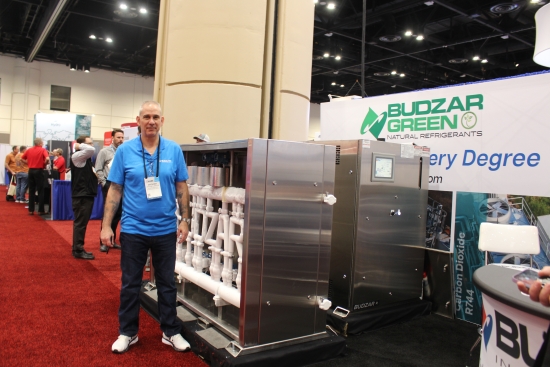
Anthony LaRiccia of Budzar Industries with a cascading chiller system.
LG showcased its inverter scroll heat pump chiller, offered in 17, 20, 33, 40 and 60 ton models. With a 20.13 Integrated Part Load Value (IPLV) and COPH up to 3.5, energy efficiency is a major focus. It uses low-GWP R-32. “LG is unique in how we build our chillers. DX circuits reside in all air-cooled chillers, and the norm has been two circuits. LG has built our chillers with multiple independent circuits, which gives us immense redundancy when it comes to just refrigeration power,” explained Kevin Shewmaker, Regional Sales Engineer, LG. Another highlight of the booth was the LG oil-free water-cooled inverter centrifugal chiller using R-1233zd. The company has made water-cooled chillers since 1968 overseas, and has just begun bringing them to the U.S.
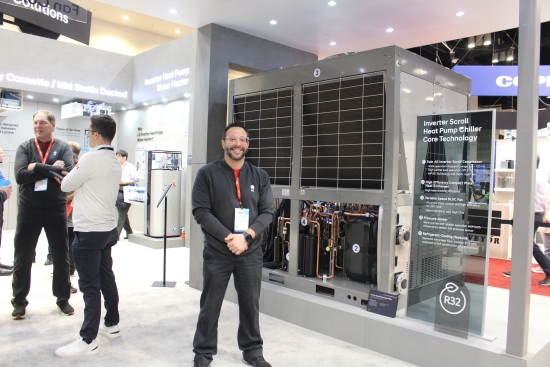
Kevin Shewmaker of LG with an inverter scroll heat pump chiller.
Mikropor displayed its atmospheric air filtration solutions. Jeff Thibodeau is an industry expert on ambient air quality and filtration. Thibodeau serves as Vice President of Atmospheric Air Filtration for Mikropor America and serves with the National Air Filtration Association. Mikropor also offers the M-Chill process water chiller.
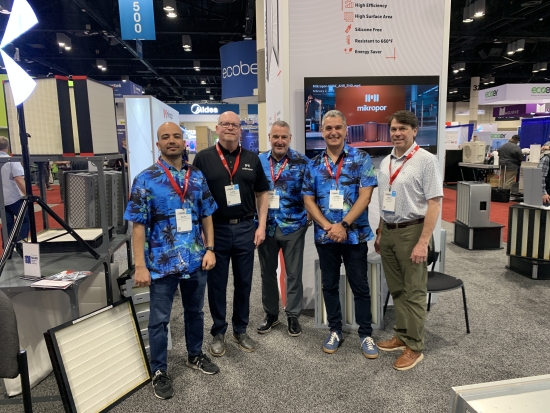
Musa Kurtulmus, Chris Wells, Jeff Thibodeau, Evren Yazici and Matt Smith with Mikropor (left to right) displayed the company’s atmospheric air filtration solutions.
Heat Rejection
EVAPCO’s booth featured its adiabatic fluid cooler from the eco-Air Series, which includes a variety of adiabatic and dry cooler options. First introduced in 2018, this product has undergone improvements with the latest model released in 2024. On display was the single stack product used for large industrial applications, but the company also offers a double stack option. “I would say almost every large industrial manufacturing job we work on is evaluating adiabatic cooling,” said Andrew Kollasch, Product Application Manager, EVAPCO.
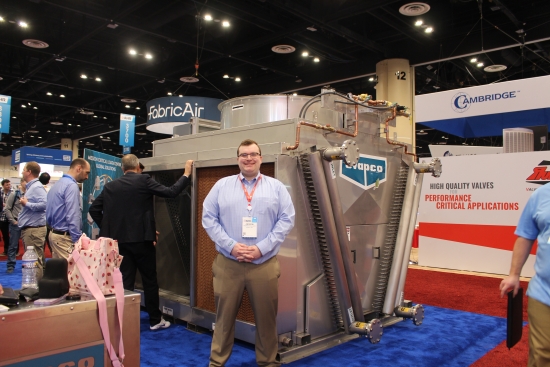
Andrew Kollasch of EVAPCO with an eco-Air Adiabatic Fluid Cooler.
The SPX Cooling Tech – Marley booth was buzzing with excitement over news of its new Aftermarket Parts Trailer going on tour across the U.S. “This is not just a component showcase. We’re taking our training on the road,” said Emily Rose Giunta, After Product Manager, SPX Cooling Tech. “The Aftermarket Parts Trailer has a lot of real parts, not demos. They're not 3D printed. We want to teach people hands-on, right at home.” The booth featured models of its adiabatic cooling systems, such as the Marley OlympusV Fluid Cooler, and had a Marley WaterGard – a cooling tower filtration system – on display.
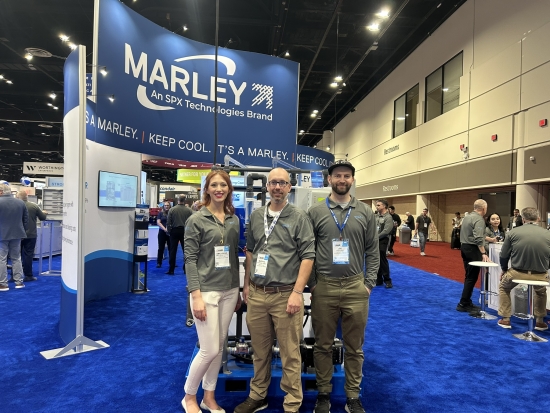
Emily Rose Giunta, Marshall Zabel and Joe Evans of SPX Cooling Tech (left to right).
Nimbus highlighted its full line of VIRGA™ hybrid adiabatic cooling systems, available in four configurations. At the front of the booth was a VIRGA III, a one-fan unit with an EC motor, capable of up to 50 tons. It’s constructed from 304 stainless steel with copper coils, and has coated fins and coils that repel water to minimize potential calcium buildup. “Cooling towers are efficient at what they do, but they use a massive amount of water. Adiabatic coolers use about 80% less water if sized the same,” said Jerry Petit, Director Business Development & Sales, Nimbus.
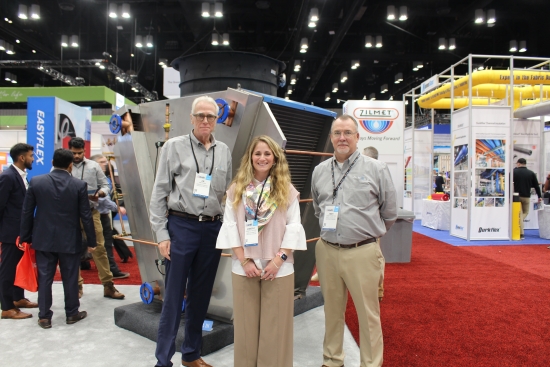
Jim Dyer, Kimberly Glasko and Jimmy Horton of Nimbus (left to right) with the VIRGA III.
Tower Tech drew in visitors with its factory-built, modular composite cooling tower. Unlike a traditional induced draft cooling tower where fans are on the top, this product’s fans are at the bottom. “We have technology that allows us to put the mechanical equipment – the fans and motors – at grade level where they’re easy to access,” said Micah Curtis, Director of Sales, Tower Tech. “If there’s a motor failure, you don’t need a crane. All routine maintenance is done with a boots-on-the-ground approach.”
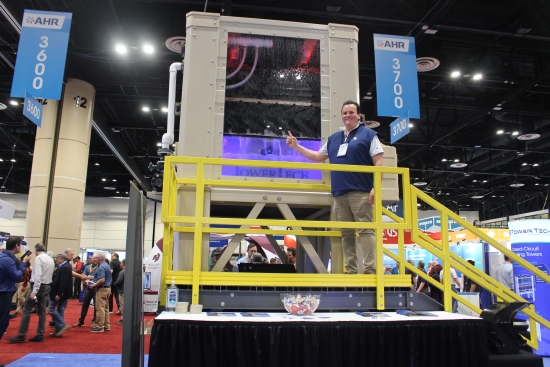
Micah Curtis, Director of Sales, Tower Tech with a modular composite cooling tower.
Baltimore Aircoil Company’s booth had a TrilliumSeries® Adiabatic Cooler – Model TRF. Its capacity range is 350 to 1600 kW and the maximum entering fluid temperature is 140°F (60°C). While not at the show, the company has a new innovation – the TrilliumSeries Dry Cooler. “You have energy use and water use, and both are precious resources. We want to find a happy medium between those. The controls in all our hybrid products are set up so owners can choose whether they want to rely more on energy or water to support their operations, or they can set it in the middle and let it operate automatically,” said Adrienne Lowke Stoinoff, National Sales Manager HVAC and Manufacturing – North America, BAC. “Energy and water use is key to what we're trying to do as a company.”
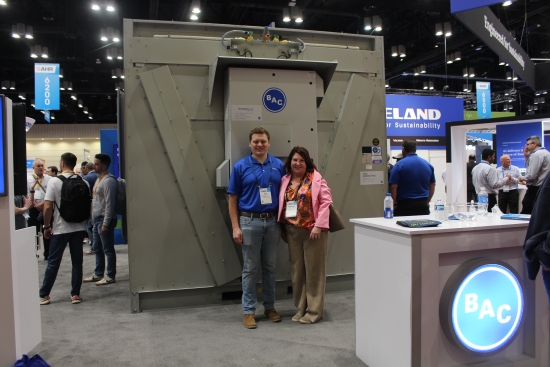
Ben Seidel and Adrienne Lowke Stoinoff of Baltimore Aircoil Company (left to right) with the TrilliumSeries Adiabatic Cooler – Model TRF.
The highlight of the Delta Cooling Towers booth was its new TMX Series Cooling Tower. The tower sump is molded from non-corroding HDPE in a single, continuous piece over 20 feet long, eliminating joints, seams or welds prone to leaks and maintenance issues. “We had to build one of the biggest molding machines in North America to create this series,” said Jay Flaherty, Northeast Regional Sales Manager, Delta Cooling Towers. Models range from 300 to 3,250 tons. “One cell can cool about 600 tons compared to our previous cooling tower that got up to 420 tons. This allows us to use fewer cells in a smaller footprint.”
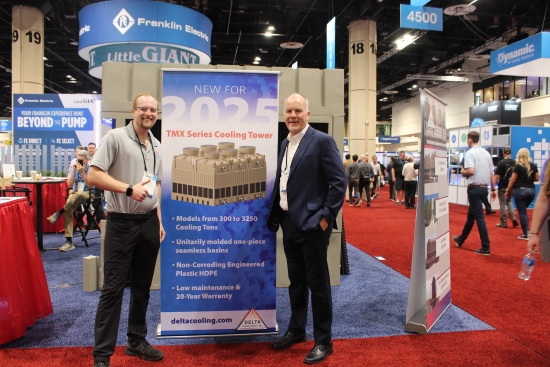
Jay Flaherty and John Flaherty of Delta Cooling Towers (left to right) with the TMX Series Cooling Tower.
Refrigerant Compressors
Danfoss received an AHR Expo Innovation Award in the refrigeration category for its BOCK HGX56 CO2 T, a transcritical six-cylinder CO2 compressor using R-744. It has expanded range to enable larger refrigeration and heat pump applications with a smaller footprint, and strong energy-efficient performance. The company also introduced show attendees to the Danfoss Turbocor® Active Cooling Variant with an oil-free check valve and oil-free suction ball valve. This is used to cool the electrical components in Turbocor refrigerant compressors and can handle SST up to 86°F (30°C) for cooling applications and SDT up to 179°F (82°C) for heating applications. Danfoss Turbocor celebrates 30 years of operation in 2025.
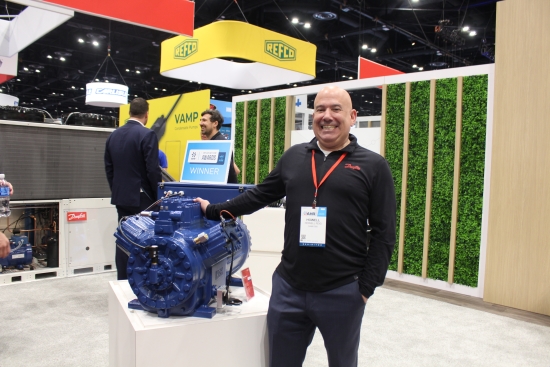
Howell Feig of Danfoss with the BOCK HGX56 CO2 T.
Copeland held a press conference led by John Schneider, President, HVACR Technologies, Americas, and Patrick Forsythe, Chief Technical Officer, to discuss the company’s recent innovations and growth. Since divesting from Emerson in 2023, the company has launched over 100 products and filed 430 patents. Forsythe discussed how Copeland is addressing global challenges – including energy transition, refrigerants transition and food and pharmaceutical availability – with innovation. “Innovation is not a department at Copeland. It’s not a specific team. It’s in our DNA and our work is focused on the technical solutions for some of the most pressing global challenges,” Forsythe said. Copeland also highlighted its oil-free centrifugal compressor with frictionless Aero-lift™ bearing technology, developed for the 50 to 200 ton capacity range and compatible with R-1234ze, R-515B and R-513A.
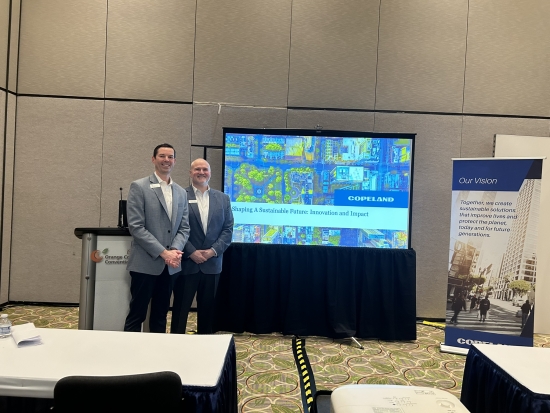
John Schneider and Patrick Forsythe of Copeland (left to right) at the company’s press conference.
Motors, Drives and Pumps
On the first day of the show, ABB unveiled its latest innovation: EHR, a direct drive EC motor technology for fan wheels. It has two frame sizes ranging from 1 to 7.5 horsepower. EHR supports variable speed operations and is designed for direct drive applications. “EHR delivers as much as 40% improved power consumption compared to fixed speed solutions, leading to significant energy savings,” said Richard Kirkpatrick, Global Product Manager for Integrated Motors and Drives, ABB. Also on display were the Baldor-Reliance® Cooling Tower Direct Drive and the ABB drive package, which can replace the gearbox, driveshaft and motor typically used in industrial cooling tower fans.
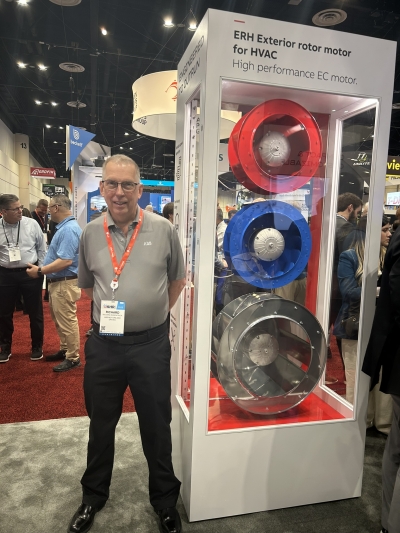
Richard Kirkpatrick of ABB with the newly unveiled EHR.
Armstrong Fluid Technology ended day one of the show with a press conference to announce the launch of several products including Envelope™. This integrated digital platform connects components in a mechanical system and has the ability to create detailed performance profiles. Pratik Sharma, Global Director, Building Services & Performance Management, Armstrong, said, “The true power of the Envelope platform is in how it enables system optimization through performance coupling with partner products or solutions. Working within this platform, Armstrong and digitally controlled solutions of all types can connect and coordinate operations for improved performance and efficiency. Components that can be connected to Envelope include chillers, cooling towers, boilers and heat pumps made by a wide range of well-known industry manufacturers.”
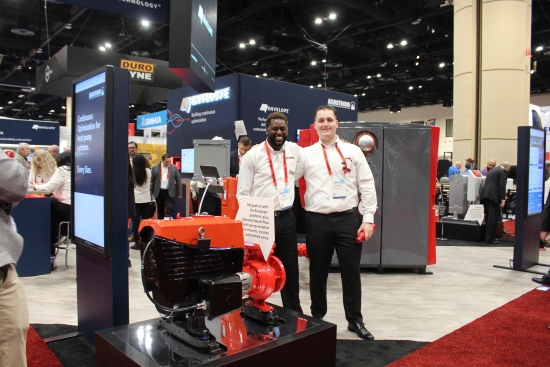
Tunji Asiwaju and Anthony Mihajlovic of Armstrong Fluid Technology (left to right) with a Design Envelope Horizontal End Suction Pump with permanent magnet motors.
The 2026 AHR Expo will next be held Feb. 2-4 at the Las Vegas Convention Center in Las Vegas, NV. For more information, visit https://www.ahrexpo.com.
For similar articles on Cooling Technology, visit https://coolingbestpractices.com/index.php/technology/cooling-towers.
Visit our Webinar Archives to listen to expert presentations on Cooling Technology at
https://coolingbestpractices.com/index.php/magazine/webinars.