Manufacturing plants with highly efficient compressed air systems keep diligent records and monitor compressed air pressure and flow at multiple locations. This case study looks at what happened when one manufacturer skipped its usual best practices at one location, and how it got a factory back on track after a sudden air compressor failure.
A Compressed Air Capacity Problem and a Needed Wake-up Call
A well-known Canadian designer furniture manufacturer, whose furniture is even found in museums, has production facilities in Europe and North America. Demand for designer furniture continues to rise globally, and, as a consequence, the company must expand its production capacity year after year. Its compressed air consumption also shows an upward trend, and the manufacturer closely monitors whether the layout and capacity of its compressed air systems still meet changing needs. This requires continuous monitoring of the operation and condition of air compressors, compressed air pipes, compressed air filters, compressed air dryers and compressed air storage tanks.
However, because these procedures weren’t followed at one factory, and other essential data was also missing, its compressed air system was essentially a mysterious black box. The exact age of the air compressors and their energy consumption were unknown. Furthermore, it wasn’t possible to determine the factory’s current compressed air demand. While the black box provided compressed air, technical management lacked critical operational parameters and insight into efficiency and operating costs.

Pascal van Putten, CEO, VPInstruments.
The wake-up call came when one of its five air compressors suddenly failed, causing an acute capacity problem. Rapid and costly emergency measures were needed to temporarily restore capacity, and management realized there might be more to come. In mid-2020, the Canadian service provider Pecheanu Air Compressors was commissioned to meticulously assess the compressed air system and advise on how to proceed. Was replacing the failed air compressor sufficient, or were further measures needed to make the compressed air system more efficient and reliable?
Pecheanu Air Compressors Proceeds with an Extensive Audit
To provide a meaningful answer to this question, it was crucial to first map the current compressed air system and perform both permanent and mobile measurements in the factory. Pecheanu installed flow meters, dew point meters and energy meters from VPInstruments. The service provider also conducted a comprehensive audit to provide a detailed inventory of the entire compressed air system. It used mobile flow and dew point meters to measure the compressed air system at various locations throughout the factory.
The compressed air system layout at the factory consists of three air compressor rooms. One room contains three air compressors, and the other two rooms each contain one air compressor. The total power of the five air compressors was theoretically 900 horsepower (hp), but since these air compressors had been in place for decades (no one knew exactly how long), it was assumed that the actual power output was lower than 900 hp due to mechanical wear. Compressed air dryers and filter systems were located in each air compressor room, and compressed air storage tanks were installed in various locations to absorb pressure fluctuations and provide additional peak capacity. The production areas are supplied with compressed air via a ring network, from which separate compressed air pipes run to the individual production machines.
The audit revealed significant inefficiencies. All air compressors showed clear signs of internal wear, and their standard modulating controllers did not function optimally. Combined compressed air pressure and flow measurements revealed a significant pressure drop in several piping systems, along with a high flow rate. This is usually a sign that the pipe diameter has drastically decreased due to contamination or corrosion. This was confirmed by endoscope examination, which showed the compressed air piping was clogged in many places and, therefore, no longer suitable for efficient and reliable compressed air transport.
Selecting the Right Type of Flow Meter for the Audit
"When deciding to start measuring, it's important to carefully consider the type of flow meter used in the compressed air system," said Pascal van Putten, CEO, VPInstruments. "There are unidirectional and bidirectional flow meters, and there are also significant differences in mounting and servicing options. For this project in Canada, the insertion type of the VPFlowScope M was chosen, which offers several advantages. Insertion flow meters allow for installation under pressure using hot tapping, with a ball valve that allows the meter to be installed and removed for maintenance under pressure. If an insertion type is not used, the entire compressed air system (or sections thereof) will have to be shut down before the meter can be installed or removed. This type of flow meter is also easy to maintain, as calibration or recalibration is simply a matter of replacing the cartridge."
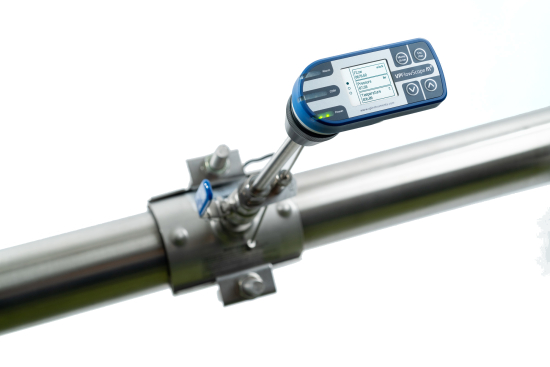
A bidirectional flow meter was installed in a hot tap saddle with a ball valve for installation in pressurized conditions.
The air compressor rooms at this factory are connected by a compressed air ring network. Depending on the load and which air compressor is running, compressed air can flow in two directions. A unidirectional flow meter would add the flows together, creating a distorted picture. A bidirectional flow meter, however, measures the net flow in one direction, providing an accurate representation of the actual flow.
It became clear that this factory’s existing compressed air system wasn't ideal, but what constitutes an ideal compressed air system? "That varies from user to user," said Van Putten. “To create the ideal compressed air system, you first need to know what's present and what its status is. That's what the service provider did for this factory. An audit often reveals inefficiently controlled air compressors, compressed air leaks and pressures that are too high or too low. Assuming the air compressors and compressed air piping are still in good working order, you can address some issues immediately to reduce costs. For example, too high a pressure is a waste of money. If machines still function well at a pressure that's 22 psig lower, you immediately save 10% on energy costs when using single-stage rotary screw air compressors. On the other hand, too low a pressure is also not good, as it can lead to machine failures. If only one machine or department needs a higher pressure, while the rest of the factory can operate at a lower pressure, a booster might be a better solution.”
Leakage Measurement in Dust Collectors
Leaks are one of the most expensive and overlooked problems in compressed air systems. The factory has 11 dust collectors, the pressure and flow of which were measured with an inline flow meter. Several dust collectors were found to leak. When a dust collector functions properly, there are clear air pulses, with valves completely closed between pulses. During the pauses between pulses, no flow should be measured. If, however, flow is measured, this indicates a compressed air leak, and the valve must be replaced quickly to avoid further costs. Based on the positive results and the knowledge that air leaks can cost a lot of money, the company is considering permanently equipping all 11 dust collectors with inline flow meters. Besides dust collectors, flow meter information can also be used in factories to detect and repair leaks in compressed air piping, fittings and machinery.
"People often think, 'Oh, it's just a slight hissing sound, so the loss won't be too bad,' but nothing could be further from the truth," Van Putten said. "In a 24/7 factory with an air pressure of 90 psi, a hole with a diameter of just 1 mm, for example, wastes 3 cubic feet per minute (CFM). That's nearly 1.6 million cubic feet per year. In monetary terms, that’s a loss of $1,150 per year, which rises to around $28,000 for a 5 mm hole. Compressed air leak management, compressed air demand reductions and 24/7 monitoring normally result in significant savings reaching from 10% to 40%.”
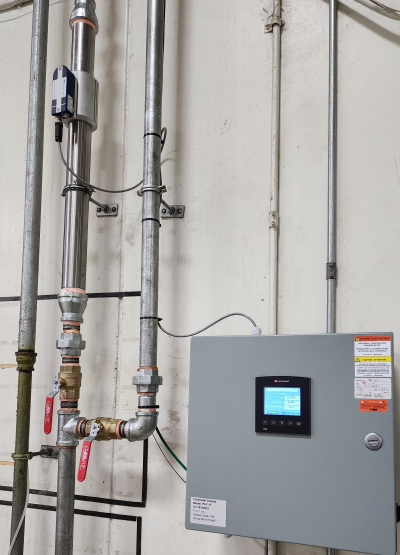
An inline flow meter was used at the Canadian factory.
Replacement Air Compressors Deliver 20% Energy Savings
The measurements taken over several weeks yielded a surprising outcome. The service provider concluded the most cost-effective option was replacing the entire compressed air system. It also recommended reinstalling all measuring instruments in the new setup to enable optimal real-time monitoring. Replacing the entire compressed air system required a significant investment, but given the expected energy cost savings, a government subsidy was applied for and received. This resulted in lower investment costs and a shorter payback period. In total, the renovation of the compressed air system cost this manufacturer $708,000. However, this amount was fully recouped within two years. The significant savings came from a combination of more efficient air compressors and compressed air dryers, improved compressed air system control and the elimination of a significant number of leaks. Furthermore, thanks to compressed air system measurements and real-time monitoring, predictive maintenance was possible.
When designing the new installation, the service provider based its design on the original layout: three air compressors in the main compressed air room and one air compressor in each of the two smaller rooms. Based on the audit results, the installation of a new compressed air piping system and the higher efficiency of the new equipment, a lower total air compressor capacity would have been an obvious choice. However, it chose a consistent cumulative capacity of 900 hp. This would provide the compressed air system with a certain overcapacity, which improves reliability. Furthermore, additional production growth would avoid the need for immediate expansion of the air compressor capacity. The main compressed air room contains three 150 hp lubricated, air-cooled, rotary screw air compressors, while the other two rooms contain 200 and 250 hp lubricated, air-cooled, rotary screw air compressors. One air compressor in the main room is a variable speed drive (VSD) model; the other air compressors are fixed-speed models. Because the air compressors are equipped with modulation control, the pressure measurement from the flow meter, along with the measured power consumption, is used for more precise control.
Immediately after the new compressed air system was commissioned in 2021, it became clear that the factory used 20% less energy to produce compressed air compared to the old compressed air system, while maintaining the same or even slightly higher production capacity. Continuous compressed air system monitoring helps minimize leaks, which further contributes to increased efficiency. Besides the financial savings, the higher efficiency of the new compressed air system meant one 150 hp air compressor could be shut down. It serves as a backup air compressor. A sequential control system distributes operating hours across the air compressors so they align with the maintenance schedule. The VSD air compressor is always operational. The result is an energy-efficient and reliable compressed air system that can be maintained in optimal condition at low maintenance costs.
A VPFlowScope M monitors the pressure drop across the compressed air system filters and dryers, allowing accurate prediction of filter replacement requirements to maintain a constant system pressure of 90 psig. Permanent dew point sensors have been installed on the demand side to monitor humidity in real time. This revealed the capacity of the adsorption compressed air dryers is likely too high. As became clear during the audit, further research is needed to determine to what extent and at which locations in the factory a less critical dew point is possible. If it is possible to reduce dryer capacity, this will contribute to a further reduction in energy costs.
Increased Operational Reliability with Continuous Monitoring
To optimally use data now and in the future, it is crucial to collect and analyze flow, pressure, temperature, power and dew point measurements. The service provider installed an advanced compressed air monitoring system during the compressed air system upgrade. It collects data and provides direct analysis. Data is automatically stored in the cloud. Thanks to built-in alarm functions, deviations or malfunctions are automatically reported to the appropriate departments, allowing for quick and targeted intervention. Thanks to the measuring instruments installed throughout the plant, compressed air system leaks can be more easily located and resolved. The real-time data overview enables the plant to make informed decisions, improve efficiency and save money.
About Cynthia Kuiper
Cynthia Kuiper brings nearly 20 years of industry experience, including 13 years at VPInstruments in a variety of key roles. She currently serves as Operations Director, ensuring customers receive high-quality instrumentation and monitoring solutions with fast delivery and excellent service.
About VPInstruments
VPInstruments develops, produces and supplies energy management solutions for compressed air and industrial gases. It shows the manufacturing industry where, when and how much it can save. For more information, visit https://vpinstruments.com.
To read articles about Compressed Air System Instrumentation, visit https://www.airbestpractices.com/technology/instrumentation.
For expert presentations on Compressed Air System Instrumentation, visit our webinar archive section at https://www.airbestpractices.com/webinars.