Industrial Utility Efficiency

Technology

Learn how engineers can safely remove moisture from compressed air systems in hazardous environments by eliminating ignition risks through pneumatic controls. This article explores design considerations, performance characteristics and reliability factors for regenerative desiccant dryers operating in Class I, Division 1 locations.

Talking Dewpoint

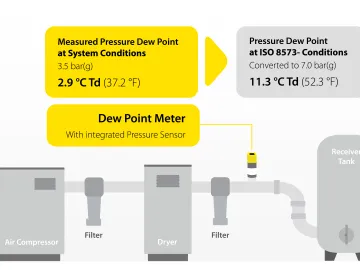
Dewpoint is defined as the temperature to which a gas (e.g. air) must be cooled, at constant pressure, for water vapor to begin to condense to liquid water. In other words, when the dewpoint temperature has been reached, the gas is fully saturated with water vapor.

Chillers Provide Temperature Regulation For Fine Wine

Temperature control of the musts during the fermentation process is required for the production of high quality wines. Alcoholic fermentation is the chemical reaction in which yeast is used to transform the natural sugars of the fruit into alcohol. The heat generated by this exothermic reaction has to be managed. If must temperatures are allowed to reach the 85°F to 105°F range the reaction will be stopped. This results in high sugar content and an unstable product that requires the addition of sulphur dioxide (SO2) to allow it to be stored without spoiling. In general, optimal fermentation temperatures are 65°F - 68°F for white wines and 77°F for red wines.

Real-World $mart Sequencer® Controls

The \$mart Sequencer® is an air compressor control system designed to reduce a plant’s energy costs by continuously monitoring system demand and automatically selecting the most energy efficient combination of available air compressors.

Compressed Air Controls

Compressed air system controls match the compressed air supply with system demand and are one of the most important determinants of overall system energy efficiency. This article discusses both individual compressor control and overall system control of plants with multiple compressors. Proper control is essential to efficient system operation and high performance.  

Compressor Sequencer Problems and Solutions

The goals of this article are to show why sequencers often have problems, and to demonstrate how avoid problems by proper system integration and controls design.

Starting a Long Distance Relationship with Your Compressed Air System

When was the last time you visited your compressor room? A week ago? Several weeks ago? If you are like many, you went in for the last scheduled maintenance interval and have rarely been back since. Air compressors, dryers and other air system components have become more reliable and self sustaining from a maintenance standpoint with each generation, requiring less and less human intervention.

Demand Versus Supply, Parts l and ll

The purpose of this article is to investigate the cause and effect that can occur when you reduce demand with no supply changes and the alternative which will produce positive, long term results which you can take to the bank.

Mattei Dresses Up a Textile Compressed Air System

This textile plant uses compressed air in their knitting, sewing, and dye house operations and needed a system designed for the significant fluctuations in demand. Compressed air demand profiles were placed into four segments; 1st shift peak demand and minimum demand, and 2nd shift peak demand and minimum demand.

Energy Saving Opportunities in Blowoff Applications

Assessing payback on engineered air nozzle and blower upgrades There are a variety of means factories can use to remove or “blowoff” moisture from a package. Open tubes or drilled pipe are often viewed as simple low-cost methods. However, there are considerable drawbacks to these approaches, most notably – increased operating expense. While they may be convenient and inexpensive in the short term, these approaches often cost 5-7 times more to operate than preferred alternatives.

Optimizing Pneumatic Systems for Extra Savings

Compressed air users looking for energy reduction often identify their air compressors as a prime area for savings potential. But …what about end uses? There are a large number of obvious measures that can be implemented, such as leakage reduction, reducing open blowing and eliminating inappropriate uses..however, there are other more technical opportunities available that involve properly specifying or redesigning existing pneumatic circuitry in compressed air operated machines and processes.

Air Compressors

From October 29-31, 2024, professionals who operate, maintain and design industrial compressed air,

Air Treatment/N2

A modular nitrogen generation system integrated with compressed air infrastructure enabled on-site

Blowers

The plant upgrades, in combination with a progressive management strategy, allows the plant to

Compressor Controls

Hitachi Astemo’s efficiency gains will turn into significant cost savings. In this article we

Instrumentation

The ISO 8573-1 standard defines clear limits for various compressed air quality parameters. This

Pneumatics

The U.S. Department of Energy’s 2002 Motor Market Assessment established that pumping systems offer

Vacuum

Industrial ceramics have been produced in Hermsdorf, near Jena, since 1890. In the past, high

Cooling Systems

The AIM (American Innovation and Manufacturing) Act was finalized by the US government at the end of