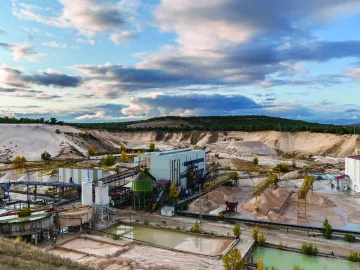
Making cement is an energy-intensive process. In a cement plant, the electrical energy load can reach up to 25 MW, consuming 185 million kilowatt hours of electricity annually. In addition, the plant consumes a large amount of coal and natural gas. CalPortland is an enormous producer of cement, concrete, aggregates and asphalt. With 80 facilities spanning five states across the western U.S., one might logically assume that CalPortland consumes a lot of energy.
By Don Dyck, President, Compressed Air Performance Specialists
Compressed Air Performance Specialists (CAPS Inc.) is a compressed air consultancy located in Calgary, Alberta. In its most recent compressed air project, the company reduced a 200-hp, multi-compressor system down to a single, 100-hp variable speed drive (VSD) air compressor utilizing 75 hp of compressor energy (kWh), resulting in \$70,000 in annual energy savings.
A major snack food manufacturer spends an estimated \$148,220 annually on energy to operate the compressed air system at its food processing plant located in the Mid-Atlantic area. As electric rates rise from their current average of 8 cents per kWh, their annual expenditure will only increase.
Cement production facilities have a significant number of dust collectors. Many have continuing problems with short bag life and low-pressure problems at the further points from the central air system. They often run on timers. When they try to run on demand control, they often get extreme short cycling, which causes even more bag problems. Most have gauges at the entry, on at least half of the dust collectors, and the compressed air feed lines are always the same size as the connector opening. This article reviews where these problems come from and provides some troubleshooting ideas.
Vale in Thompson, Manitoba, Canada has reconfigured a system of large turbo compressors in their mining, milling, smelting and refining operation and gained very large energy savings through a series of improvement projects. In addition, these projects qualified for some significant financial incentives from their local power utility. Vale is a large multinational mining company with headquarters in Brazil. Vale operations focus on the production of iron ore, coal, fertilizers, copper and nickel. The Thompson Manitoba operations consist of mining, smelting, milling, and refining of Nickel in the 250 acre complex that employs 1,500 people.
By Andrew Chase Harding, P.E., CEM, and Darin Nutter, Ph.D., P.E., Mechanical Engineering Department, University of Arkansas
Rockline Industries is one of the largest global producers of consumer products, specializing in wet wipes and coffee filters. The company contacted the Arkansas Industrial Energy Clearinghouse after identifying that the compressed air system in their Springdale, Arkansas facility was a potential source of significant savings. Experts from the Clearinghouse then began working with Rockline Industries, representatives of the electric utility, and a local compressed air vendor to perform a complete evaluation of the system.
In 1979 I received a call from a business friend that had just purchased his first single-stage base cup blow machine. He was surprised to find out that he actually needed something more than 100 psi of plant air to blow bottles. This was my entry into engineering a polyethylene terephthalate (PET) compressor system. Since then, I have engineered and delivered over 350 systems—from Tobago to Tibet—and many locations in between.
The beverage industry has been using polyethylene terephthalate (PET) 2-liter plastic bottles primarily for packaging carbonated soft drinks since the 1970s. As that market has grown to encompass bottled drinking water, stretch blow-molding machines continue to produce those plastic bottles. The concept is simple: A pre-form plug is inserted into the blow molding machine heated, and compressed air is injected, “blowing” into the pre-form to create the bottle.
By Tim Dugan, P.E. President, Compression Engineering Corporation
As readers of this publication know, there are many ways to save energy in industrial compressed air systems. One common supply side technology is the variable frequency drive (VFD) of the compressor. It is well-documented that positive-displacement compressors with VFDs provide cost-effective savings in comparison to inlet modulating, load-unload, and variable displacement control.
Compressed air is a critical utility widely used throughout the food industry. Being aware of the composition of compressed air used in your plant is key to avoiding product contamination. Your task is to assess the activities and operations that can harm a product, the extent to which a product can be harmed, and how likely it is that product harm will occur. Assessing product contamination is a multi-step process in which you must identify the important risks, prioritize them for management, and take reasonable steps to remove or reduce the chance of harm to the product, and, in particular, serious harm to the consumer.