Industrial Utility Efficiency

Auto

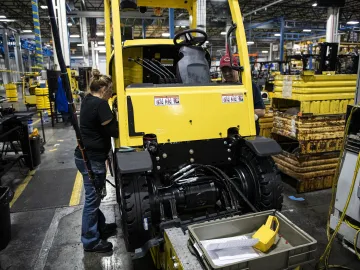
Hyster-Yale’s Greenville, North Carolina, plant reduced compressed air waste through employee-driven leak detection and system optimization, achieving $177,000 in annual energy savings. The initiative also avoided 858 tons of CO2 emissions and earned the facility Environmental Steward recognition from the North Carolina Department of Environmental Quality.
Tier 1 Automotive Plant Saves $218,000 in Energy Costs

A Tier 1 automotive plant was spending \$364,259 annually on electricity to operate their compressed air system. This figure was expected to increase as electric rates were forecasted to rise from their current average of 7.16 cents per kWh. Our firm, Air Power USA, conducted a full supply and demand-side compressed air system assessment. The set of projects recommended by the assessment, would reduce these energy costs by \$218,670 or 60%.

New EPA 6H Paint Standard Drives Hydrovane Compressed Air Upgrade. Compact Kars Converts to Waterborne Paints.

The new paint specification, for Mercedes Benz Collison Repair Centers like Compact Kars, is for waterborne paints. “The new waterborne paints contain only two (2) pounds of volatile organic compounds (VOC) compared to 5.65 pounds per gallon of VOC’s present in solvent-based paints,” according to Mr. Elder. “For this reason, Mercedes Benz is asking all certified facilities to convert to waterborne paints.”

Saving Energy in Automotive Assembly

This automotive assembly facility has tremendous peaks and valleys in compressed air demand. Our audit using flow meters and pressure transducers with calibrated gauges has proven this. Our Phase 1 audit recommends the use of storage tanks and flow meters to reduce air consumption while stabilizing pressure.

Chrysler Finds Vacuum Savings of $400,000 per Plant

A recent comparative vacuum technology study performed by Dr. Kingman Yee, as part of a Chrysler Summer Intern Professors Program, found that air consumption could be reduced by 98% when equipping a robot’s end-of-arm tooling with COAX® technology and a Vacustat™ check valve.

An Automotive System Assessment

This stamping plant is a 2.5 million-square-foot facility with over two thousand employees.  At the time of the assessment, the plant was processing approximately 1,600 tons of steel per day into automotive vehicle components and parts such as body parts.

Audit of Transit-Bus Manufacturing

New Flyer Industries is a Winnipeg based heavy duty bus manufacturer, supplying vehicles to the US and Canadian markets.  The company specializes in vehicles with†alternative-fuel drives such as electric trolleys, gasoline-electric and diesel-electric hybrid vehicles; as well as standard diesel buses.

Audit Savings for Motor Coach Industries

Motor Coach Industries, headquartered in Schaumburg, Illinois, is the largest manufacturer of intercity tour coaches for the tour, charter, line-haul, scheduled service, commuter transit and conversion markets in the U.S. and Canada. The company operates a four screw-type air compressor system at its Clarence Avenue plant in Winnipeg. To maintain adequate system pressure at the plant, Motor Coach was forced to run all four compressors 24 hours a day, seven days a week.

Class Zero Air Measures Race Car Performance

A four thousand, five hundred and fifty pound (4550 lbs.) race car is running at 170 mph and facing wind resistance of 150 mph. The car then enters a curve creating a three-degree “yaw” (the change in angle from the direction the car is headed and the airstream).  The car struggles to maintain speed as the yaw changes and the dynamic downforce load on the car changes.  Suddenly, the driver-less car comes to a stop on the stainless-steel track...