Industrial Utility Efficiency

Air Treatment/N2

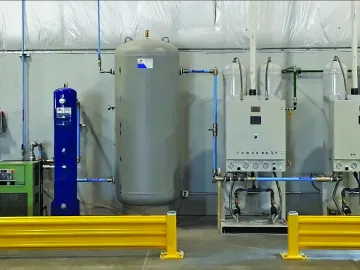
Producing nitrogen locally is an excellent way to reduce nitrogen costs and ensure a continuous supply of nitrogen gas at the appropriate purity. The ideal nitrogen generation solution varies by application, based on the specific levels of nitrogen purity, flow, pressure and dryness that are required. Environmental factors such as air quality, humidity and temperature also affect the performance of the system.

Auto Manufacturer Eliminates Dryer Purge Air

This northeastern U.S. automotive manufacturing facility spends \$269,046 annually on energy to operate their compressed air system. This figure will increase as electric rates are raised from their current average of .019 cents per kWh. The set of projects, in this system assessment, reduce these energy costs by \$110,166 or forty percent. Reliability of compressed air quality, however, is the main concern in this plant and the primary focus of this system assessment.

The Energy Costs Associated with Nitrogen Specifications

So you need nitrogen in your plant! In a high percentage of cases, generating your own nitrogen using commercially available equipment is a very cost effective alternative to purchasing liquid nitrogen or cylinder nitrogen from traditional supply sources like the industrial gas companies. In some cases, the return on investment (ROI) ranges from six months to 2 years, but ROI can range, depending on several factors, to several years while still being a good investment. With rising fuel and energy costs, the cost of liquid nitrogen is going up and is making it much easier to justify the purchase of a nitrogen generator in a wide range of purities and pressures.

The Biggest & Worst: Tales from a Compressed Air System Auditor’s Personal Notebook

Years ago, while managing the service department of my compressor distributorship, I received a call from a nearby customer who told me his 200hp compressor wouldn’t make any air. When I arrived at the plant I found the inlet air filter differential indicator showing “Red”, which indicates the filter element was dirty. When I pointed this out the maintenance manager said he had just changed the filter element; however, when I removed the element the compressor immediately started making air. He then admitted that the element was one that they had simply washed out approximately seven times before. Unwittingly, when he tried to save money by cleaning the filter element he was increasing his energy cost several times more than the cost of the element.

Nitrogen Solutions for the Food Industry Generated on Location

Nitrogen, an inert gas comprising 79% of the atmosphere, can be distilled from ordinary air. However, companies that use this product in their everyday operations know that it’s not quite that simple and much more expensive than the stuff we breathe. The primary means of obtaining nitrogen for industrial use is to transport it onsite in liquid form, which must be shipped and stored at cryogenic temperatures. But, really, what’s the point of turning nitrogen into liquid for shipping, transporting it to where it’s used, and then turning it back into gas?

Aluminum Mill Reconfigures Compressed Air System

This aluminum mill spends \$369,000 annually in energy costs to operate their compressed air system. This system assessment recommends actions reducing annual energy costs by \$120,000 and improving productivity and quality by delivering clean, dry compressed air.

Air Quality Standards ISO 8573.1 & ISO12500

The next time you sit down for dinner, take a good look at your food. There’s a very good chance compressed air played an essential role in preparing your meal for consumption.

Plastic Injection Molder Saves Energy

The facility is a plastics injection blowmolder and is a division of a large corporation. The following information was produced from a compressed air system assessment done over seven days.

Energy-Saving Compressed Air Resin Dryers

Resin drying is a critical step in the manufacturing process of injection molding, extrusion molding and stretch blow molding.  Compressed air resin dryers are one of the most commonly used dryers in the plastics molding industry. Recent advancements in compressed air membrane-type resin dryers, have reduced the associated energy costs significantly.