Industrial Utility Efficiency

Air Treatment/N2

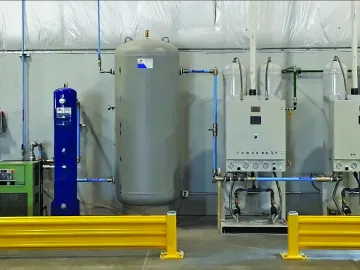
Producing nitrogen locally is an excellent way to reduce nitrogen costs and ensure a continuous supply of nitrogen gas at the appropriate purity. The ideal nitrogen generation solution varies by application, based on the specific levels of nitrogen purity, flow, pressure and dryness that are required. Environmental factors such as air quality, humidity and temperature also affect the performance of the system.

Analysis of Current Air Compressors and Dryers in a System Assessment

A complete compressed air system assessment should provide detailed information on both the supply and demand sides of the system. The supply-side refers to the equipment supplying compressed air – the air compressor, dryers, filters, piping and storage tanks.  The purpose of this article is to illustrate what information we believe a factory should receive from a supply-side system assessment and more importantly – what information a plant should always know about their compressed air system.

Fine Tuning Oil-Free Air Compressors and Purification at a Pharmaceutical Plant

A pharmaceutical product manufacturer spends an estimated \$137,443 annually on electricity to operate the oil-free air compressors in its compressed air system. The compressed air system operates well and is providing the level of purification required.  Our team visited the plant and identified a group of projects which could reduce compressed air demand and reduce energy costs by \$42,248 – or 31% of current use.

NMR Spectroscopy Lab Requires a -112°F Dew Point and Pure Nitrogen

Compressed Air Best Practices® Magazine interviewed Mr. Warwick Rampley, the National Sales Manager for Sydney (Australia) based, Basil V.R. Greatrex Pty Ltd. It’s not every day one is asked to deliver a system able to provide both a reliable compressed air dew point of -80°C (-112°F) and high purity nitrogen.  We work with some excellent technology suppliers and have engineered a rather interesting system.  Although our firm was founded in 1919, this application is one of the most demanding we’ve encountered. Basil V.R. Greatrex is a unique company as we focus only on compressed air measurement, compressed air quality and compressed air efficiency.

Oversized Dryer Causes Pressure Issues at a Chemical Plant

A Canadian chemical plant installed a large heated blower-purge style compressed air dryer, years ago, to condition the instrument air system against freezing temperatures.  The dryer selected was oversized for the connected air compressors and had unused on-board energy savings features.  A compressed air assessment revealed the site air compressors and compressed air dryers were running inefficiently and causing in-plant pressure problems.  Repairs to a compressed air dryer and the replacement of aging air compressors and dryers has reduced compressed air energy costs by 31 percent.

An Auditor’s Notes on Compressed Air Dryer Installations — Part II

There is always something new to learn about compressed air systems – particularly in regards to compressed air dryer installations. As I discussed in Part 1 of this series, you can make compressed air dryer installations more reliable by understanding the consequences of any modifications you make to the system.  As a continuation of those ideas, Part II explores more ways to make a dryer installation more reliable. Discussions include: the difference between operating a desiccant dryer in a fixed cycle opposed to demand mode, what happens when you operate a heated desiccant dryer with the cooling air turned off, and how to deal with the unintended consequences of dedicating a desiccant dryer to a compressor. 

Meat Processing Plant Drops Compressed Air Costs 60%

One of the statements made in the Compressed Air Challenge’s Fundamentals of Compressed Air Systems seminar is that improvements can always be made to every compressed air system, including new ones. The statement definitely applies to a Canadian pork processing facility built a few years ago. This article is based on a compressed air audit performed two years into the life of a brand new plant. The audit found numerous problems and made recommendations that helped reduce plant compressed air operating costs by 60 percent. 

Using ISO 8573-1 to Test Compressed Air: Clearing the Confusion

Compressed air is used in more than 70 percent of all manufacturing activities, ranging from highly critical applications that may impact product quality to general “shop” uses. When compressed air is used in the production of pharmaceuticals, food, beverages, medical devices, and other products, there seems to be confusion on what testing needs to be performed.

An Auditor’s Notes on Compressed Air Dryer Installations — Part I

In compressed air systems, every adjustment or system modification has consequences, so, before making changes, it’s important to understand how those changes will affect each piece of equipment.  For example, simple things — such as lowering the compressor’s pressure set point, or failing to maintain the compressor’s aftercooler — can result in moisture contamination occurring out in the system. Why? Because the effects of these actions reduce the air dryer’s capacity. In this article, I address some ideas that can make your system more reliable.

Desiccant Air Dryer Control: Seeing Isn’t Always Believing

Many thousands of dollars of annual electrical savings are being achieved worldwide using special purge reduction controls on desiccant air dryers. These controls reduce the expensive purge air that must flow through the dryer to regenerate the desiccant beds. But, unexpected problems with these controls can cause hidden problems that can reduce or eliminate the savings.

Maximizing Dust Collection System Efficiency

In this article, we review the operating principles of both basic types of pulse-jet dust collectors — bag (sock), and reverse flow filter. We then examine the effects of various installation and accessory selection issues through several case studies, providing examples of how to fix the issues and optimize the system’s compressed air use.