Industrial Utility Efficiency

Leaks

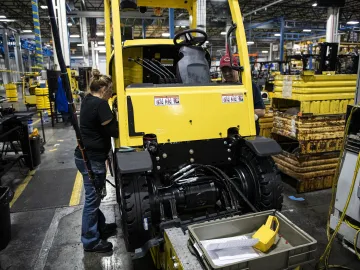
Hyster-Yale’s Greenville, North Carolina, plant reduced compressed air waste through employee-driven leak detection and system optimization, achieving $177,000 in annual energy savings. The initiative also avoided 858 tons of CO2 emissions and earned the facility Environmental Steward recognition from the North Carolina Department of Environmental Quality.
Milk Products Plant Finds 52 Percent Potential Savings

A food processor was having compressed air problems, so they invited a compressed air auditor into their plant for an assessment and to help them size future permanent air compressors. The plant was experiencing low air pressure and detecting water in the compressed air lines despite having a desiccant air dryer. The auditor thoroughly analyzed the compressed air system production equipment and did end-use assessment and leakage detection. This article discusses the findings leading to a potential cost savings of 52% of the current level.

Culture Building with ENERGY STAR® Energy Treasure Hunts

There are many reasons why the U.S. Environmental Protection Agency (EPA) ENERGY STAR® Energy Treasure Hunts have proven successful in helping companies save energy and natural resources, but one that rises to the top is their ability to build a culture of energy efficiency throughout an organization.

Technical College Audit Finds Savings of $45,000 in Energy and Water Use

As part of an energy reduction effort, a Canadian technical college hired a compressed air auditor to do a leakage audit of their large campus, which houses over 30 mixed use buildings, including laboratories, research facilities, shops and classrooms. The audit found very few leaks, the reduction of which would achieve minimal savings; however, a few surprising items of interest were noticed during the study that showed very good potential for operating cost savings of 64% with an estimated \$45,000 per year in reduced energy and water costs. This article discusses some of the findings and how savings can be achieved on lightly loaded compressed air systems.

Everyone Wins with Tennessee Tech University Industrial Assessment Center Program

Launched in 2006, the TTU-IAC program provides manufacturers in the state with free energy, productivity, and waste assessments – including best practices for compressed air systems, and blowers and vacuum, as well as cooling towers and chillers. The assessments to date have provided manufacturers in the program with \$27.48 million in recommended cost savings, equaling 3.82 trillion British thermal units of energy savings.

Keeping Compressed Air Leaks to a Minimum at Petrochemical Plants

In terms of compressed air systems, it’s not unusual to see a plant with 10 to 15 air compressors, each of which is rated to provide 3,000 to 4,000 scfm of air. The air is used for everything from moving product, to powering pneumatic tools, pumps, and fans, to cleaning. There are easily 1,500 pneumatic control valves at a single plant.

Compressed Air Piping Changes Help Dairy Producer Optimize

Annual plant electric costs for compressed air production, as operating today, are \$147,469 per year. If the electric costs of \$750 associated with operating ancillary equipment such as dryers are included, the total electric costs for operating the air system are \$148,219 per year. These estimates are based upon a blended electric rate of \$0.087 /kWh. The air system operates 8,760 hours per year. The load profile or air demand of this system is relatively stable during all shifts. Overall system flow ranges from 800- 1,000 acfm during production. The system pressure runs from 95 to 80 psig in the headers during production.  

Notes From Down Under: Having a Go at a Leakage Survey?

So you’ve purchased an ultrasonic leak detector after a sales person gave you a demonstration on detecting compressed air leaks. You’ve read all those articles on how air leaks are wasteful, expensive and leakage programs provide good paybacks. Perhaps you’ve even had a go at a leakage survey. Either way, by now you’ve realised leakage programs are not as simple as they sound and without an ongoing plan of attack, you will probably never see the results you thought you could achieve. This article is written to illuminate common mistakes made in leak surveys and hopes to provide guidance on how to turn that around.

PCE Compressed Air Leak Surveys for the Petrochemical Industry

Petro Chemical Energy, Inc. (PCE) specializes in energy loss surveys for the refining and chemical industries. We’ve been providing Compressed Air Leak Surveys, Nitrogen Leak Surveys, Steam Leak Surveys and Steam Trap Surveys – for over twentyfive (25) years. We operate totally independent of all equipment manufacturers to ensure our clients receive a complete and unbiased report of the leaks in their facility. PCE has conducted compressed air leak surveys for hundreds of customers at thousands of sites. Undetected, compressed air and gas leaks rob efficiency in manufacturing and processing industries. As a result, businesses lose millions of dollars annually in energy costs and lost production time.

Low-Pressure Air Compressors Deliver Savings for Lafarge Cement Distribution

The Lafarge Cement Distribution terminal located in Winnipeg, Canada has significantly reduced the site electrical demand and energy charges by changing the way they transport their cement.  Two new low-pressure rotary screw air compressors have replaced two large high-pressure air compressors that previously powered their dense phase transport system.  The resulting power reduction has saved the company 46 percent in transport operating costs.