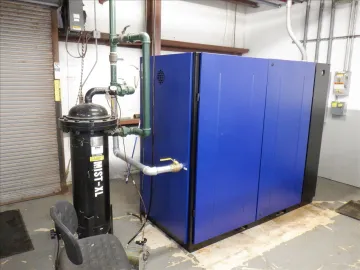
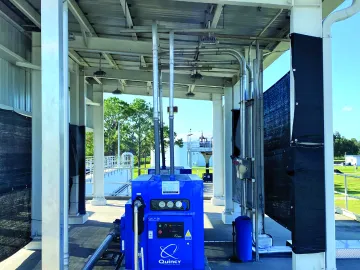
TIGG Corporation, a manufacturer of activated carbon adsorption vessels, custom air receivers and other steel tanks and pressure vessels, substantially reduced its energy costs after implementing equipment, labor consolidation and procedural changes resulting from a compressed air energy audit. The audit was performed at TIGG's 155,000 square feet manufacturing facility in Heber Springs, Arkansas to determine the efficiency of the existing compressed air system and to set a baseline for TIGG's participation in Entergy Arkansas’ Large C&I Custom Incentive Program.
Air gauging relies on a law of physics that states flow and pressure are directly proportionate to clearance and react inversely to each other. As clearance increases, air flow also increases and air pressure decreases portionately. As clearance decreases, air flow also decreases and air pressure increases.
This article reviews portions of an audit report of a compressed air system in a food industry factory located in the U.S. Although the audit explored different supply-side options the client should consider to improve dynamic efficiency, we will focus on the demand side of the system for this article.
This brewery is a relatively large operation with nine production lines plus a keg line. There are five bottle lines and four can lines. Operations in the plant include palletizing de-palletizing, filling, packaging operations, and brewing.
Annual plant electric costs for compressed air production, as operating today, are \$693,161 per year. If the electric costs of \$43,016 per year associated with operating ancillary equipment such as the blower purge dryers are included, the total electric costs for operating the air system are \$736,177 per year. These estimates are based upon a blended electric rate of \$0.06 /kWh.
By Mark Hinckley, Director Strategic Projects, SKF Strategic Industries
With sustainability and energy-efficiency targets tougher than ever, magnetic bearings are drawing the attention of engineers in many industries, offering a whole range of advantages from increased performance to extended lifespan.
By Nate Ventress, Process Automation Specialist, Western Region, Festo
Recently the capacity of the Las Palmas, California, waste water treatment operations were expanded by combining two plants and making one centralized filtration center. The new center expanded the flow capacity from 162,000 Gallons per Day (GPD) combined to 288,000 GPD when the manually controlled reclaimed water operations were updated to a state-of-the-art automated system. Reclaimed water from the plant irrigates local community green spaces. The new automated system ensures lower labor costs, consistent quality, and peak efficiency in the process of reclaiming waste water for irrigation.
By Rod Smith, Compressed Air Best Practices® Magazine
Compressed Air Best Practices® Magazine interviewed Mr. Omar Hammoud, the CEO and President of APG-Neuros.
APG-Neuros was founded in 2006 in Quebec as a result of seeing an opportunity for innovation in the North American blower market. Our mission is to distribute, manufacture, provide aftermarket support and continued development of high-efficiency turbo blowers and complete Aeration Systems for the municipal and industrial markets in North America and Europe.
By Andrew Balberg, Business Development Manager–Low Pressure, Atlas Copco
In the absence of official third party specifications on energy efficiency, it is difficult to evaluate and compare blower technologies fairly and effectively. The lack of readily available evaluation tools leads to misinformation and unfair comparisons between technologies. Further, the performance verification process is difficult to prove.
The plant air system consists of eight, single-stage, lubricated, Sullair rotary screw compressors. All units are in good working order. Units 2, 3, 4 and 7 are water-cooled and units 6, 8, 9, 10 and 11 are air-cooled. The main plant air system has two primary compressed air dryers, a Thompson Gordon model TG 2000 refrigerated dryer, and a Sullair model SAR 1350 heatless desiccant dryer. Both units are working according to their design. The TG 2000 uses approximately 11.2 kW and is a non-cycling type unit, and the SAR 1350 uses approximately 200 cfm of purge air to regenerate the wet tower.
By Kurt Sorschak (President and CEO) and Guy Couturier (Applications Manager) from Xebec Adsorption, Inc.
Compressed Natural Gas (CNG) is an alternative fuel source (to diesel and gasoline) with far-reaching benefits to North America. Strategically important benefits include energy independence, improved air quality, job creation, and lower and more stable fuel prices. This article discusses natural gas desiccant dryer requirements in Natural Gas Vehicle (NGV) refueling stations, compares deliquescent to desiccant dryers and reviews two on-site field gas upgrading examples in displacing diesel fuel.