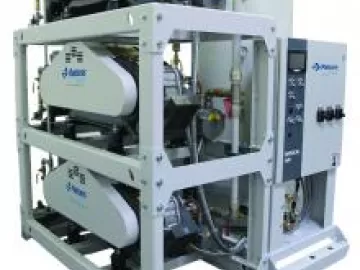
Most P.E.T. bottle-blowing machines require anywhere from 550 psig (38 barg) to 580 psig (40 barg) and an air flow of 247 cfm FAD (420 m3/hr) to 3700 cfm FAD (6290 m3/hr). The air compressor technology used most prevalently for this application is the double-acting, oil-free, water-cooled, reciprocating air compressor. With the higher pressures and air flows that are required, the P.E.T. bottle blowing market is a strong niche market for the double-acting oil-free reciprocating (piston) compressors.
Compressed Air Best Practices® Magazine interviewed Jennifer Meier, Global Energy & Engineering Manager, at Visteon Corporation.
There are three main segments in Visteon's climate group are climate systems, powertrain cooling and engine induction. Climate systems include refrigeration compressors, fluid transport, heat exchangers, battery cooling modules, climate controls, auto defog/demist systems, and multi-zone HVAC systems. Powertrain cooling systems include heat exchangers (radiators, condensers, charge-air, exhaust-gas), airflow management, and diesel and hybrid thermal management. Engine induction includes air induction systems and intake manifolds.
Several days prior to our visit, during a cold winter evening, the lead air compressor in one mechanical room tripped off (apparently due to a fouled intake filter and low air flow through the machine). A crucial situation then developed: The "stand-by" unit did not start. Maintenance folks had to be called in to get a compressor running. That delay caused low plant air pressure, production curtailment and some defective product. They had yet to determine the conditions that caused the "no-start".
Encouraged by government regulators, the conversion to waterborne paints is now moving into the collision repair and refinishing industry. The conversion to waterborne paints is proving to have implications for the compressed air systems in the shops. This document provides a checklist of compressed air system topics to ensure a successful conversion to waterborne paints.
Nitrogen gas provides a number of diverse uses for a wide variety of manufacturers. As a sister function of compressed air, on-site nitrogen generation can provide additional opportunities for cost savings and other efficiencies for manufacturers who shift from delivered liquid nitrogen service.
By Rod Smith, Compressed Air Best Practices® Magazine
Compressed Air Best Practices interviewed Doug Barndt (Manager, Demand Side Energy-Sustainability), Joseph Gress (Principal Engineer, Demand Side Energy) from Ball Corporation and Chris Gordon (Compressed Air System Specialist) from Blackhawk Equipment.
This article describes a compressed air retrofit project implemented at Kellogg’s Eggo factory located in San Jose, California. Kellogg’s continues to realize both annual energy savings and quality improvements because of the upgrade. In addition, Kellogg’s received a substantial utility incentive from Pacific Gas and Electric Company, which was based on the achieved energy savings.
Power Smart® efficiency measures for compressed air systems at Tolko’s paper mill and sawmill at The Pas are saving the company more than \$125,000 a year.
Pneumatic air cylinders play a major role in allowing a modern sawmill to produce at the high-speed production rates required. Stable air pressure is critical to allow the air cylinders to respond in a timely manner and avoid any production delays.
By Tim Dugan, P.E., Compression Engineering Corporation
Recently, this major pulp & paper mill made compressed air optimization a mill-wide priority. At the request of the utility company providing energy to the mill, Compression Energy Services performed a comprehensive energy analysis that outlined the following four energy efficiency measures (EEM’s) for the mill to consider.