Industrial Utility Efficiency

Air Treatment/N2

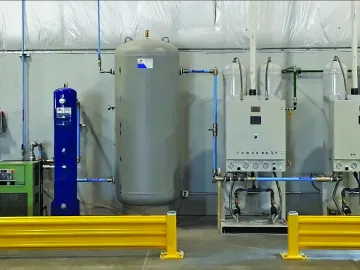
Producing nitrogen locally is an excellent way to reduce nitrogen costs and ensure a continuous supply of nitrogen gas at the appropriate purity. The ideal nitrogen generation solution varies by application, based on the specific levels of nitrogen purity, flow, pressure and dryness that are required. Environmental factors such as air quality, humidity and temperature also affect the performance of the system.

Technical College Audit Finds Savings of $45,000 in Energy and Water Use

As part of an energy reduction effort, a Canadian technical college hired a compressed air auditor to do a leakage audit of their large campus, which houses over 30 mixed use buildings, including laboratories, research facilities, shops and classrooms. The audit found very few leaks, the reduction of which would achieve minimal savings; however, a few surprising items of interest were noticed during the study that showed very good potential for operating cost savings of 64% with an estimated \$45,000 per year in reduced energy and water costs. This article discusses some of the findings and how savings can be achieved on lightly loaded compressed air systems.

Reviewing Dust Collectors and Nitrogen in a Food Manufacturing Plant

This major food manufacturing plant in the Midwest uses compressed air and onsite nitrogen generation to operate multiple snack production and packaging lines. The plant spends an estimated \$430,344 annually on energy to operate its compressed air system based on an average rate of 4.5 cents per kWh.

Lessons Learned: Saving Energy Costs with Heated Blower Desiccant Dryers

Experienced auditors become wary when they see desiccant dryers installed in customers’ plants. These dryers are required when a plant needs instrument-quality compressed air, or when compressed air piping is exposed to freezing temperatures. However, while desiccant dryers can gain this level of quality, the energy cost of stepping up from a dewpoint of 35°F to a level of -40°F increases quite considerably. To attempt to reduce the energy costs of drying to these low levels, heated blower desiccant styles may be used. This article describes three common desiccant dryer types, as well as some experiences, good and bad, with heated blower types.

University of Manitoba Bannatyne Medical Campus Saves 15% Annually in Energy Costs

The University of Manitoba Bannatyne Campus, Canada, upgraded its compressed air system to include variable speed drive (VSD) air compressors and the use of internal heat-of-compression (HOC) drying, replacing oil-free air compressors and refrigerated dryers that reached the end of useful life. In doing so, the campus reduced annual energy consumption by 15%, improved the quality of the compressed air to modern day instrument air standards and gained additional compressed-air capacity. The local utility also awarded the medical campus an incentive of \$13,500, offsetting the cost of the initiative.  

Instrument Air and Breathing Air at a Pharmaceutical Plant

A pharmaceutical plant, has had a compressed air assessment performed on two plant systems.  The studies uncovered poor compressed air production efficiency, high air dryer loss, and problems with high flow compressed air uses negatively affecting plant pressure. The plant implemented energy efficiency measures, on the two compressed air systems, saving 46 and 64 percent in energy costs respectively.

Correctly Solving Low Air Pressure Problems

One of the most common problems in plants is low air pressure. One of the most common solutions is to purchase new air compressors. Often this advice leads to a poor return on investment with the company’s hard-earned money. Often the issues are related to demand, distribution, or both. Solving the wrong problem can be expensive from a capital and operating cost perspective. Determining root cause analysis may cost more up front, but will save tens if not hundreds of thousands of dollars long term.

Innovative Adsorption Medium for Pressure Swing Desiccant Air Dryers

Compressed air contains contaminants such as dirt, water and oil which must be removed before use. ISO8573.1 specifies air quality classes for these contaminants. Humidity is expressed in terms of Pressure Dew Point (PDP). PDP is the temperature at which air is fully saturated with moisture, when the air temperature falls below this point further condensation will occur.

Canadian Steel Processor Optimizes Compressed Air at Two Facilities

A steel distribution and processing company has upgraded and consolidated the compressed air systems in two of their distribution and processing facilities for big energy savings. The previous compressed air systems were running in modes of operation with very low efficiency. A complete replacement of the two systems with new air compressors and dryers has reduced the energy consumption significantly.

Nitrogen, Vacuum and Compressed Air at a Snack Food Plant

This plant has three production lines producing snack food. Depending on the time of year and production demand the plant can operate anywhere from no production lines to all three production lines. A thorough supply and demand-side system assessment was done at this plant. This article will focus on some recommended demand-side reduction projects including nitrogen generation, air vibrators, leaks and vacuum venturis.

Sizing Issues at a Pulse Crop and Seed Processing Plant

A small pulse crop and seed processing facility located in Canada has upgraded their facility compressed air system to accommodate the expansion of their production capacity.  While completing this project the facility has learned some valuable lessons about sizing and maintaining lubricated screw air compressors and compressed air drying equipment.