Industrial Utility Efficiency

System Assessments

We asked a hand-selected list of original equipment manufacturers, independent compressed air system sales and service companies, manufacturing plants and independent system auditors to share their thoughts, highlighting the changes they’ve seen over the past 20 years, then predicting what the next 20 years will bring.
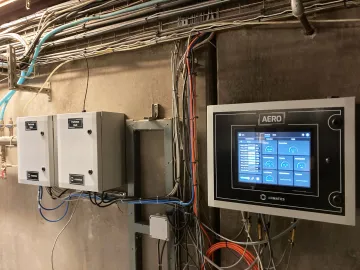
Cell-Connected Compressed Air Monitoring Systems Save Time and Money

Like any system, to properly manage compressed air equipment some measurements have to be taken. Typically, some sort of data logging equipment is installed to measure various pressures, amps or power, flow, and sometimes temperatures and dewpoints. Placing this equipment on a system is like putting an electrocardiograph machine on a human heart, the heartbeat of the compressed air system in a plant can be analyzed to determine if everything is normal or if there is a problem, all without interrupting the system. 

Milk Products Plant Finds 52 Percent Potential Savings

A food processor was having compressed air problems, so they invited a compressed air auditor into their plant for an assessment and to help them size future permanent air compressors. The plant was experiencing low air pressure and detecting water in the compressed air lines despite having a desiccant air dryer. The auditor thoroughly analyzed the compressed air system production equipment and did end-use assessment and leakage detection. This article discusses the findings leading to a potential cost savings of 52% of the current level.

Culture Building with ENERGY STAR® Energy Treasure Hunts

There are many reasons why the U.S. Environmental Protection Agency (EPA) ENERGY STAR® Energy Treasure Hunts have proven successful in helping companies save energy and natural resources, but one that rises to the top is their ability to build a culture of energy efficiency throughout an organization.

Technical College Audit Finds Savings of $45,000 in Energy and Water Use

As part of an energy reduction effort, a Canadian technical college hired a compressed air auditor to do a leakage audit of their large campus, which houses over 30 mixed use buildings, including laboratories, research facilities, shops and classrooms. The audit found very few leaks, the reduction of which would achieve minimal savings; however, a few surprising items of interest were noticed during the study that showed very good potential for operating cost savings of 64% with an estimated \$45,000 per year in reduced energy and water costs. This article discusses some of the findings and how savings can be achieved on lightly loaded compressed air systems.

Understanding and Treating an Industrial Static Problem

In this article, we discuss problems associated with static electricity in industrial manufacturing operations and how to effectively address them. At the atomic level, materials have a balance of positively charged protons in the nucleus and negatively charged electrons in the shell. Balance requires the same number of each.  A static charge occurs when that balance shifts due to the loss or gain of one or more electrons from the atom or molecule. The primary mechanism for this loss or gain, among several possibilities, is friction.

Show Report: 2019 AEE World Energy Conference and Expo

The 2019 AEE World Energy Conference and Expo was held September 25-27 at the Walter E. Washington Convention Center in Washington D.C. The event featured 14+ tracks, 56 sessions, over 260 individual speakers, and 62 exhibitors.  Both Chiller & Cooling Best Practices and Compressed Air Best Practices® Magazines were pleased to be in the literature bins at the 2019 AEE World!

How to Keep Reverse Pulse Dust Collectors Operating Efficiently and Reliably

Reverse pulse type dust collectors often represent a challenge to compressed air energy efficiency, and sometimes throw a wrench into the works by causing huge air pressure fluctuations, high transient flows and just plain large leaks. This article discusses this type of dust collector, often installed in food processing plants, and gives some real-life examples of problematic installations. Some suggested measures are mentioned to ensure your dust collectors keep running in a trouble-free manner.

Eliminate the Cost of Artificial Demand with Proper Storage and Piping

This article reviews the benefits and design considerations of controlling system pressure from the air compressor room to the production headers and selected production processes and areas. Over the last several decades, the phrase “demand-side control” has become the generic term to describe establishing a “flat line” header pressure using proper storage and an appropriate pressure regulator, or “pressure flow controller.” Use of a demand-side controller to control pressure and flow can be implemented at the entry to the production area header(s) and at selected production areas or processes.

Compressor Controls

Wood-based materials manufacturing plant transformed its compressed air system from an invisible

Piping Storage

Efficient compressed air distribution depends on proper piping design to balance flow, pressure and

End Uses

Without compressed air monitoring, up to 30% of the compressed air generated goes to waste. This

Pressure

Before CAGI data sheets were created, air compressor distributors and their customers could only go

Air Treatment/N2

Producing nitrogen locally is an excellent way to reduce nitrogen costs and ensure a continuous

Leaks

Hyster-Yale’s Greenville, North Carolina, plant reduced compressed air waste through employee-driven

Pneumatics

Current Good Manufacturing Practices (cGMPs) under FSMA CFR Title 21 117.40 is the cornerstone of

Vacuum/Blowers

There is no single right approach to putting the necessary volume and pressure of air in the pipe to