Industrial Utility Efficiency

Air Compressors

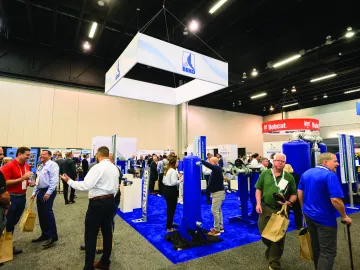
From October 29-31, 2024, professionals who operate, maintain and design industrial compressed air, vacuum, blower, nitrogen generation, process cooling and HVAC systems gathered at the Cobb Galleria Centre in Atlanta, GA, for the 6th annual Best Practices 2024 EXPO & Conference. The event featured two tracks of conference presentations and panels.

The Evolution of Biomass Compressors

When the Environmental Protection Agency was formed, in1970, it used its congressional mandate to issue all sorts of regulations regarding the discharge of contaminants into the land, water and air of this country. Over the years, air pollution has been one of the key areas where the Agency has put in place stringent requirements to control the emission of VOCs or Volatile Organic Compounds. Today the mandates of this government agency require extensive steps be taken to curtail their release by all operators of tank farms, chemical plants, refineries, fermentation plants and landfill operations. As a result of these regulations the Bio-Mass utilization industry was born.

Applying Variable Speed Compressors in Multiple Applications - Application Success Stories and Improvement Stories

Variable speed control for all types of industrial equipment is now readily available on the market with competitive pricing to non-variable speed controlled alternatives, including in the air compressor industry. With the advent of prescriptive rebate programs for variable speed compressors and other equipment, the demand for these types of controls has increased. General wisdom would recommend a variable speed compressor for all applications, or multiple variable speed compressors within each system.

Calculating the Water Costs of Water-Cooled Air Compressors

Compressed air systems are present in almost all industrial processes and facilities. They have been correctly identified as an area of opportunity to reduce electrical (kW) energy costs through measures like reducing compressed air leaks and identifying artificial demand and inappropriate uses. Water-cooled air compressors can also be significant consumers of water and reducing these costs can represent a second area of opportunity.

Food Processor Saves $101,000

This facility is part of a major corporation with dozens of manufacturing facilities where consumer good food products are processed and packaged for shipment to retail outlets. The factory was spending \$210,000 annually on energy to operate their compressed air system. This system assessment detailed four (4) project areas where yearly energy savings totaling \$100,855 could be found with an investment of \$100,000.

Oil-Free Technology From Anest Iwata

Anest Iwata was the first company in the world to develop the air-cooled, oil-free(dry), scroll vacuum pump. We provide a very compact package with lower vibration and noise levels than competitive offerings. Our oil-free vacuum pump market share, in Japan, is estimated to be fifty percent in the <600 L/min flow range.

Value in Valves – Why a Compressed Air Control System is Worth a Look

A large multi-service public utility provider was faced with an ongoing problem. The utility, which services 93,000 retail and wholesale customers, employed five oil-free compressors at one power generation facility, but, if they needed to take down Unit 2 at the facility, it almost always pulled Unit 1 down with it, overloading the system’s capacity and causing service interruptions.  

Substance in Sustainability at Atlas Copco

Having set a goal to reduce their own energy intensity by 20 percent by the year 2020, Atlas Copco has also set the ambitious target for the energy consumption of the products they sell. Using the Global Reporting Index as the way to establish metrics, there is real substance behind the sustainability program at Atlas Copco.

How to Troubleshoot a Large Motor Drive Safely

Any time you troubleshoot a large motor drive, you run the risk of both electric arc and electrical shock. Arc blasts are less frequent but deadly. They’re most commonly caused by a dropped wrench or other tool that lands across high-energy bus bars in an open cabinet. This kind of short circuit is upstream of protective fuse links and lets loose thousands of amperes of fault current.

Double-acting Reciprocating Air Compressors for P.E.T. Bottle Blowing

Most P.E.T. bottle-blowing machines require anywhere from 550 psig (38 barg) to 580 psig (40 barg) and an air flow of 247 cfm FAD (420 m3/hr) to 3700 cfm FAD (6290 m3/hr). The air compressor technology used most prevalently for this application is the double-acting, oil-free, water-cooled, reciprocating air compressor. With the higher pressures and air flows that are required, the P.E.T. bottle blowing market is a strong niche market for the double-acting oil-free reciprocating (piston) compressors.  

Sanity Check: Will the Standby Air Compressors Start-Up During Cold Weather?

Several days prior to our visit, during a cold winter evening, the lead air compressor in one mechanical room tripped off (apparently due to a fouled intake filter and low air flow through the machine). A crucial situation then developed: The "stand-by" unit did not start. Maintenance folks had to be called in to get a compressor running. That delay caused low plant air pressure, production curtailment and some defective product. They had yet to determine the conditions that caused the "no-start".