Industrial Utility Efficiency

Air Compressors

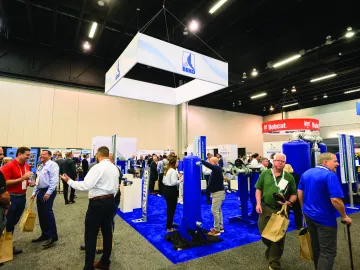
From October 29-31, 2024, professionals who operate, maintain and design industrial compressed air, vacuum, blower, nitrogen generation, process cooling and HVAC systems gathered at the Cobb Galleria Centre in Atlanta, GA, for the 6th annual Best Practices 2024 EXPO & Conference. The event featured two tracks of conference presentations and panels.
Danmar Industries Custom Engineers for Oil and Gas

The items included three 550 horsepower (hp), oil-flooded, water-cooled, single-stage air compressors with inlet valve modulation capable of providing 1,540 scfm at 165 psi (11.4 bar), two heatless desiccant, 3,138 cfm, 165 psi (11.4 bar) compressed air dryers, and two nitrogen generators for the main station, as well as two smaller air compressors and heatless desiccant compressed air dryers for each of three smaller facilities. Air compressor packages typically meet API 619, but the customer did not request that in this case. The motors, however, need to meet API 547. Air compressor system piping needed to be carbon steel built to ASME B31.3. 

The Case For Low Horsepower, Two-Stage Rotary Screw Air Compressors

The isentropic efficiency of single-stage rotary screw air compressors, as reported by CAGI data, typically falls between 65% and 75%. Since isentropic efficiency is the ratio of ideal work to actual work, this range suggests these air compressors consume roughly 33% to 54% more power than the theoretical minimum for the given air pressure output. Much of the discussion in this article is theoretical since low-horsepower two-stage air compressors are new to the U.S. market. 

Blue Mountain Reins in a Sprawling Compressed Air System

The plant was intermittently operating a staggering 11 air compressors scattered across its facility. Its system was a patchwork of different air compressor sizes and technologies, including two 25 hp fixed-speed rotary screw air compressors, one 30 hp fixed-speed rotary screw air compressor and one 100 hp fixed-speed rotary screw air compressor as its primary air compressors. It also kept several 15 to 50 hp reciprocating air compressors on standby, turning to them when primary units were down for maintenance. 

IPS Advises Midwest Industry on Compressed Air Efficiency

IPS supplies compressed air to a lot of machinery running outdoors, such as dust collectors and feed mills on grain elevators, as well as to other equipment in environments lower than 32°F (0°C). Temperatures that low require desiccant dryers. Hoffman helps his customers sort out their options and determine which type of desiccant dryer – heatless, heated purge, heated blower purge – is ideal for their needs.

The Effect of Increased Storage Capacity on Load/No Load Air Compressors

Fixed speed, lubricated, rotary screw air compressors offer three different part-load control methods: inlet modulation, load/no load and variable displacement. Over the years, load/no load has become the predominant control method offered by fixed-speed air compressor manufacturers. 

New ABB Super Premium Motors Bring Energy Efficiency Gains

SP4 motors provide the high efficiency and reliability required for air compressors which operate under demanding and variable-load conditions. The reduced energy losses and cooler operating temperatures mean a lower total cost of ownership for manufacturers. Additionally, the NEMA Super Premium efficiency level ensures compliance with stringent energy regulations, making this a future-proof investment.

Compressed Air Scoping Tool Teaches Energy Efficiency Best Practices

Oak Ridge National Laboratory and the Department of Energy’s Better Plants program created the Compressed Air Scoping Tool with the most up-to-date best practices in the industry. It can be used as a nonbiased, one-stop shop for best practice recommendations. The Excel-based tool is designed to be an initial step in understanding the operation of a compressed air system, a baselining tool enabling users to comprehend various aspects of a facility’s system from the production of compressed air to its application by end users. 

New DOE Air Compressor Regulations

The U.S. Department of Energy has initiated the efficiency regulation of oil-flooded rotary air compressors. This has the potential to cause a big change for the air compressor industry, as models from 35-1,250 cfm with pressures ranging from 75-200 psi (5.2-13.8 bar) will need to meet a minimum isentropic efficiency. 

Aeronautics Giant Evaluates Oil-Free and Oil-Flooded Air Compressors

A leading aerospace engineering firm, sought a quote for a compressed air system for its new manufacturing plant. This firm, which already operates seven existing systems across its campus, was planning its eighth and turned to its longtime partner for a solution.

Best Practices 2024 EXPO & Conference: Day 2 Highlights

Day 2 of the Best Practices 2024 EXPO & Conference began with high-level learning sessions. For some attendees, the most important session of the conference was the expert panel on designing compressed air systems compliant with the ASHRAE 90.1 standard, which now includes compressed air systems.