By Troy Dreier, Senior Editor, Compressed Air Best Practices® Magazine
Before CAGI data sheets were created, air compressor distributors and their customers could only go by the manufacturers’ claims. He found there wasn’t any uniformity to the numbers manufacturers put out, so making comparisons was challenging. Some compressed air manufacturers measured capacity from the bare airend, while others measured from the air compressor’s outlet.
By Troy Dreier, Senior Editor, Compressed Air Best Practices® Magazine
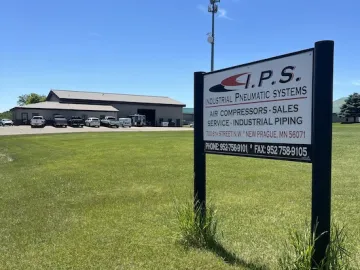
IPS supplies compressed air to a lot of machinery running outdoors, such as dust collectors and feed mills on grain elevators, as well as to other equipment in environments lower than 32°F (0°C). Temperatures that low require desiccant dryers. Hoffman helps his customers sort out their options and determine which type of desiccant dryer – heatless, heated purge, heated blower purge – is ideal for their needs.
By Brett Maiorano, Business Development Manager, PEAK Scientific
The brewing industry has long used carbon dioxide (CO2) in various brewing processes. Carbon dioxide has been the workhorse gas for the industry. It’s not only used to carbonate beer and give it fizz, but also to purge oxygen from tanks and lines to prevent spoilage and preserve freshness and flavor throughout the entire brewing process.
By Ron Marshall, Chief Auditor, Marshall Compressed Air Consulting
Estimates based on the captured data show 567,000 kWh costing \$23,375 per year, while feeding an average of 240 cfm to the plant. Estimated savings for upgrading the VSD air compressor to higher efficiency and higher capacity, converting failing desiccant compressed air dryers to cycling refrigerated compressed air dryers and reducing wasted demand total \$9,160 per year, resulting in 39% lower energy use.
By Sumit Kapde, Global Business Development Manager, Robotics and Proportional Valves, Emerson
When building powder coating solutions, it can be a challenge to optimize compressed airflow with minimum reaction time. Without this level of control, the coating thickness may not be uniform and transfer efficiency – the amount of powder adhering to the object being sprayed – may be low. The resulting overspray can waste powder material. The control of a powder coating machine — and the quality and efficiency of the application — depends on the performance of the valve block.
Compressed Air Best Practices® Magazine sat down with Richard Compton, Owner of Abundant Air Compressor of Springfield, MO, and one of his clients, Kenny Schulte, Owner of A-1 Custom Car Care, to talk about why this regional air compressor installation and maintenance company is known for its excellent service.
By Roderick M. Smith, Compressed Air Best Practices® Magazine
In most of our factories, we have installed detailed energy monitoring systems at multiple points along production lines, including air compressors, chillers and lights. These systems feed into a digital dashboard that displays energy consumption throughout the factory. For data visualisation, we use dashboards that aggregate data collected via SAP from production lines and allows us to visualise the data at a high level.
By Brooke Jones, Compressed Air Best Practices® Magazine
Beer manufacturing creates three byproducts: heat, CO2 and alcohol. The CO2 vents back into the atmosphere, but soon Tröegs will be able to put it into a collection system and reuse it.
By Troy Dreier, Compressed Air Best Practices® Magazine
NPE2024: The Plastics Show took place in Orlando, Florida, May 2024, and Compressed Air Best Practices® Magazine and Chiller & Cooling Best Practices Magazine were there to cover the highlights. This year’s conference drew over 50,000 registrants, including 15,000 from outside the United States. Filling both buildings of the Orlando Convention Center, the conference included zones dedicated to bottling, recycling and sustainability, material science, advanced manufacturing, mold-making and packaging.
Hitachi Astemo’s efficiency gains will turn into significant cost savings. In this article we outline the savings reported by the client since the changeover was complete. It shows a sizeable reduction in energy costs, air compressor energy costs and maintenance costs to the tune of 21.95%, 24.14% and 24.14%, respectively. Total operating costs to date have dropped from \$1,277,394 to \$941,959 with the new system a decrease of 26.25%.