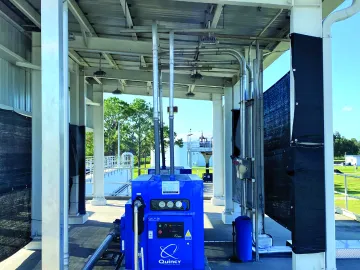
Gaseous nitrogen is used in a variety of systems and processes in the food manufacturing and packaging industries. Often regarded as the industry standard for non-chemical preservation, nitrogen is an inexpensive, readily available option. Suited for a variety of uses, Nitrogen needs to be monitored for purity and potential contaminants. Depending on the type of use, the distribution channel, and the required purity levels, different testing plans should be implemented to ensure safety.
By Ron Marshall, Marshall Compressed Air Consulting
The University of Manitoba Bannatyne Campus, Canada, upgraded its compressed air system to include variable speed drive (VSD) air compressors and the use of internal heat-of-compression (HOC) drying, replacing oil-free air compressors and refrigerated dryers that reached the end of useful life. In doing so, the campus reduced annual energy consumption by 15%, improved the quality of the compressed air to modern day instrument air standards and gained additional compressed-air capacity. The local utility also awarded the medical campus an incentive of \$13,500, offsetting the cost of the initiative.
By Mike Grennier, Compressed Air Best Practices® Magazine
Compressed Air Best Practices® interviewed Norman Davis, Jr., President of ENMET, LLC.
Our products include medical verification instrumentation, compressed airline monitors, and single- and multi-gas detectors along with ambient air oxygen monitors. Many of these systems are designed to ensure compliance with NFPA 99 (National Fire Protection Agency) Medical Air Systems Guidelines and OSHA monitoring requirements for Grade D breathing air.
Wastewater treatment processes have come a long way in the past century, but demand continues to grow for more reliable and efficient treatment technologies. As a result, industry professionals are searching for an all-encompassing solution to enhance their treatment plants and processes. One of the purest environmental aids on the market is oxygen.
When the New York City Transit Authority (NYCT) set out to comply with local regulations calling for reductions in energy usage, it leveraged new air compressors for use in transit bus maintenance and repair – and took things to another level by recovering air compressor waste heat to provide hot potable water for the bus depot. The air compressor and heat recovery system, installed in spring 2017, is on its way to helping NYCT achieve the best energy savings possible.
By Ron Marshall, Marshall Compressed Air Consulting
As many well know, system measurement is essential to ensuring a compressed air system is running efficiently and effectively, with good air quality and adequate pressure. This is also well understood by a multi-national food company (name has been withheld to protect the innocent) who started a focused effort to measure and improve their compressed air systems in their many processing plants worldwide.
By Mike Grennier, Contributing Editor, Compressed Air Best Practices® Magazine
Chicago Heights Steel, Chicago Heights, Ill., leveraged an advanced data monitoring system and adopted a demand-based compressor air management approach to save 2.5 million kWh and \$215,037 per year in energy costs. With an incentive of \$188, 714 from local utility ComEd, the project delivered a payback of 2.4 months.
By Patrick Hyland, Technical Specialist, Valin Corporation
Factory lasers use nitrogen right at the cutting point on the metal because the high temperatures used in the process can often cause oxidation. When oxidation occurs, the metal pieces being cut can be damaged, as can the tooling creating the cut. Structural damage or inaccurate cuts can make parts weak and render them useless. The use of nitrogen at the point of contact from laser to metal removes oxygen from the cutting area and helps cool the die as it cuts, thus preventing oxidation. This prevention improves the quality of the final products, produces less scrap metal and cuts back on the reworking of pieces.
When the 18th Century Italian physicist Giovanni Venturi discovered when air is forced through a conical nozzle its velocity increases as the pressure decreases, neither he nor anyone could conceive it would ultimately spawn one of the most used and most highly controversial products in the industry today- the Venturi vacuum generator (aka, ejector).
By Russell Morine, Compressed Air Systems Evaluation Specialist, The Baker Group
A flour based frozen foods manufacturer orders a compressed air efficiency audit. The audit establishes the cost of compressed air at \$0.27/1000 cubic feet. The study finds the 116 pulse jet dust collectors represent the greatest opportunity for compressed air demand reduction and energy cost savings. A dust collector optimization study/service is suggested and the customer agrees to proceed. In this facility, pulse jet dust collectors are used to filter dust from raw materials entering the plant, for conveying and mixing of ingredients, and for the final packaged finished products leaving the plant.