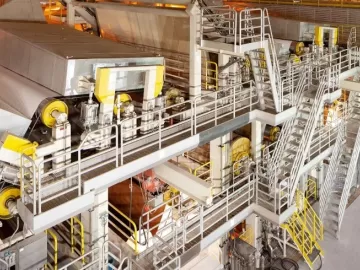
This facility operates one of the largest compressed air installations in industry, with 21 4000 hp process air and five 750 hp instrument air centrifugal compressors to support large-scale aerobic fermentation and related processes that require large volumes of oxygen.
By Matthew Gray, Senior Process Engineer and Steve Kestel, Lead Systems Engineer, BioChem Technology, Inc.
With the recent and future increases of the cost of energy, operating a wastewater treatment plant (WWTP) as efficiently as possible has become one of the most important factors that operators and managers are facing today. The implementation of a properly designed aeration control system has been reported by the United Sates Environmental Protection Agency to reduce aeration energy by 25 to 40 percent.
A recently completed energy efficiency improvement programme at the Britvic Beckton bottling plant has resulted in substantial energy savings and a positive impact on the company’s carbon emissions allocation.
This northeastern U.S. automotive manufacturing facility spends \$269,046 annually on energy to operate their compressed air system. This figure will increase as electric rates are raised from their current average of .019 cents per kWh. The set of projects, in this system assessment, reduce these energy costs by \$110,166 or forty percent. Reliability of compressed air quality, however, is the main concern in this plant and the primary focus of this system assessment.
This facility is part of a major corporation with dozens of manufacturing facilities where consumer good food products are processed and packaged for shipment to retail outlets. The factory was spending \$210,000 annually on energy to operate their compressed air system. This system assessment detailed four (4) project areas where yearly energy savings totaling \$100,855 could be found with an investment of \$100,000.
By Air Technology Group Hitachi America, Ltd., Industrial Components & Equipment Division
Compressed air is a key utility supporting the food packaging and food processing industries in North America. Compressed air must be contaminant-free to ensure the protection of the food products processed in each facility. The U.K. Code of Practice for Food-Grade Air helps define three types of compressed air systems and air purification specifications required for each.
Aeration systems at wastewater treatment facilities present significant, cost-effective energy savings opportunities. Aeration—the introduction of air into the wastewater stream to support anaerobic bacteria and mixing—is a key function at the majority of wastewater treatment facilities in North America. Aeration accounts for 25-60 percent of total energy consumption at wastewater treatment facilities , and a significant piece of operating budgets sector-wide.
Compressed Air Best Practices® Magazine interviewed Kris Drewry from O₂ Automation and Pulsed Hydraulics Inc.
We have industrial accounts where we mix chemicals and acids. Our favorite is blending wine and spirits using compressed nitrogen. The old way to blend was to use “air rousing.” This was done by installing rows of perforated pipes in the bottom of the tank and attaching an air pipe to this grid. Since the typical mixing cycle was 45 minutes, copious amounts of air and energy were used.
By Roy Stuhlman, Kaeser Compressors, Consultant and an instructor for the Compressed Air Challenge® and Stephen Horne, Kaeser Compressors for the Compressed Air Challenge®
In recent years, there have been many changes in wastewater treatment. Most modern processes control three cycles: DO, NH4, and NO3, and all of the processes require high volumes of air. Undeniably, the low pressure air system uses more electrical power than the rest of the wastewater treatment plant combined. The blower packages in these systems can be equipped with low noise enclosures, fixed speed or variable speed drives, and can include all the instrumentation needed for self-protection.
By Rod Smith, Compressed Air Best Practices® Magazine
Compressed Air Best Practices® Magazine interviewed Ms. Julie Gass P.E., Lead Process Mechanical Engineer, from Black & Veatch on trends in the wastewater treatment industry especially pertaining to new technology aeration blowers and energy efficiency.