By Mike Grennier, Compressed Air Best Practices® Magazine
A focus on sustainable products and packaging, in combination with a passion for quality, has resulted in considerable growth for the firm. Plans to add production lines at facility #1, in turn, drove the need to address the plant’s faltering compressed air system.
There were two situations brought to our attention. The first was that production at times was having to slow down, or even stop, due to compressed air system pressure falling below the required levels. The second reason was due to reports, from plant personnel, of compressed air moisture problems negatively affecting the bag life of the dryer baghouses.
This assessment identifies a path to reduce the energy consumption from \$85,000 to \$51,000 per year. This can be done with little capital by fixing poppet-valve control problems on the air compressors and reducing flow and pressure requirements. Due to article space limitations, this article does not provide detail on the flow reduction projects. It focuses only on the impact these projects have on the air compressors and provides readers with a template on the information they should have on their units, by shift.
By Mike Grennier, Compressed Air Best Practices® Magazine
Logoplaste, based in Cascais, Portugal, introduced its embedded wall-to-wall manufacturing model to reduce waste and increase efficiency. The model also results in a more economically and environmentally sustainable method of production of rigid plastic packaging since it eliminates the need for a separate secondary packaging plant and the logistics associated with transporting empty bottles.
By Jerry Zolkowski, Industrial Energy Management Principal Engineer, Consumers Energy Business Energy Efficiency Programs
Vane motors can run at much higher speeds (2000 rpm and up), but piston motors tend to turn much slower – less than 1000 rpm. For slower speed applications, vane motors are mated with a gear reducer and called a gearmotor. The gearmotor can produce the higher torque and slower speed needed for some applications, but the gear reducer can add some drivetrain loss. While a piston air motor may not be able to replace a vane motor where high speed is needed, it can be a good choice for high torque/low speed applications.
By Ron Marshall, Marshall Compressed Air Consulting
Their system was designed and built to achieve premium performance, yet in a recent compressed air assessment the numbers showed their system had surprisingly poor performance, and worse, their staff was unaware of the problems. This article discusses some of the challenges faced and some future solutions that could get their system back to higher performance levels.
By Garrett Rinker, Senior Project Engineer, South-Tek Systems
The initial cost of a nitrogen generation system may be greater than high-pressure cylinders and liquid nitrogen containers, but most companies will reach a return on investment within 12-18 months with proper sizing of the system based on process demands. Breweries typically experience savings associated with gases of 50-75% by switching to on-premises nitrogen generation. If a regular maintenance schedule is followed, PSA nitrogen generation systems can have a life expectancy of 15-20 years.
The use of high performance boosters to raise low pressure air (100 psig) to high pressure air (500-600 psig) for blow molders is very power efficient and offers good operating performance and reliability when well applied.
By Robert Lung, BGS, with contributions from: Ed Willhite, Schneider Electric; Stephen Tankersley, Ring Containers; Marco Gonzalez, Waupaca Foundry; and Darwin Jaeger, Plastics Engineering Company.
Compressed air is used in all the company’s plants and is often the single largest energy end use within them. As a result, compressed air energy-saving measures are often replicable across the company and offer significant positive impacts. One area of focus is with compressed air leaks since they are “the best low hanging fruit to focus on and they always keep popping up and waste energy”.
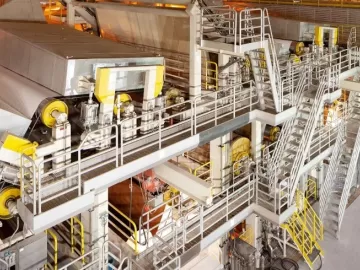
The pulp and paper industry depends on reliable sources of energy, water and compressed air; maintaining cost-effective supplies of these utilities is important to every successful business. Within paper making processes, a clean, oil-free air supply is essential for the reliable operation of pneumatic equipment and a high-quality end product. For one manufacturer in Italy, the selection of an oil-free turbocompressor enabled both operational and maintenance costs to be reduced.